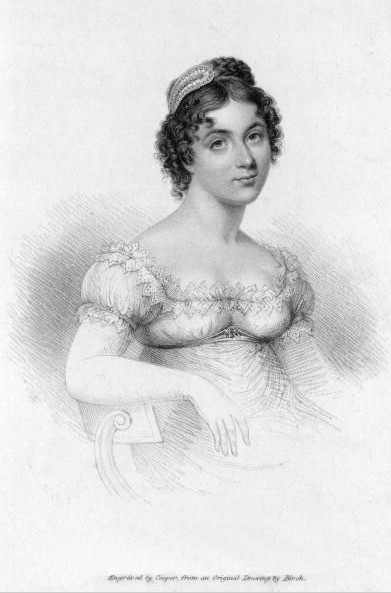
 ‘I love a masquerade; because a female can never enjoy the same liberty anywhere else. It is delightful to me, to be able to wander about in a crowd, making my observations, and conversing with whomsoever I please without being liable to be stared at or remarked upon...’ Harriette’s own words on the freedom a masked ball gave women, and particularly courtesans. If no one knew who she was, no one could judge her.
Last week I left Harriette entering the great fete, held at the Wattier’s gentlemen’s club in 1814, and today she is going to give us a view of the grand evening, attended by all the memorable celebrities of the Regency era, and tell us what this incredible masked ball was like from her point of view.
But before I do, as ever, here is a quick introduction to this series of posts on Harriette Wilson, for anyone joining today, (if you want to go back and read them all from the beginning they are listed on the index page, begin at the bottom). For everyone else who has been following them, skip to where I have marked the text in bold.
In 1825 Harriette Wilson, a courtesan, published a series of stories as her memoirs in a British broad sheet paper. The Regency gentleman’s clubs were a buzz, waiting to see the next names mentioned each week. While barriers had to be set up outside the shop of her publisher, Stockdale, to hold back the disapproving mob.
Harriette was born Harriette Debochet, she chose the name Harriette Wilson as her professional name, in the same way Emma Hart, who I’ve blogged about previously, had changed her name. Unlike Emma, it isn’t known why or when Harriette changed her name.
She was one of nine surviving children. Her father was a watchmaker and her mother a stocking repairer, and both were believed to be from illegitimate origin.
Three of Harriette’s sisters also became courtesans. Amy, Fanny and Sophia (who I have written about before). So the tales I am about to begin in my blogs will include some elements from their lives too.
For a start you’ll need to understand the world of the 19th Century Courtesan. It was all about show and not just about sex. The idle rich of the upper class aspired to spending time in the company of courtesans, it was fashionable, the thing to do.
You were envied if you were linked to one of the most popular courtesans or you discovered a new unknown beauty to be admired by others.
Courtesans were also part of the competitive nature of the regency period too, gambling was a large element of the life of the idle rich and courtesans were won and lost and bartered and fought for.
So courtesans obviously aspired to be one of the most popular, and to achieve it they learnt how to play music, read widely, so they could debate, and tried to shine in personality too. They wanted to be a favoured ’original’.
The eccentric and outspoken was admired by gentlemen who liked to consort with boxers and jockeys, and coachmen, so courtesans did not aim for placid but were quite happy to insult and mock men who courted them, and demand money for any small favour.
‘On our entrance the Duke of Devonshire presented us with tickets for a raffle. ‘These,’ said His Grace bowing low, without in the least guessing who we were, ‘these tickets will entitle you to one chance each in the lottery, which will commence drawing at twelve o’clock.’
The two best characters in my opinion, were the Honourable Douglas Kinnaird as a Yorkshireman in search of a place, and Colonel Armstrong as an old, stiff, maiden-lady of high rank in the reign of Queen Anne. He wore no mask; but his face, though curiously patched and painted, was easily known. He sat on a bench, with hoops and ruffles and high powdered head, his point laced lappets, etc., fanning himself, and talking to his young maids of honour, who sat one on each side of him. Everybody who passed stopped to examine him with much doubtful curiosity, which was constantly followed by a loud laugh, and exclamations of ‘It is Colonel Armstrong!’ ‘Ha! ha! ha!’ ‘Captial!’
Harriette says that Colonel Armstrong withstood all teasing, and kept playing his part, as he was teased with conversations about what his character may have been up to the night before. She also tells us that Douglas Kinnaird’s role as a grouchy Yorkshire man had him wandering around offending people deliberately.
Harriette also tells us about her favourite room… ‘One of the immense suite of rooms formed a delicious, refreshing contrast to the dazzling brilliancy of all the others. This room contained, in a profusion almost incredible, every rare exotic root and flower. It was lighted by large ground glass, French globe lamps, suspended from the ceiling at equal distances. The rich draperies were of pale green satin, with silver muslin. The ottomans, which were uniformly placed, were covered with satin to correspond with the drapery, and fringed with silver.’
The most unusual thing about this special night in history, which Harriette captures in words, is that because the ball was a masquerade, she and other courtesans could mix not only with the men of high society, but with the women and wives also, because no one knew who each other were.
‘Meyler looked very interesting and handsome, in his blue domino… I had given him leave to find me out if he could, and I guessed that he was busily but vainly employed in the pursuit. I waltzed and danced quadrilles with half the young ladies and gentlemen in the room.’
Harriette recalls some of the debate over her friend Julia, who had come dressed in male costume…
‘Is that a boy, or a girl, think you? Was the question from every mouth, as Julia and I passed them. ‘The leg is a boy’s, the finest I ever saw,’ said one; ‘but then that foot, where shall we find a boy with such delicate feet and hands?’ Still it remained a puzzle, and everybody seemed undecided as to the sex of Julia.
At last Meyler discovered my sister Fanny by her voice.
‘Pray point out Harriette to me,’ said Meyler, ‘for I am tired and worn out with my fruitless search.’
‘That is Harriette,’ answered Fanny, directing his attention to a young flower-girl who, with her disguised mincing voice, kept him a quarter of an hour in suspense, before he could ascertain the joke Fanny had practiced against him; and it took him a second quarter hour to find Fanny again.
‘Oh you little, wicked, provoking creature!’ exclaimed Meyler, at length, catching hold of her hand. ‘I now vow, and declare not to relinquish this fair hand until you conduct me to your sister.’
‘Upon my word and honour that nun is my sister,’ answered Fanny, leading him towards Amy, who was standing near her in conversation with Colonel Armstrong.
‘Thank you,’ said Meyler, releasing Fanny’s hand in his zeal to join the nun.
Fanny was out of sight in one instant, and, in the next, Meyler had discovered his mistake and resumed his pursuit of her.
Harriette talks then of what William Lamb wore, the husband of the infamous Caroline Lamb… She describes him wearing a black dress that looked ill on him, and accuses his wife of having perhaps forced him into wearing it. She also talks about a conversation with Lord Byron who she says was dressed as a monk. Then she describes an exciting interlude…
‘A gentleman in a rich white satin Spanish dress, and a very magnificent plume of white ostrich-feathers in his hat, suddenly seized me in his arms, and forcing over my chin my mask… pressed his lips with such ardour to mine that I was almost suffocated; and all this without unmasking, but merely by raising for an instant, the thick black crape, which full concealed the lower part of his face. I would have screamed but from the dread of what might follow.
‘This is most umanly conduct said I’…
‘My dear, dear, sweat, lovely Harriette,’ said the mask, ‘I implore your forgiveness of a poor married wretch, who hates and abhors the wife whom circumstances oblige him to fear. I have been mad for you these five years. I knew you were here, and how could I fail to discover you? I shall never on earth have such another opportunity, and I had taken an oath to press my lips to yours as I have now done, before I died.’
‘I believe this to be all nonsense,’ answered I, ‘so prey tell me who you are.’
‘So far from it,’ answered the mask, ‘with mysterious earnestness, ‘that, after what has passed, were you to discover me I would blow my brains out.’
This lover, kept himself secret, but stole a few more kisses from Harriette, which she must have enjoyed as she claims she had no inclination to scream, and then he took her into supper, among the other guests, who Harriette estimated at five thousand, and left her with her sister…
Next week, Harriette gives a little information on how her memoirs were received by the men who had previously enjoyed her company but now did not appreciate the general public knowing it…
Jane Lark is a writer of authentic, passionate and emotional Historical and New Adult Romances, and the author of a No.1 bestselling Historical Romance novel in America, ‘The Illicit Love of a Courtesan’ and ‘I Found You’ a bestselling novel in the contemporary chart. Currently reduced to $1.99 in the USA from $7.
Book 3 in the Marlow Intrigues series, The Scandalous Love of a Duke, will be published on the 3rd April, and is now available for pre-order, click on the cover on the right-hand side to order. Jane’s novels, The Passionate Love of Rake and I Found You, will also be available in Paperback on 17th April and are available to pre-order. The Illicit Love of a Courtesan and I Found You, are already available in print in the USA.
Why not also read A Lord’s Desperate Love the story of two of the characters from The Passionate Love of a rake which Jane is telling for free here, there is a link to each part in the index of posts.
Click here to find out more about Jane’s books, and see Jane’s website www.janelark.co.uk to learn more about Jane. Or click ‘like’ on Jane’s Facebook page to see photo’s and learn historical facts from the Georgian, Regency and Victorian eras, which Jane publishes there. You can also follow Jane on twitter at @janelark
 Author, Jane Lark's stories