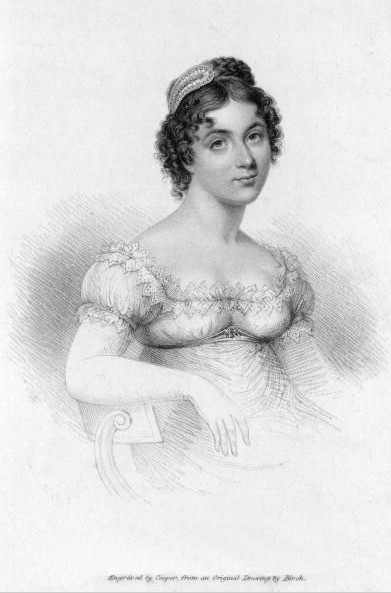
 Harriette Wilson never shares her point of view on the subject, although I think it’s safe to say, from her descriptions of her affair with Lord Ponsonby, that if he had not already been married, she would have been hopeful of a happy ending with him.
But as for her sisters… Well I’ll tell their stories in a moment. But first, as usual, in case anyone is picking up reading this series of posts today, here’s the background. Read from the end of the italics if you’ve read it before.
In 1825 Harriette Wilson, a courtesan, published a series of stories as her memoirs in a British broad sheet paper. The Regency gentleman’s clubs were a buzz, waiting to see the next names mentioned each week. While barriers had to be set up outside the shop of her publisher, Stockdale, to hold back the disapproving mob.
Harriette was born Harriette Debochet, she chose the name Harriette Wilson as her professional name, in the same way Emma Hart, who I’ve blogged about previously, had changed her name. Unlike Emma, it isn’t known why or when Harriette changed her name.
She was one of nine surviving children. Her father was a watchmaker and her mother a stocking repairer, and both were believed to be from illegitimate origin.
Three of Harriette’s sisters also became courtesans. Amy, Fanny and Sophia (who I have written about before). So the tales I am about to begin in my blogs will include some elements from their lives too.
For a start you’ll need to understand the world of the 19th Century Courtesan. It was all about show and not just about sex. The idle rich of the upper class aspired to spending time in the company of courtesans, it was fashionable, the thing to do.
You were envied if you were linked to one of the most popular courtesans or you discovered a new unknown beauty to be admired by others.
Courtesans were also part of the competitive nature of the regency period too, gambling was a large element of the life of the idle rich and courtesans were won and lost and bartered and fought for.
So courtesans obviously aspired to be one of the most popular, and to achieve it they learnt how to play music, read widely, so they could debate, and tried to shine in personality too. They wanted to be a favoured ’original’.
The eccentric and outspoken was admired by gentlemen who liked to consort with boxers and jockeys, and coachmen, so courtesans did not aim for placid but were quite happy to insult and mock men who courted them, and demand money for any small favour.
So what does Harriette say about her sisters’ hopes for a happy ending…
Let’s start with Harriette’s sister Amy. Well, if you’ve been following these posts, you will have picked up, what I picked up, I’m sure, that Amy was a manipulator. She was the orchestrator in her relationships, in the past she had made arrangements to get money off men, and not fulfilled the agreement, and she’d taken money off men who’d pay her, and then continued an affair with the man she really liked who had no money. Her last ploy, that I mentioned, was to steal Harriette’s ex-lover, who’d inherited a dukedom, and needed a wife to give him an heir, and who’d been very chivalrous and constantly loyal to Harriette, even though he knew for four years she had loved another man, and slept with many others. A potential happy-ever-after probably glistening as a sparkle in her eyes.
I don’t think Amy wanted a happy-ever-after for happiness sake though. I think she sought it for status, as though it was the final rung of a ladder to be reached. She probably imagined she would have everything she wished for if she married a duke. She was probably hungry for that, in the way people are hungry for fame today. Well Amy already had fame, in the demimonde, the disreputable group of London’s elite, but she wanted to be lifted out of the demimonde and become a part of the ton, the respectable elite.
So having claimed the Duke of Argyle from Harriette, what greater joy can there have been, than for her to fall pregnant by him, almost immediately. Dollar signs were probably ringing up in her eyes, when she realized her success, though actually, Harriette claims it was coronet’s she saw in Amy’s eyes.
Amy probably thought the duke would offer for her instantly, he was so chivalrous, his guilt would be tweaked. Certainly Harriette mentions that while pregnant Amy imagined her son would be Argyle’s heir. Whether the duke made any indications he might marry Amy or not, Amy was telling her sisters, it was going to happen. It was probably more likely she was trying to convince the duke of the idea.
However, fate overtook the matter, when the Marquis of Anglesea eloped with another man’s wife, leaving his own behind. So, Argyle’s chivalrous nature turned in another direction when he was looking for a wife, and while Amy was still pregnant (and Harriette claims, probably after he’d fortified himself with a bumper of brandy) he went to see his pregnant mistress, to tell her he was getting married – to someone else. I can imagine Amy’s anger, I bet she was livid, to have her hopes crushed so bitterly, and to be left bearing his child.
However, the duke’s chivalrous nature kept him with Amy, during her pregnancy, though by the end of it he was pleading with her to hurry up and have the child, as he needed to go away and get married. Amy was delivered of his son two weeks before the date of his marriage, but contrived to say she needed him with her, until the right up to the point he could stay no longer and then hurried north.
Harriette describes Amy’s anger then, saying she would work herself up into a passion at the mention of the Duchess of Argyle, and say cruel and cutting things.
Well that was the end of Amy’s plan for a happy ending.
Next week I will share the hopes of another of Harriette’s sisters.
Jane Lark is a writer of authentic, passionate and emotional love stories.
See the side bar for details of Jane’s books, and Jane’s website www.janelark.co.uk to learn more about Jane. Or click ‘like’ on Jane’s Facebook page to see photo’s and learn historical facts from the Georgian, Regency and Victorian eras, which Jane publishes there. You can also follow Jane on twitter at @janelark
 Author, Jane Lark's stories