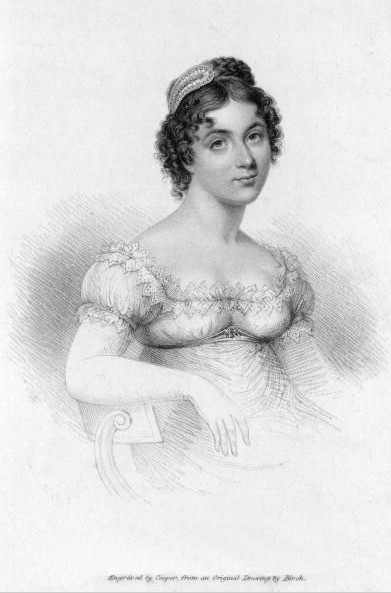
 So last week we dipped our toes into the reality of Harriette’s relationship with Mr Meyler, today lets discover what her friends said about it, and what his competition did about it. But as usual let me write the quick recap of the history behind this series of posts for anyone joining today. If you’ve already read it, skip to the end of the italics.
In 1825 Harriette Wilson, a courtesan, published a series of stories as her memoirs in a British broad sheet paper. The Regency gentleman’s clubs were a buzz, waiting to see the next names mentioned each week. While barriers had to be set up outside the shop of her publisher, Stockdale, to hold back the disapproving mob.
Harriette was born Harriette Debochet, she chose the name Harriette Wilson as her professional name, in the same way Emma Hart, who I’ve blogged about previously, had changed her name. Unlike Emma, it isn’t known why or when Harriette changed her name.
She was one of nine surviving children. Her father was a watchmaker and her mother a stocking repairer, and both were believed to be from illegitimate origin.
Three of Harriette’s sisters also became courtesans. Amy, Fanny and Sophia (who I have written about before). So the tales I am about to begin in my blogs will include some elements from their lives too.
For a start you’ll need to understand the world of the 19th Century Courtesan. It was all about show and not just about sex. The idle rich of the upper class aspired to spending time in the company of courtesans, it was fashionable, the thing to do.
You were envied if you were linked to one of the most popular courtesans or you discovered a new unknown beauty to be admired by others.
Courtesans were also part of the competitive nature of the regency period too, gambling was a large element of the life of the idle rich and courtesans were won and lost and bartered and fought for.
So courtesans obviously aspired to be one of the most popular, and to achieve it they learnt how to play music, read widely, so they could debate, and tried to shine in personality too. They wanted to be a favoured ’original’.
The eccentric and outspoken was admired by gentlemen who liked to consort with boxers and jockeys, and coachmen, so courtesans did not aim for placid but were quite happy to insult and mock men who courted them, and demand money for any small favour.
Last week, Mr Meyler, Harriette’s new lover, had gone out of town to spend the week with the family (mother) of Harriette’s previous lover, but Harriette says she refused to repine, and that same evening went out to her sister Amy’s seeking company at one of Amy’s famous parties. There she meet Lord Hertford and asks ‘Is it possible, think you, to pass one’s life with a man of bad temper?’
‘Better live on a bone,’ he replied.
Harriette challenged ‘What do you know about living on a bone?’
Then Harriette’s sister fanny said her piece. ‘Oh, pray make up your mind, at once, to leave that vile, ill-tempered Meyler… for his jealousy is really mere selfishness, and though he goes to balls and parties every night of his life, and does not return till five or six in the morning, he never fails to call here for Harriette, in ten minutes after she is set down, declaring he is miserable till he knows her safe in bed, and there he leaves her.’
‘Cut him, cut him by all means,’ said everybody at once.’
Lord Hertford’s answer, however, was to seek to escort Harriette home himself, which she refused, but then he coerced. ‘Well then… you really must pay me a visit at my little private door in Park Lane. You say you are going to the play tomorrow night, and you know you can rely on my discretion. The king dines with me; but his majesty will be gone before the play is over, and I will open the door for you myself, after my people are gone to bed, and you shall find everything ready and comfortable.’ To this Harriette agreed.
Harriette’s story about this then turns very typically Harriette, going back to the behaviour I would have known from her years before. The following night Harriette was at the play in the company of Fanny and Julia, and decided on a little trick for Lord Hertford and his generous invitation to his private rooms. She teases Fanny and Julia ‘I said that we now lived in the age of fairies, and that a good-natured one would, this night, tap some door with her wand, and it should fly open and disclose a magnificent repast, served out on gold and silver, and composed of every delicacy which could possibly be imagined… what would you say if I had discovered a fair, witch, or magician, who would, this very night, do all I have named for us.’
She then persuaded Fanny and Julia to join her in her carriage once the play was over and had it drop them off near Lord Hertford’s. She said the pathway to the back door was so dark she had to feel along the wall to find the door, while Julia and Fanny complained wondering where on earth they were being taken.
‘Pray don’t be alarmed, and, in half a minute you shall see what the good fairy has provided for us.’
Harriette says the low door, ‘resembled that of a cellar’ and she tapped on it three times, to then find it immediately opened by Lord Hertford. ‘who was, absolutely, struck almost dub at observing that he had three fair ladies to entertain instead of one. He just looked.’
However Harriette says he hid his shock, and any annoyance, being too well-bred to concede it, ‘and therefore turned the whole affair into a joke, saying he cut a comical figure, coming downstairs thus shyly, with his miniature key, to let in a whole party!’
Inviting them in, he led them up winding narrow stairs, covered in a red carpet, to a luxurious room, and to indeed face the fairytale style supper Harriette had described.
True to his jealous nature, Mr Meyler returned to town early, not because he had caught word of Harriette’s visit to Lord Hertford’s but because some man ‘laughed at the idea of me being constant.’
Next week one of Mr Meyler’s friends uses Meyler’s absence to accost Harriette.
Jane Lark is a writer of authentic, passionate and emotional Historical and New Adult Romance stories.
See below on the side bar for details of Jane’s books, and Jane’s website www.janelark.co.uk to learn more about Jane. Or click ‘like’ on Jane’sFacebook page to see photo’s and learn historical facts from the Georgian, Regency and Victorian eras, which Jane publishes there. You can also follow Jane on twitter at @janelark
 Author, Jane Lark's stories