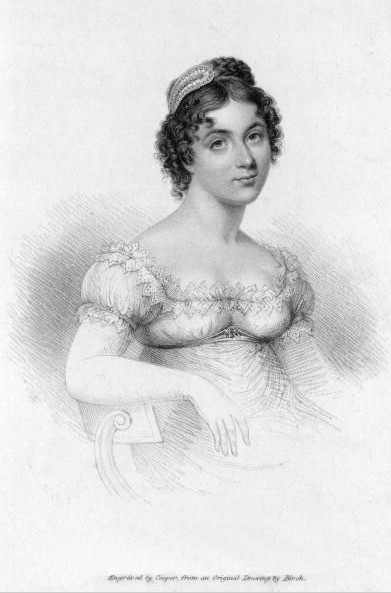
Lady Caroline Lamb’s whole disgraceful truth… Part one – a member of ‘The Mist’

I am really excited, because today I am beginning a new true story that I will share weekly in the same way I’ve shared Harriette Wilson’s memoirs. This story is not from memoirs though, but from the letters of Lady Caroline Lamb! Another of the Regency period’s most scandalous women, but not from the perspective of the demimonde, Caroline was a Lady and a member of the highest elite level of society, known as the ton, and the beaumonde.

I began researching Caroline Lamb, because Harriette mentions the Ponsonby and Lamb family so much in her memoirs and the story of Caroline’s affair with Lord Byron captured my imagination. It was about four years ago probably that I read her letters, while staying in a hotel in Ashford for three days, as we explored Kent. I was in the process of researching and writing The Scandalous Love of a Duke 😉 then.

And after I read her letters, I  was pulled into reading her life story and then one of the novels she wrote. Doing so has taught me a lot about the real life of the aristocracy in the Regency era, and now I will share it all with you… 😀

So meet Caroline Lamb…

Carolinelamb

People have said now, that perhaps Caroline’s bizarre behaviour was due to a mental health condition we now call bipolar, but there is obviously no way anyone can know that today. So that implies much of Caroline’s behaviour was abnormal, but in fact many elements of Caroline’s life were typical of the Regency era, as you will see.

Harriet Ponsonby

Harriet Ponsonby

Lady Caroline Lamb was born Caroline Ponsonby, on the 13th November 1785. She was the daughter of Frederick Ponsonby, Viscount Duncannon, and Henrietta, the sister of the now famous Georgiana Duchess of Devonshire. Of course, Georgina was also pretty famous in her day, and so was Caroline’s mother who was known more frequently as Harriet. The sisters in their day were renowned beauties, who held considerable power in the political set.

Lady Spencer, Caroline’s grandmother, and the formidable matron of the family – who organizes and watches over Georgianna’s marriage to the Duke of Devonshire in the film The Duchess – wrote of Caroline’s birth, ‘a lovely little girl – who seems very lively and in perfect health.’

Caroline became an official lady when her grandfather died, and her father became Earl of Bessborough, earning her the honorific title ‘Lady’.

So Caroline grew up in a world of luxury, even Marie Antoinette was a family friend. But Caroline’s ‘liveliness’ earned her a reputation as a troublesome child and she was deemed a ‘brat’ by her family at an early age. One of the instances which earned her the title was when she told her aunt Georgiana, that Edward Gibbon’s (the author of The Decline and fall of the Roman Empire) face was ‘so ugly it had frightened her puppy’.

When the brat grew up, Byron once described Caroline as “the cleverest most agreeable, absurd, amiable, perplexing, dangerous fascinating little being that lives now or ought to have lived 2000 years ago.” I think that gives you a measure of Caroline even from her youth, she had a temper, and yet her brat-ishness equally charmed the sisters who had charmed the world… and her grandmother.

Perhaps surprisingly Lady Spencer spent a lot of time with her grandchildren, she records staying with Harriet and the new born Caroline for a little while after the birth, and taking Caroline into her own bed on the third day to quieten her cries. She left after ten days, but she frequently visited both Caroline and her older brothers, Frederick and John (the John the poor courtesan, Harriette Wilson, fell hopelessly in love with and was let down by). When asked to take care of Caroline when she caught her first cold at six months old, Lady Spencer wrote. ‘I shall be delighted to be entrusted with Caroline.’

And so her grandmother became a key defining character in Caroline’s early life. Caroline loved the bible because her grandmother did, and saw her grandmother with a demigoddess like view. She wrote this poem for her, in later life…

May no sad dream disturb thy rest.

No anxious care thy peace molest,

But angels’ whisper’d blessings shed.

For tho’ so glorious high their state.

Proud they will be to guard that head

Where all is noble, good and great.’

And her grandmother also obviously had a significant physical influence on Caroline’s upbringing, for instance Harriet was told by her mother to cut Caroline’s hair every day to keep it thin.

Caroline also had a nomadic childhood, aristocratic households moved around a lot, and Georgiana and Harriet mostly travelled together with Caroline, her bothers, her cousins, and a group of children who were named ‘the mist’ those who had been adopted into the family who had been born of adulterous affairs, or were charitably taken in. This pack of children gave the famous beauties an air of mystique, and an observer of them wrote at the time ‘There were such countless illegitimates among them, such a tribe of Children of the Mist’.

They regularly visited all the Duncannon and Devonshire residences, including Chatsworth, and they visited Brocket Hall, the home of Lord and Lady Melbourne, and stayed abroad with friends in Belgium, Italy, France, Switzerland, and Germany.

But despite all the travelling, Caroline was educated by governesses from an early age, and when she was six her father wrote that she could speak French, “very tolerably” and play a tune on the harpsichored. By the time she was seven she had also begun to read in French and Italian.

So we can see already that Caroline was set for an elitist, and unusual life in the heart of the scandalous elements of high society.

I’ll leave her there for now… But she will be back next week 😀

~

The Lost Love of Soldier

The prequel to The Illicit Love of a Courtesan

is available to pre-order just click on the cover in the side bar

~

 Go to the index

For

  • the story of the real courtesan who inspired                                                 The Illicit Love of a Courtesan,
  • another free short story, about characters from book #2,                              A Lord’s Scandalous Love,
  • the prequel excerpts for book #3                                                                   The Scandalous Love of a Duke

Jane Lark is a writer of authentic, passionate and emotional Historical and New Adult Romance stories, and the author of a No.1 bestselling Historical Romance novel in America, ‘The Illicit Love of a Courtesan’.

Click here to find out more about Jane’s books, and see Jane’s website www.janelark.co.uk to learn more about Jane. Or click  ‘like’ on Jane’s Facebook  page to see photo’s and learn historical facts from the Georgian, Regency and Victorian eras, which Jane publishes there. You can also follow Jane on twitter at @janelark

Jane’s books can be ordered from most booksellers in paperback
10367596_633268423430916_6741081225667559588_n


The end of Harriette Wilson’s tale, not told by her… Where does the life of a courtesan end?

Harriette_Wilson00After writing her memoirs, Harriette had the writing bug, and also an awful lot of unsaid information about people who did not want her to tell it. She wrote a play called Bought In and Bought Out to explore in a comedy how some of her former lovers had bought out of her memoirs with certain stipulations…

In 1828 she and the man she called her husband at the time, Mr Rochfort, moved back to London permanently, she purchased a fourteen year lease on a town house on the corner of Trevor Square, and began writing novels. Clara Gazul and Paris Lions and London Tigers

In 1829 though she once again hit the press, as her maid accused her of having pulled away a chair so she fell on the floor, and then refused to feed her anything but bread and water, Harriette was arrested and taken to court Bell’s Life in London, ran an article on her appearance. She was described as old, ugly and grey haired.  And at this court case Rochfort stated that Harriette was not strictly his wife.

In this year Harriette is known to also have begun testing the water in London, as far as possible new courtesan style relationships. She approached an author sixteen years her junior, and he kept her letters. But she is older, and times had changed, and the young author had no interest, other than to be flattered enough to keep the letters. But he marked them stating that he never met her.

In 1830, Harriette wrote a letter stating that in order for Mr Rochfort to obtain his inheritance from his estranged mother, he would need to be single, as his mother disapproved of Harriette and so she had decided to separate from him. Rochfort hired rooms in Berkeley Square.

In December 1831 however Rochfort began another affair. He fell in love with another man’s wife and moved in with her. It was another swift kick to poor Harriette’s ego. At first she still wrote to others as though she was his wife, but in 1832 she stopped mentioning him, and simply pretended he’d never existed, and then began using her real surname Debuchet. She had continued to write to Lord Ponsonby through the years since she published her memoirs, though he never replied. In 1832 the letters to him became even more regular, and were filled with outpourings of the pain she suffered following his desertion of her in favour of her younger sister. At this point she lived at 69 Vauxhall Bridge Road and Lord Ponsonby and his friends wrote to one another using terms such as ‘Obscene harpy’ ‘vile woman’ ‘wretched individual‘ to describe Harriette.

While Harriette spent the next two years falling into being nothing but regretted history, Rochfort used the connections he had made through her to begin walking in the world of the men who had passed her around among them, he began working for the Duke of Wellington.

In 1834 Harriette moved back to Knightsbridge and tried her hand at playing the bawd and bringing younger woman into favour as prostitutes among the men of the ‘first nobility.’ Of course these men no longer trusted her and so the attempt did not succeed. She even wrote a letter to Lord Ponsonby offering him one of the girls, but the letter was as much a message reminiscing on her past with him.

The next we here of Harriette is in 1840, when her life finally took a turn  for the good. She was baptised into the Catholic Church, as Mary Magdalen, and began to preach of her conversion, dedicating all her energy and keen mind to her faith. There is one letter to the young author she had tried to seduce some years before saying her commitment to God meant she was no longer available for ‘love’ … ‘when I was a sinner and a good looking one’ …

Harried lived in a cottage then, tending a cottage garden and devoted now to only her faith. She died on the 10th March 1845 two weeks after her 59th birthday. In her final letters, she asked that the Duke of Leinster and Frederick Lamb pay her medical bills, and that Brougham, Leinster and Lord Worcester, now the Duke of Beaufort pay for her burial. Brougham wrote to Beaufort from Parliament.

My dear Duke,

Our old acquaintance, Mme De Bochet (Harriette Wilson) died the week before last and left a note to say she hoped two or three of her former acquaintance would give the few pounds (fifteen) required to bury her – she having had an estimate price in with all the particulars  of the church and struck off what was merely ornamental – which has reduced it as above. Duke of Leinster has given a little and I think as she also named you and me, we ought to contribute our might.

What say you?

A few days later Brougham wrote again, and asked for a little more saying that she had left additional debts for medical care, which her brother, a piano turner could not afford.

Harriette’s funeral took place at Chelsea Catholic Chapel and her death certificate recorded her as Harreitte De Bochet a ‘woman of independent means’.

It’s not known where she was buried.

😥

So that is goodbye to Harriette and her colourful life. I shall miss her. But perhaps one day we may discover even more of the truth. After Harriette and her publisher Stockdale had died Sophie Stockdale, the publisher’s wife, is known to have tried to begin a new blackmail campaign.

My Lord,

Pardon the liberty I take in writing to your Lordship.

In  looking over my late husband’s papers I find that the MSS of Harriette Wilson is quite perfect, and more than appeared in print, for there are all those who withheld their names only merely crossed out with the pen. In offering the MSS to your Lordship, I was recollecting the circumstances of the late Lord Spencer’s undoubtedly a true history of our times, and there are also the numerous letters of who shall be in print and who shall not, for in years to come who would suppose that the greatest men of any age appear in the MSS.

I am not like Junius, I cannot afford to commit my MSS to the flames.

Sophie Stockdale…

One day then, perhaps, this original manuscript may be discovered…

Jane Lark is a writer of authentic, passionate and emotional Historical and New Adult Romance stories, and the author of a No.1 bestselling Historical Romance novel in America, ‘The Illicit Love of a Courtesan’.

Look at the index to discover all the true stories Jane has discovered during research, and to find links to excerpts and a FREE novella ~ A Lord’s Desperate Love

Click here to find out more about Jane’s books, and see Jane’s website www.janelark.co.uk to learn more about Jane. Or click  ‘like’ on Jane’s Facebook  page to see photo’s and learn historical facts from the Georgian, Regency and Victorian eras, which Jane publishes there. You can also follow Jane on twitter at @janelark