Lady Caroline Lamb’s whole disgraceful truth… Part ten ~ Another illegitimate child graces the family

Last week I wrote about the friendships the Bessbroroughs and Devonshires developed during their visit to Paris, and before they left they invited both Germaine de Staël and Juliette Récamier.  Madame Récamier was the first to accept the invitation, but before I go on to tell you what happened and how it affected Caroline, here is the background to this series of posts for anyone joining them for the first time today and for those who have been following my posts, as always then simply skip to the bold type after the italics.
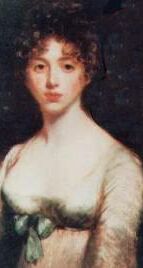
CarolinelambI was drawn to Lady Caroline Lamb, who lived in the Regency era, because Harriette Wilson the courtesan who wrote her memoirs in 1825, mentions the Ponsonby and the Lamb family frequently. Also the story of Caroline’s affair with Lord Byron captured my imagination. Caroline was also a writer, she wrote poems, and novels in her later life. I have read Glenarvon.

Her life story and her letters sucked me further into the reality of the Regency world which is rarely found in modern-day books. Jane Austen wrote fictional, ‘country’ life as she called it, and I want to write fictional ‘Regency’ life rather than simply romance. But what I love when I discover gems in my research like Caroline’s story is sharing the real story behind my fiction here too.

Lady Caroline Lamb was born Caroline Ponsonby, on the 13th November 1785. She was the daughter of Frederick Ponsonby, Viscount Duncannon, and Henrietta (known as Harriet), the sister of the infamous Georgiana, Duchess of Devonshire.

Caroline became an official lady when her grandfather died, and her father became Earl of Bessborough earning her the honorific title ‘Lady’ and she grew up in a world of luxury, even Marie Antoinette was a family friend. Caroline was always renowned as being lively, and now it is suspected she had a condition called bipolar. As a child she earned herself a title as a ‘brat’, by such things as telling her aunt Georgiana that Edward Gibbon’s (the author of The Decline and fall of the Roman Empire) face was ‘so ugly it had frightened her puppy’.

And when she grew up Byron once described Caroline as “the cleverest most agreeable, absurd, amiable, perplexing, dangerous fascinating little being that lives now or ought to have lived 2000 years ago.”

Madame Récamier arrived in England in April 1803, and her name spun about the gossips of high society as she wore white, loose garments and lace, which skimmed across her skin, leaving her curves on show.

The Greek looking style reclaimed from ancient statues became known as Nude, because the dresses and fabrics left so little to imagination.

Madame Récamier had a certain way in which she carried herself, it was dramatic, and Lady Caroline fell in love with it and began to mimic her in a way that replicated her love of theatricals. She liked to dress up and imagine fairies, and she was as much in love with  flowing dramatic dresses as with wearing breeches, as women did when playing a man’s role in a play. This quirkiness which ran through her life, and later fascinated Lord Byron, had her riding beside the coachman on the bench when she travelled, and jumping down at her destination.

But during this time, when perhaps a daughter would have appreciated a mother’s guidance, Harriet’s thoughts were more focused on not only her current lover Granville, but also her former lover Sheridan, who was a significant influence in the political  set that Harriet and Georgiana mingled with. He was having difficulty with his wife and had turned to drink and chasing Harriet, and when he was not chasing her, stirring up trouble for her, spreading ill rumors, and whispering in the ear of the Prince Regent.

During those two years, Caro continued to be courted by William Lamb, but also by her Cousin Hart, who would be the future Duke of Devonshire, and by another cousin Lord Althrop.

In 18o4 Harriet became pregnant again, but not by her husband, by her lover Granville. The child was a boy who was born in the autumn and soon after Harriet wrote a letter to her lover about a play she had seen, about a natural (the word used at the time for those born out of wedlock) born child who’d discovered his father by stealing from him. She wrote ‘I cried my eyes out. The detail of all ye disadvantages a natural child must suffer would alone have affected me, but it is impossible to give you an idea of what this creature is  – his tenderness to his Mother, his perfect freedom from all affection and whining… it is impossible to conceive greater perfection.”

We can only wonder how her mother’s behaviour impacted on Caroline.

But Caroline’s own life was about to take a huge turn… When William Lamb’s eldest brother died, leaving him the heir, he proposed to Caroline…

We will pick them up there next week:D
CompleteCollecvtion_Facebook_Advertv5


Go to the index

For

  • the story of the real courtesan who inspired                                                 The Illicit Love of a Courtesan,
  • another free short story, about characters from book #2,                              A Lord’s Scandalous Love,
  • the prequel excerpts for book #3                                                                   The Scandalous Love of a Duke

Jane Lark is a writer of authentic, passionate and emotional Historical and New Adult Romance stories, and the author of a No.1 bestselling Historical Romance novel in America, ‘The Illicit Love of a Courtesan’.

Click here to find out more about Jane’s books, and see Jane’s website www.janelark.co.uk to learn more about Jane. Or click  ‘like’ on Jane’s Facebook  page to see photo’s and learn historical facts from the Georgian, Regency and Victorian eras, which Jane publishes there. You can also follow Jane on twitter at @janelark

Jane’s books can be ordered from amazon by clicking on the covers in the sidebar,  and are available from most booksellers.
10367596_633268423430916_6741081225667559588_n


Lady Caroline Lamb’s whole disgraceful truth… Part eight ~ coming out in France in the time of Napoleon

CarolinelambDoes the title surprise you? Well this story surprised me when I read it some time ago… Who would have thought that the British aristocracy were bringing their daughters out in Paris during the time of Napoleon. But that is what happened.

Before I go on to tell you the tale though here is the background to this series of posts for anyone one joining us today, and for those who have been following my blog for a while, well as always just skip to the bold type at the end of the italics.

I was drawn to Lady Caroline Lamb, who lived in the Regency era, because Harriette Wilson the courtesan who wrote her memoirs in 1825, mentions the Ponsonby and the Lamb family frequently. Also the story of Caroline’s affair with Lord Byron captured my imagination. Caroline was also a writer, she wrote poems, and novels in her later life. I have read Glenarvon.

Her life story and her letters sucked me further into the reality of the Regency world which is rarely found in modern-day books. Jane Austen wrote fictional, ‘country’ life as she called it, and I want to write fictional ‘Regency’ life rather than simply romance. But what I love when I discover gems in my research like Caroline’s story is sharing the real story behind my fiction here too.

Lady Caroline Lamb was born Caroline Ponsonby, on the 13th November 1785. She was the daughter of Frederick Ponsonby, Viscount Duncannon, and Henrietta (known as Harriet), the sister of the infamous Georgiana, Duchess of Devonshire.

Caroline became an official lady when her grandfather died, and her father became Earl of Bessborough earning her the honorific title ‘Lady’ and she grew up in a world of luxury, even Marie Antoinette was a family friend. Caroline was always renowned as being lively, and now it is suspected she had a condition called bipolar. As a child she earned herself a title as a ‘brat’, by such things as telling her aunt Georgiana that Edward Gibbon’s (the author of The Decline and fall of the Roman Empire) face was ‘so ugly it had frightened her puppy’.

And when she grew up Byron once described Caroline as “the cleverest most agreeable, absurd, amiable, perplexing, dangerous fascinating little being that lives now or ought to have lived 2000 years ago.”

This is purely my guess – but I suppose the Cavendishs and Ponsonbys gravitated more towards France because they were from an old family, and when Harriette and Georgiana were in their youth the French court was seen as the most eloquent, and Marie Antionette had been their close friend. In the early period of the Georgian era people traveled all the time, many people know of the London seasons but in reality there was a Paris season, a Bath season and a Brussels season, and many more, the aristocracy moved around to socialize and to find marriage partners. I am stating the obvious now, but people didn’t have telephones, and the majority lived on country estates, how else were the young men and women to meet each other unless families came together, and as they did not want them marrying beneath them then travelling to meet others of the same standing was the only way to match make. Especially in the days of know pictures either (look what happened to Henry VIII when he chose a wife from a portrait). It was not the only reason for gathering, but it played a large part in why whole families traveled.

But why on earth did they travel to Paris to bring Caro out into French society? Well a treaty had been signed between France and Britain in March 1802 so they were no longer at war, so perhaps it was not so extraordinary, but Caro’s grandmother did not agree with the idea, and yet to Caro and her mother in the letters which were shared, this seemed a much bigger event than coming out among high society in London.

They sailed in December 1802 and Caro recorded her feelings in a poem.


‘Farewell to England and farewell to frocks. 

Now France I hail thee with a sweeping train.

Subdued I’ll bed my stubborn locks

And enter on a life of art and pain. 

Farewell to childhood and perhaps to peace

Now life I shall upon thy dangerous stream. 

And oh may wisdom with each year encrease 

And prove my follies but an infant’s dream.’


What Caro wore to her first Parisian ball, the Duchess of Gordon’s, on the 22nd December 1802, is recorded too. It was a fashionable white gown, with rows of bows, made from blue ribbon, along with shoulder length white doeskin gloves, and her white slippers were satin. Her hair had also been more significantly decorated in a ‘Whig bouffant’ and adorned with pearls and a diamond diadem, while pearls and diamonds were also about her neck.

The Duchess of Gordon was as much of a high society socialite as Harriette and Georgiana, all her daughters had married dukes, and so obviously the decision to take Caro to Paris was not without forethought, they knew the circuit they were taking Caro into.

Caro would have danced until daylight at the ball. Society then engaged through the night parted in the early morning and then reconvened calling upon each other after two in the afternoon, and then their evenings began again.

Caro and her mother record attending many balls, the Duchess of Luyens, Princess Dolgorouk’s and Lady Melbourne, the mother of Caro’s future husband, William Lamb, gave a party on 13th January (implying therefore that many people from British high society had traveled over to Paris for the period).

Harryo, Georgiana’s daughter, who was with the family too, had obviously taken a dislike to William Lamb and his brother Frederick; she wrote in a letter that they were drunk at their mother’s ball, and quotes William discussing ‘the danger of a young woman believing in weligion and pwacticing mowality

Oh those Lambs 😉 sorry that is pinching phrase Caro used later in her life.

However if Harriette had taken Caro there with the hope of attaching her to some suitable Frenchman, Caroline was having none of it. She wrote to a friend in England while she was there…

Frenchman, smile not thus on me;

I hate your race. I hate your nation. 

In vain you bend your supple knee.,

I care not for your adulation. 

I love a man of English race

Who never learned to fawn or dance. 

He has an English heart and face.

Oh there is no such man in France.


Next time I will share Harriett’s opinion of the French and how she carefully maneuvered through society there with an aim to honour her memory of Marie Antoinette.

CompleteCollecvtion_Facebook_Advertv5

 Go to the index

For

  • the story of the real courtesan who inspired                                                 The Illicit Love of a Courtesan,
  • another free short story, about characters from book #2,                              A Lord’s Scandalous Love,
  • the prequel excerpts for book #3                                                                   The Scandalous Love of a Duke

Jane Lark is a writer of authentic, passionate and emotional Historical and New Adult Romance stories, and the author of a No.1 bestselling Historical Romance novel in America, ‘The Illicit Love of a Courtesan’.

Click here to find out more about Jane’s books, and see Jane’s website www.janelark.co.uk to learn more about Jane. Or click  ‘like’ on Jane’s Facebook  page to see photo’s and learn historical facts from the Georgian, Regency and Victorian eras, which Jane publishes there. You can also follow Jane on twitter at @janelark

Jane’s books can be ordered from amazon by clicking on the covers in the sidebar,  and are available from most booksellers.

10367596_633268423430916_6741081225667559588_n