Attending the theatre in Jane Austen’s life-time

In my Regency period novels I often set scenes in theatre boxes, and for some that may seem a strange place when there would be little conversation between characters, yet, for the 19th Century that wasn’t true. As I learned from descriptions in the diary of a courtesan, Harriette Wilson.
Writings that talk about the every day life in that era are rarer, and I usually search this information out in letters between family members, but it was Harriette’s diary that helped me visualise what going to the theatre meant at the time. For the middle and upper class, it was a place to meet people, to see people and be seen, in the same way we might use a night club now. The rich paid to retain a box for months. Though, if they were not using the box they may let others hire their seat for an evening. The owner of the box often saw entertainments numerous times, and so they had no desire to listen, or men may pop in to listen to one particular element of a performance that they loved most and leave again. Those with no interest in the performance often talked through a whole performance. Something Harriette laughed about when someone became annoyed with her, because talking was why people used the boxes. She told the couple they should have sat in the seats below. For Harriette, the theatre was also part of her shop window. It was one of the best places where she and her fellow courtesans could meet new men, they clubbed together to rent a box and dressed up to be admired and deliberately laughed and conversed loudly to sell themselves as good company. They needed to be admired because the more men who were interested in them the higher price they could charge the men they agreed to enter into a relationship with.

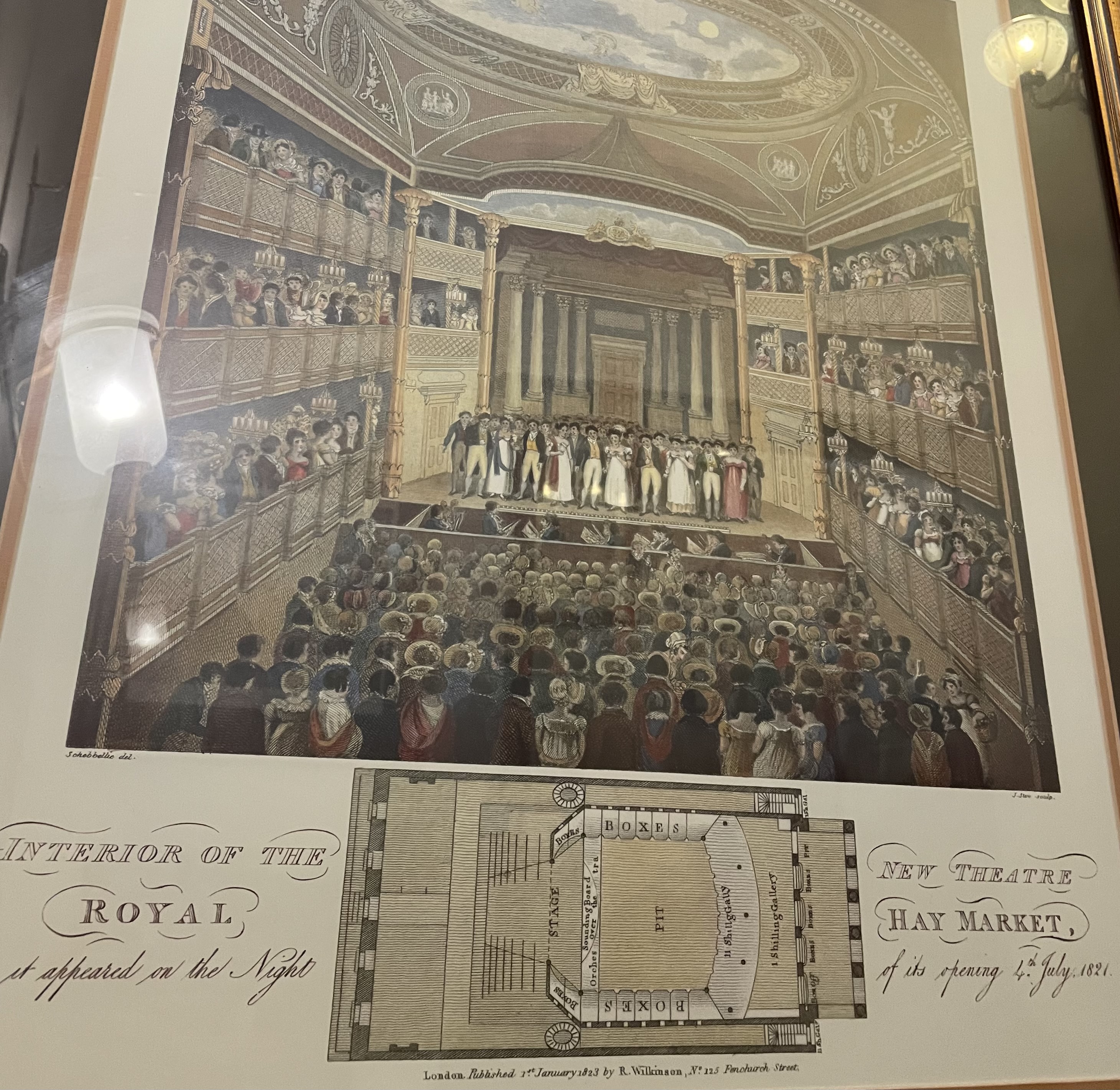
So then, with all of these comings and goings, and the continual conversation, and I’m sure the actors shouting to be heard, the theatre would have been a very different place than it is today, and it’s one of those regency ways of life that fascinates me. I was, therefore, thrilled when I saw these prints hiding high up on the stairway of a 17th Century pub in the Lake District which depicted exactly what I have imagined from Harriette’s descriptions.

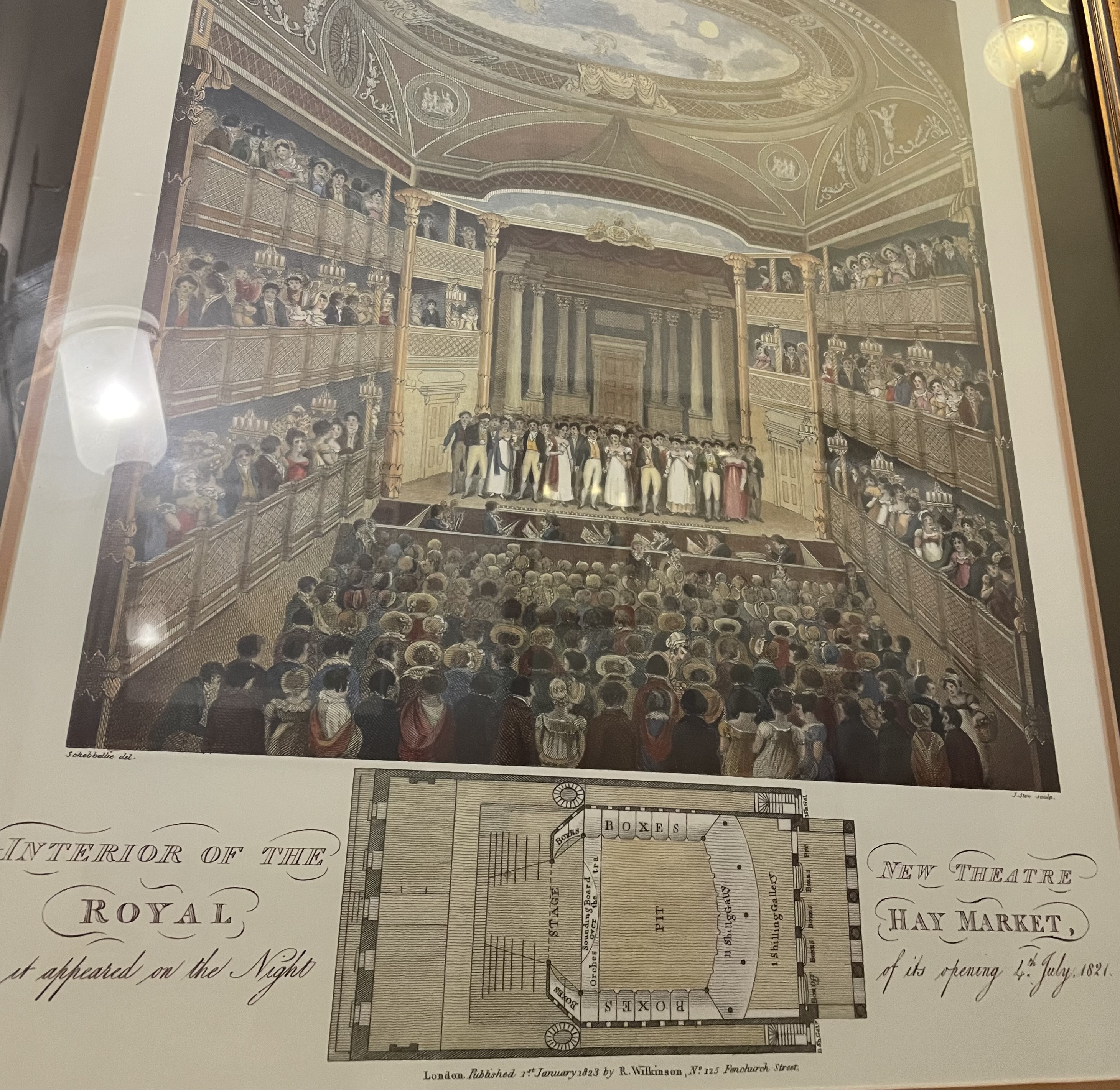
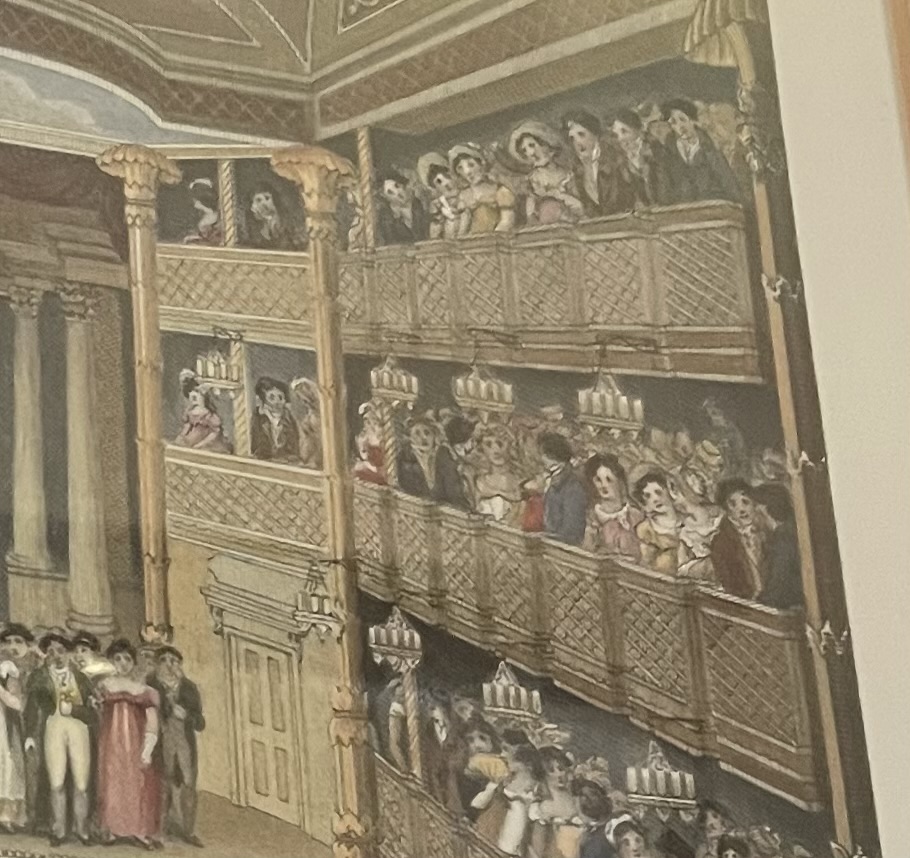
The Interior of the Royal ~ as it appeared on the night – New Theatre Hay Market – of it’s opening night 4th July 1821, published London 1 January 1823

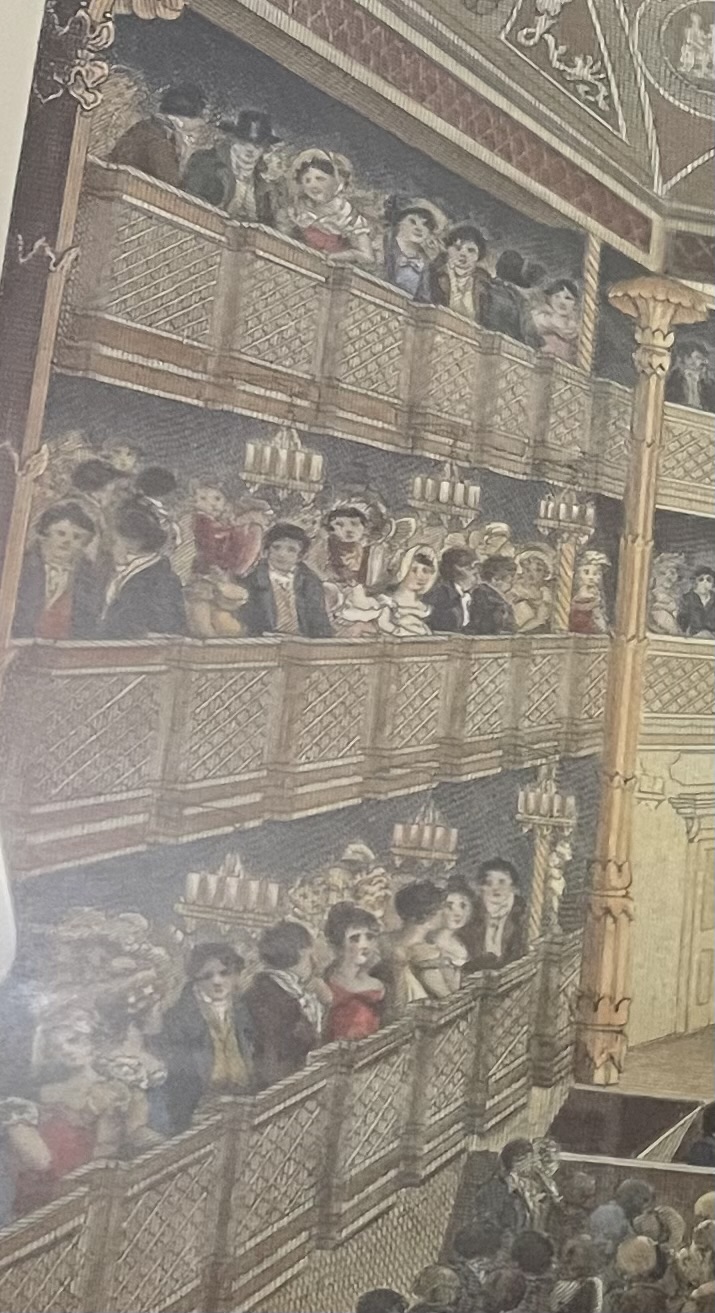
This first print, which is contemporary to the time, shows exactly what I have read described, look at how many people in the boxes are seated with their backs to the stage, and are clearly talking, it displays how much of a social event theatre going was for those with money. While in the pit, we see those who may have their one and only opportunity to see the entertainment facing forward and concentrating on the stage.

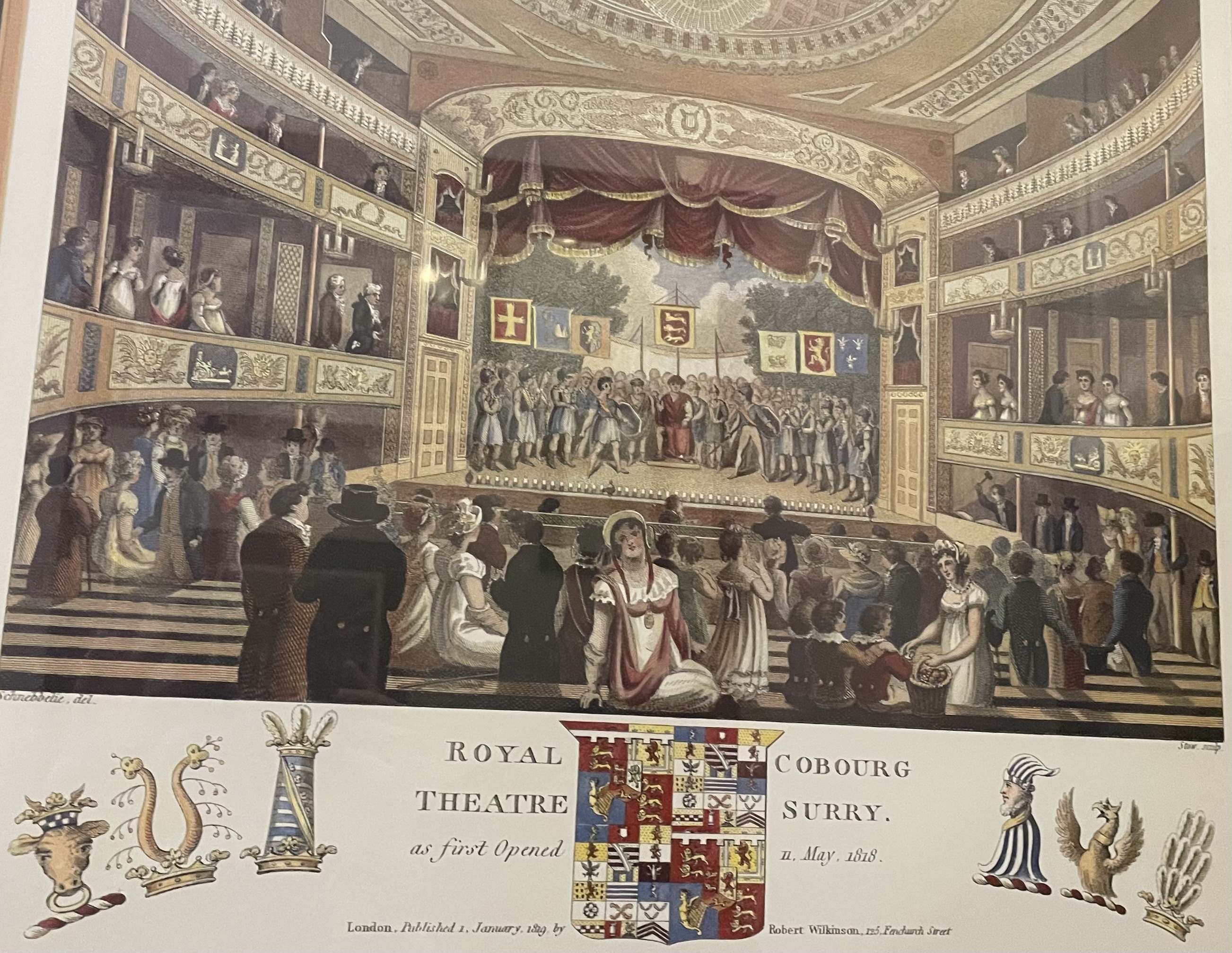
The image of the second theatre, The Royal Theatre Cobourg Surrey dated as the opening night in 1818 published 1 January 1819, is not anywhere near as busy a picture, and yet again it portrays that the people attending are talking, some with their backs turned on the stage. Both images portraying the theatre was a social hub.

A wonderful insight, so, if you love insights into history as I do, keep your eyes peeled for those interesting wall-filling prints in old hotels and pubs. I always have a walk around and a good look.

For more information on the history of theatres take a look at the UK’s National Archives here https://www.bl.uk/romantics-and-victorians/articles/19th-century-theatre
Sign up to receive my new newsletter here

https://www.janelark.co.uk/contact

Books and dogs

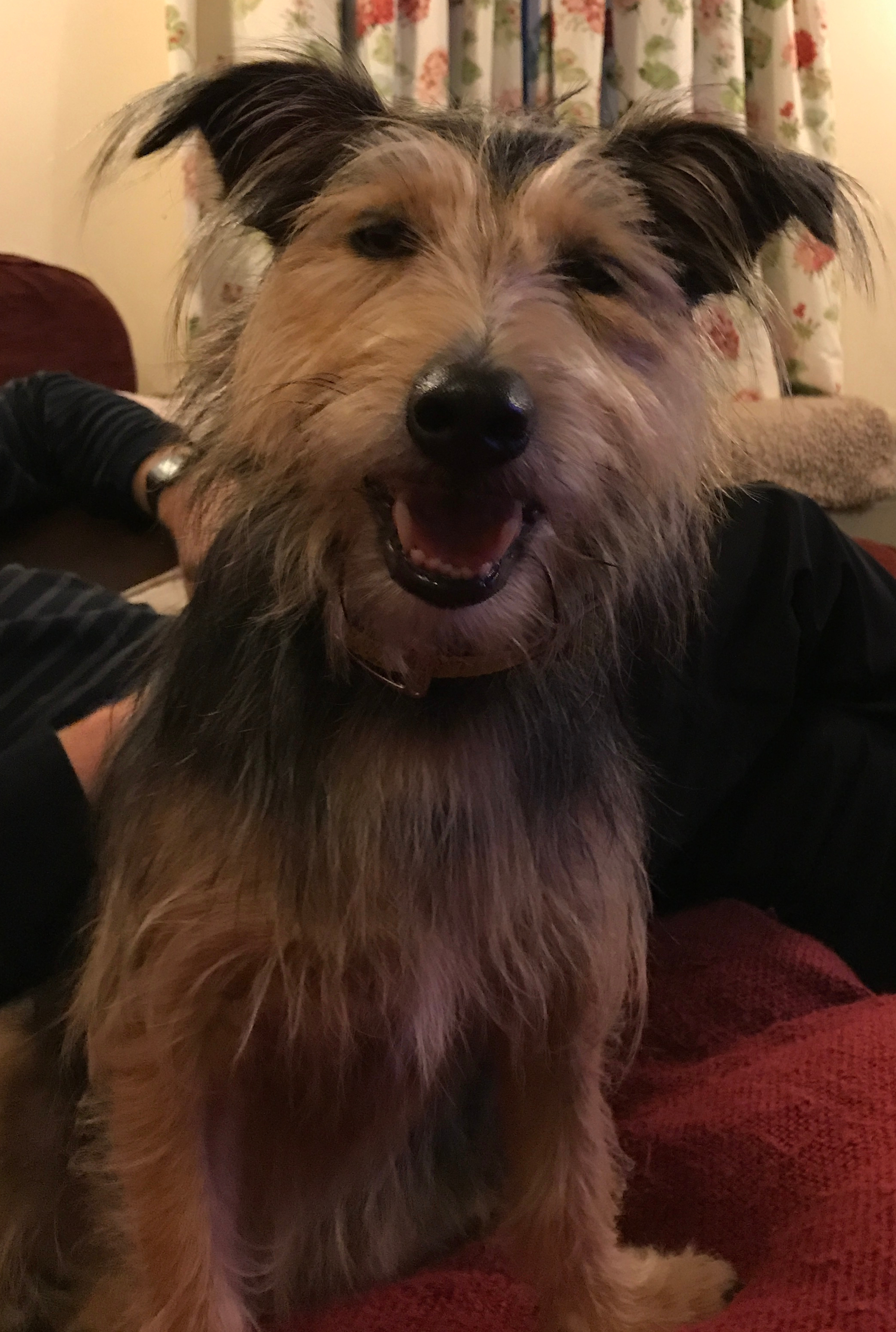
I didn’t have a pet dog as a child, it wasn’t until my daughter was fourteen that we introduced a dog into our lives. The idea of having our first dog came from a book. I picked up a book on dog breeds in a garden centre. It opened at random on a page with the image of a black Patterdale Terrier. I said to my daughter, ‘If we have a dog, we’ll have that breed.’ It was probably three years later that we found Pepper. He was the last dog in the litter, a family dog from the outset not a working dog. We found him after visiting the vets to ask what we needed to do as we planned to pick up a Patterdale Terrier from Wales. Patterdales weren’t very common then. Pepper was born just up the road from our house and it was as though he was meant for us, the timing was so perfect. He was a very placid loving dog, which is a rare character for a Patterdale. He grew up to be the image of the dog in the book, he had long legs for a Patterdale, as the image in the book had.

And what a revelation it was to have my first dog! If you don’t have a significant pet, you can’t imagine the importance and intensity of that relationship, or at least I couldn’t. Like many first-time adult dog owners, I was surprised by the attachment that developed, and how quickly it developed. Dogs really do become a part of the family. Dogs are childlike when they’re young and it immediately makes you feel like their parent.

Writers, because we are working at home, sitting still, in one place, often have a dog that keeps us company. Of course, in a COVID world that’s true for more people. My first dog would simply squeeze into a chair beside me and sleep. My current dog is far less patient with my laptop 😀 I am barked at in the evenings and told to put it down, so he can have his cuddle. He upstages me too, by sitting on the bed behind me during video calls.

Our first dog became so much a part of my life, though, that, of course, having experienced that relationship it was an obvious step to write dogs into my books. So far the dogs have only slipped into the historical books. But what I like about adding the dogs into stories, is that they help define the personality of the human character.

Robert’s Deer Hounds in The Passionate Love of a Rake show a high level of loyalty to a man who struggles to glean loyalty from human beings, he is much better at pushing people away. But his dogs … The dogs’ loyalty implies that there is something beyond the hard shell. The dogs likewise tell a tale in his son’s story, The Reckless love on an heir. It was quite a few years ago now that we watched the deerhounds running from a 17th Century Grandstand. They are very stately and sleek looking dogs. Perfect for Robert.

Then there is Pippin, the King Charles Spaniel, in Treacle Moon, Polly’s pet. He’s a lapdog that travels everywhere with her. His nature is more like the nature of my Pepper the Patterdale Terrier. He likes to be held and fussed. Her close relationship with Pippin expresses her desire to feel close to someone, and that she is a warm, generous-hearted, tactile person who appreciates displays of affection. The displays of affection that she’d lacked in her childhood when she was orphaned.

Somebody asked in the interview with One More Chapter this week, ‘Who would your side-kick be if you were a detective?’ I said my dog. Jack, our rescue dog, who we have now worked out is mostly a Lancashire Heeler. He is a perfect inspiration for a thriller accomplice. He observes everything, keeping an eye on who and what passes by the house. He is also a good tracker and a heel nipper – good at rounding people up like sheep. So, there may be a dog in a future thriller.

The dogs in books don’t always behave, though. There is the issue of not wanting to write too much about them; if they aren’t adding to the storyline in some way then I don’t want to keep going on about them. But they need to be there in a scene somewhere. It’s when there’s an intense scene that they become a difficult addition. What’s the dog doing during the dialogue that you don’t want to break. In a film you wouldn’t interrupt a scene for the camera to pan to the pet, but in a book, people don’t have the visual knowledge that the dog is on a lap, or on the floor in the corner. 😀 Robert’s deerhounds were easier to manage, they could be looked after in the stables by the servants. But Pippin, by the very nature of a lapdog, he should always be there. He was very good at sleeping by the fire. Ha ha. Pippin’s presence in Treacle Moon, and then in Entangled was something I had to keep going back to and adding in too, because my mind would progress the scene and then I’d suddenly remember, where’s Pippin? Oh blast, I forgot him again …

It is a bit, as they say with actors, never work with children and pets. Young children are the same, you have to keep putting them into safe places in the intense scenes.