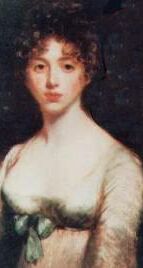
 Last week I told you all about Lady Caroline Lamb’s marriage,which I thought was just such a wonderful real Regency story and then from now on, we will follow Caroline from the honeymoon period into the confused mess which ended up with her caught up in the heart of some of the most talked about scandals in history.
But before I begin this week’s little tale, here is the back ground to this series of posts for anyone joining my blog today, but for everyone following, as always, just skip to the end of the italics where I have marked the type in bold.
I was drawn to Lady Caroline Lamb, who lived in the Regency era, because Harriette Wilson the courtesan who wrote her memoirs in 1825, mentions the Ponsonby and the Lamb family frequently. Also the story of Caroline’s affair with Lord Byron captured my imagination. Caroline was also a writer, she wrote poems, and novels in her later life. I have read Glenarvon.
Her life story and her letters sucked me further into the reality of the Regency world which is rarely found in modern-day books. Jane Austen wrote fictional, ‘country’ life as she called it, and I want to write fictional ‘Regency’ life rather than simply romance. But what I love when I discover gems in my research like Caroline’s story is sharing the real story behind my fiction here too.
Lady Caroline Lamb was born Caroline Ponsonby, on the 13th November 1785. She was the daughter of Frederick Ponsonby, Viscount Duncannon, and Henrietta (known as Harriet), the sister of the infamous Georgiana, Duchess of Devonshire.
Caroline became an official lady when her grandfather died, and her father became Earl of Bessborough earning her the honorific title ‘Lady’ and she grew up in a world of luxury, even Marie Antoinette was a family friend. Caroline was always renowned as being lively, and now it is suspected she had a condition called bipolar. As a child she earned herself a title as a ‘brat’, by such things as telling her aunt Georgiana that Edward Gibbon’s (the author of The Decline and fall of the Roman Empire) face was ‘so ugly it had frightened her puppy’.
And when she grew up Byron once described Caroline as “the cleverest most agreeable, absurd, amiable, perplexing, dangerous fascinating little being that lives now or ought to have lived 2000 years ago.”
Caro and William spent their honeymoon at his family home in the country, Brocket Hall (I just looked that up on-line, sadly now it’s a golf club, looks very nice though). Two days after her marriage Caro wrote to her mother asking for her to send a book on education and the twenty-four volume Histoire Ancienne… – William was very educated, very intelligent, and a man who loved to debate, and Caro was strong-willed,independent, probably equally intelligent, certainly very clever with words, and came from a family where the women were highly respected – equal to their men, and yet she had not been widely educated in the same areas as William, although she spoke several languages. I guess, though, if the man she loved was in a debating mood, she wished to be able to play an equal part… Her mother teased her when she wrote back…”that dear, beautiful, light amusing book.” “Could you not contrive a little rolling booke case you might draw after you, containing these precious volumes,” for Caro to pull about with her perhaps to look up things to debate with William 😉 . (Note the letter quotations are the original Georgian spelling! Just as they wanted to write it).
Four days after she was wed though Caro called for her mother to come and keep her company as she felt unwell, having lost her ‘innocence’, and knowing the Lamb’s I think William would have taken it liberally, her mother wrote to her lover, “I do think it very hard that men should always have the beau jeu (beautiful game/fine game) on all occasions, and that all the pain, Morel et Physique (moral and physical) should be reserv’d for us.”
When her mother left Caro there were more visitors at Brocket Hall, her grandmother, and her uncles. Her grandmother records Caroline’s restlessness as she ‘threw’ herself into one chair, then rose and sat in another, and another. In the end her grandmother took her out for a carriage ride. (I suppose her restlessness may indicate bipolar, which is what people now believe Caroline suffered with).
Many of her family commented on their lack of belief that little frail looking Caro would be fit for the role and responsibility of a wife, she was frequently described as fairy like, which I think was half due to her appearance and half due her flighty nature.

William in later life when he became Earl of Melbourne
Two weeks after her marriage Caroline wrote to her cousin, still perhaps a little unsure of her married state… “You told me the happiest time in your life was three weeks after being married. I am not quite arrived at that period but am much contented with my present state and yet I cannot say I have never felt happier..” She goes on then to contrast her present with her romantic love of William much earlier in their courting, when they only had snatched moments, and says they were perhaps happier because there was an anticipation and the fear of loss… But then she tells her cousin how they passed their honeymoon. “he is kinder more delightful & more attentive than even I expected. he reads to me sometimes from nine until two – walks and stays with me all day& I have found not one single moment hang heavily with me since I have been here.” she describes her self as “a soul just arrived in paradise,” unaccustomed to love and life.
Then three weeks after her wedding she wrote to her cousin Hartingdon in the role of the Fairy Queen Titania, Hart still felt jilted by her because she’d chosen another man, he never did marry. “The wand was broke her elves dismiss’d, The Deamons yell’d – the serpents hist, The skies were black the thunder round, When sad Titania left her lord” “Oberon a long adieu, and with him all his fairy crew” “Thus spoke Titania then she sigh’d, Doomed to become a Mortals bride.”
After the honeymoon the couple moved to what would be their home, in London. William was still on a restrained income, his ‘father’ who was not really his father as William was illegitimate – the product of an affair, short or long – and so because his father begrudged William now being heir, they did not have enough income to rent their own property let alone buy one, and so they moved into his parents’ home in London. His mother, who did not particularly like Caroline, did however generously move from her apartment on the top floor to the ground floor rooms, which gave Caro and William an apartment with a wonderful view of St James Park.
Then the Earl, probably to avoid embarrassment, after all, to the world, William was his legitimate heir, and so he allowed Caro, pin money of £400 a year. Their apartment did have a separate entrance from the street and so at least they could live there entirely independently if they wished… But families were families even then… and mothers were mothers – and mother-in-laws -and indeed brother-in-laws.
Caroline was a little shocked by the Lambs (Melbournes, which was the name of the title) way of life, it made such an impression on her she borrowed the families way of living and used it in her novel Glenarvon, renaming the family Montieth. Her family was of the highest rank of society, and they obeyed all etiquette, with high moral’s applying the perfect Regency facade of all appearing to be of the highest moral standard. Of course we know what was going on out of sight, but Caro was not told about any of the out of sight things, she had been kept blinkered by her family as much as possible, and so to walk into the life of the Lambs…
Dive back to my tales from the memoirs of the courtesan Harriette Wilson and you will hear her tell some of the most astonishing stories of the Lamb brothers atrocious behaviour. I would suspect she could have told some of William too, but I would make a guess he may have bought himself out of her memoirs. But she wrote about the Lamb’s. One of them stole her away from her first real protector, and his father encouraged him, while she was still living with Lord Craven, to make use of a friend’s convenience. In other words sleep with his mistress for free. Then when he did win her, because Craven threw her out, because the boy had been around there so much, he kept her for months and gave her nothing to live on. Then at another point when they were older he tried to strangle her. Harriette told us another of William’s brothers fell asleep in her sister’s bedchamber in the middle of a party because he was so drunk,and then woke up while she was using the chamber pot and walked out laughing… So that gives you a measure of the family Caroline had married into. They really did not care what anyone thought of their behaviour, they behaved how they wished.
Their habits were described as informal and irreverent. Caroline drew sketches of William and his brothers in ‘family attitude.’ Which meant they sprawled in the chairs in the drawing room, legs thrown over an arm of a chair, or lying on a couch with a leg dangling over the back. They were described as a close-knit group of practical jokers, hard-headed and unsentimental. William’s brothers treated Caroline as William’s hobby, and laughed at the fact that she wished to educate herself…
It sounds, from the very beginning, like this is a situation that could explode… boy did it explode… but we will take it one step at a time. More next week… 😀
And if you would like to read my historical romance story that was inspired by Caroline’s life… it’s just coming up for pre-order The Dangerous Love of a Rogue, will be out in ebook in January and can be pre-ordered for Paperback release in March.
But if you can’t wait for Regency stories, then grab one of my books many of them are currently on offer in the UK from 69p and in the USA from $1.99 and there are couple of little extras for free…
Go to the index
For
- the story of the real courtesan who inspired The Illicit Love of a Courtesan,
Jane Lark is a writer of authentic, passionate and emotional Historical and New Adult Romance stories, and the author of a No.1 bestselling Historical Romance novel in America, ‘The Illicit Love of a Courtesan’.
Click here to find out more about Jane’s books, and see Jane’s website www.janelark.co.uk to learn more about Jane. Or click ‘like’ on Jane’s Facebook page to see photo’s and learn historical facts from the Georgian, Regency and Victorian eras, which Jane publishes there. You can also follow Jane on twitter at @janelark
Jane’s books can be ordered from amazon by clicking on the covers in the sidebar, and are available from most booksellers.
 Author, Jane Lark's stories