Caroline Lamb and Lord Byron are mentioned in the 19th century courtesan’s memoirs which inspired my debut novel Illicit Love, and it was this reference which first drew me into Caro’s story.
Since I first discovered Caro, I have read a book of her letters and her biography, and also the novel she wrote ‘ Glenarvon’, which was first published 9th May 1816, and is said to be very representative of how people lived at the time, and semi-biographical. Though Byron joked when he was told the lead character was meant to be himself, that she could not have caught his likeness very well because he did not sit over long (as if for a portrait). Their affair was a whirlwind six months, which Caro never got over.
So now let me tell you, in Caro’s words, ‘The whole disgraceful truth.’
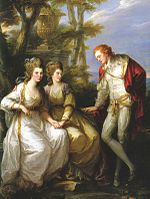
Georgiana with Caro’s mother and uncle
I think I’ll begin Caro’s story when she left England with her mother at the age of six, they were in the company of Lady Foster and her aunt, Georgiana, the Duchess of Devonshire, (yes, the one from the film starring Keira Knightley). Caro’s aunt had been banished from England by the Duke one year after her son Hart’s birth for falling pregnant by her lover, Earl Grey. She went to Italy to have the child and they lived in Naples for two and half years. However when the Duke finally agreed Georgiana and Lady Elizabeth Foster might return, Caro’s mother was too ill to travel.
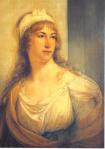
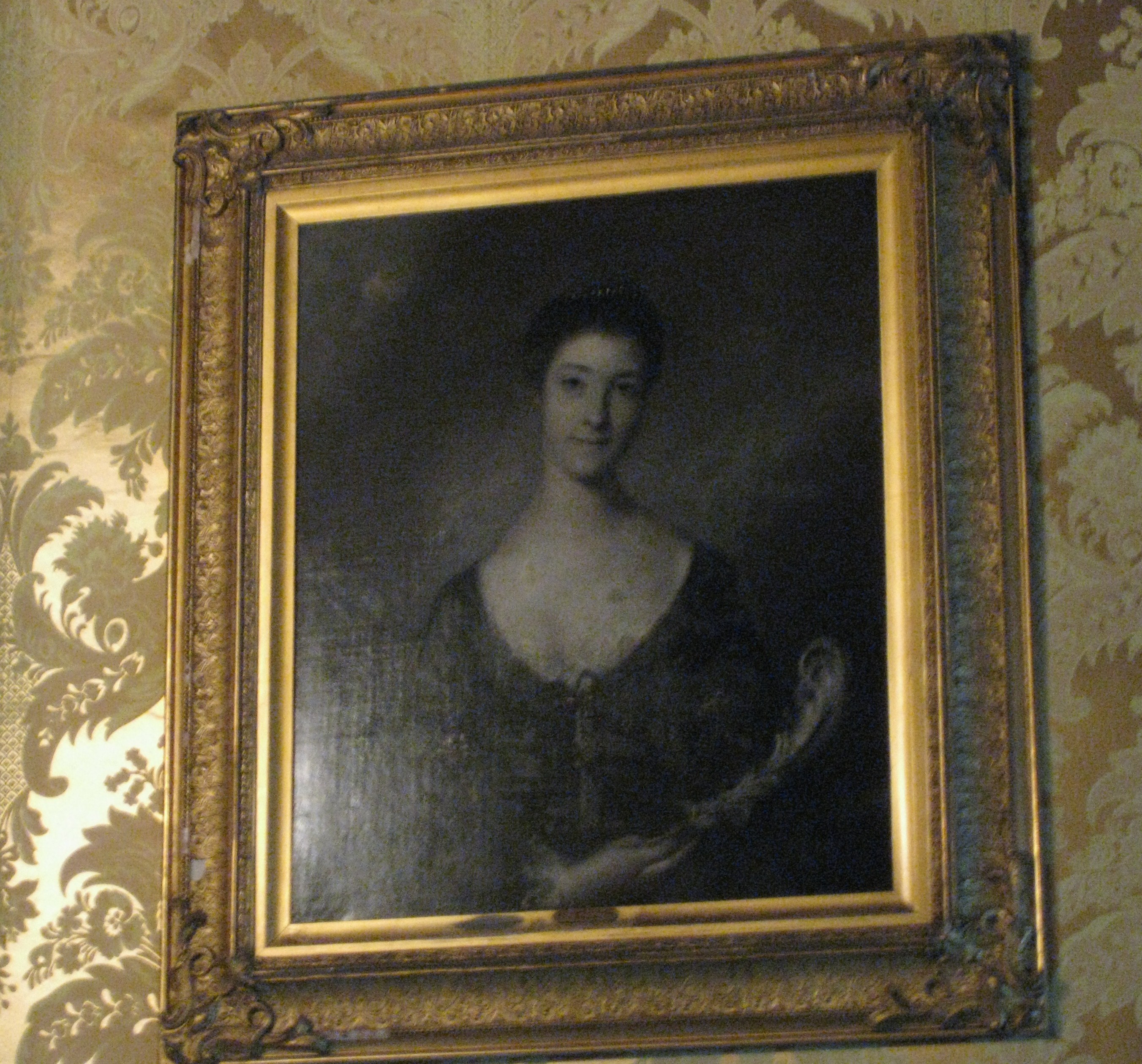
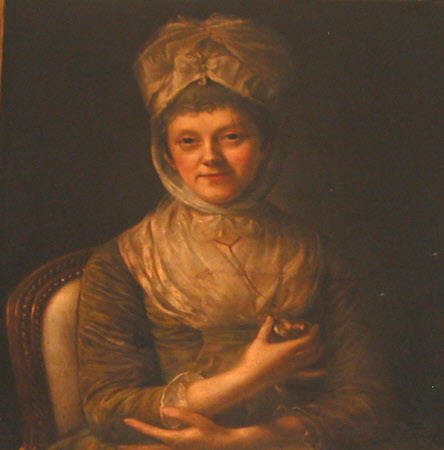
Caro’s mother
After they had left though, Caro’s mother began an affair with a younger man. It is known that on one occasion Caro actually walked in on them together, so at some level in her childhood she was made well aware of the ways of the world.
Caro’s mother came back to England and her husband who had come to fetch them in 1794, when Caro was nine, and then much of Caro’s childhood was spent living with her aunt, Georgiana (G), so she became very close to her cousin Hart, who was profoundly deaf. Although in later years Caro went to a finishing school.
Her mother speaks of her in letters as a trouble child, with fits of temper and despairs that she will ever calm down, but by the time Caro reaches her teens she is much calmer natured.
Caro seems to have thought as much of G as she did of her mother, she frequently wrote to her aunt.
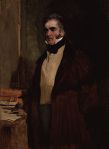
William Lamb
Caro met her husband, William Lamb, in 1802, when she was sixteen and there was an instant attraction for both of them.
Buy this time Caro is reported as shy, and she looked up to him, and his knowledge, with utter admiration, while he is drawn to the quiet, beautiful young girl who captured his awareness while they were staying in the same house for a house party.
Caroline was discouraged by her mother from progressing the connection at the time because there was always an unofficial recognition that Caroline would marry Hart.
It took three years for the couple to persuade their families that their marriage was meant to be, and in 1805 their families’ conceded.
Caro writes of William.
‘such as the breakfast at Chiswick when I walked round the garden holding Williams arm and when I wished to put a stop to time being at that moment as happy as I ever wished to be’
She wrote to Hart, who suffered a broken heart after her marriage, and never married,
‘The wand was broke her elves dismiss’d
The Deamons yell’d- the serpents hist
The skies were black the thunder roar’d
when sad Titania left her lord
And thus in plaints both loud and long
To stones adress’d her mournful song…’
Caro considered herself very naive in comparison to her husband (despite the affairs she had witnessed as a child), so how much she understood and how much her family explained away who knows.
Yet when she moved in with William Lamb’s family she was horrified by their blasphemy, and she claimed that William challenged her beliefs and argued against her piety and changed who she was.
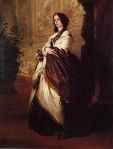
Harriet, daughter of Georgiana and Caro’s Cousin
She fell pregnant in the first year and wrote to G’s daughter to ask all about pregnancy, wanting to know if it was bad to sleep with her husband while pregnant, and asking if it is normal to have pains. The child was born in 1806 but soon died and this was the first year Caro was noted as doing something particularly memorable and a little odd.
When William was elected to Parliament and was due to make his maiden speech, in a place where women were not welcome, she dressed as a man and sneaked into the gallery to listen. He knew.
In the next year, Caro had a son by William.
Two years later, her aunt G had passed away, and the Duke of Devonshire married his mistress Lady Elizabeth, while Caro’s mother’s young lover, whom she had met in Italy and maintained a relationship with for many years, then married Harryo, Caro’s cousin, another of G’s daughters, and William Lamb’s brother married Lady Elizabeth’s illegitimate daughter by the Duke (It all seems a little incestuous doesn’t it? ha, ha. Certainly a real tangle of relationships and very scandalous – oh I haven’t even said that there are rumours Caro was also illegitimate, and the daughter of one of the members of the Whig party).
Anyway, back to Caro’s story. Caro was a woman of strong emotions, potentially she may have suffered with bi-polar disorder. Certainly her letters show a great deal of excitement and anger and jealousy at times. She wrote of herself and Lady Elizabeth’s daughter, Caroline’s namesake;
‘There is Caroline Jules
With her laces and thules
Is good yet makes men sigh
While her sister (Caro) runs wildish
And seems rather childish
but oh she’s a roving eye.’
It was four years after Caro’s son Augustus was born that Caro had her first affair and let her roving eye take hold, although she always claimed it was romantic and not consummated.
She was living in London with William now, and a new social world had opened up to her.
Jealous of her sister-in-law who was favoured in William’s family, Caro then spent more and more time away from home. At first she found the noise and vibrancy of crowded venues strange, but soon she was fully drawn into it.
She wrote to Hart ‘What world it is dear sweet boy, what a flimsey patched work face it has, all profession, little affection, no truth.’
But later she writes to a friend, describing a masquerade party she attended I ‘put on my boys shoe buckles a red Emery wig a boarding school frock so that I looked like a boy dressed up for a girl & in that character told everyone that I personated Lady Caroline Lamb had died my hair red & I jumped like a Harlequin laughed hartily & had no mercy on any one.’
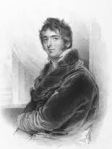
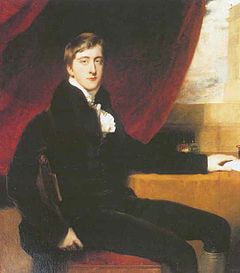
William Lamb
With Caro’s now outgoing and extravagant nature she fell into a party set through her acquaintance with Lady Holland, a previously divorced woman who was not welcome at court. As Lord Byron’s future wife put it, ‘if offered an introduction to Lady Holland, the proper thing to do would be to decline.’
However Caro’s view was, ‘no one will regard me as corrupted by being in the room with her’.
It was Lady Holland’s son by her first marriage who Caro fell for. He was twenty and Caro twenty-four and he was an out-and-out rake of the worst sort. He actively hunted women and was well known for affairs, bad morals and no conscience.
He once secured a bracelet on her wrist behind an open door to conceal the action, and they would constantly be in each other’s company which finally gave them away.
The angry letters from William’s family imply that if Caro had kept her affairs more subtle, they would not have mattered at all. But being so open about it led Caro’s mother-in-law to cut her, while William Lamb, Caro’s husband, just turned a constant blind eye focusing on his political career and not joining her at the entertainments she favoured.
Caro’s affair with Lady Holland’s son was an off an on thing for a little while. On when she could get away with it, and off when anyone in her family found out.
Caro was very willing to break rules and play jokes on people, and she would ride out alone, and she fell in love with the waltz long before most women danced it.
She was in the fast set and went to all night waltzing parties where all the dances were waltzes. When challenged about her behaviour she wrote, ‘I have always been of the opinion & still am that those who like it like it because it is doubtful – those unco good young women who shudder at the thought of vice like venture to the edge of the precipice down which so many of their frail companions have been thrown.’ (Caro is the ultimate scandalous woman, she was in the same circles as the Prince Regent, so was at the very peak of society too).
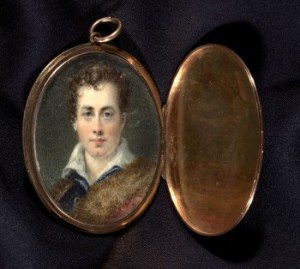
Lord Byron
It was at one of these parties that she met Lord Byron. Who actually did not dance, because he had a club foot. But as William enthralled her when she was young, Byron began to enthrall.
She knew one of Lord Byron’s friends and had seen an advance copy of Childe Harold, Byron’s first successful poem, in which she was drawn to his theme of loneliness in a crowd. She asked for an introduction to Byron and wrote to him telling him she thought Childe Harold beautiful and then again in verse addressing him as Childe Harold and declaring love.
She was one of many women who’d fallen for the character he’d written, and began courting his attention.
Right from the beginning when she had not even met him, she asked him to leave a letter for her addressed to Mr Sidney Allison, at Hookhams’ circulating library on Bond Street (which was apparently a common practice, to share love letters via this route – I know, the things you discover when you start researching).
While Byron did not reply to her letter, when he discovered the sender he did not over look it. At the time he was far beneath Caro’s standing in society, so having a Lady address herself to him like this sparked his interest significantly.
On the first occasion they may have been introduced she left the party because he was surrounded by other women. So on the next occasion, he approached her, and asked her why she had left, then sought permission to call on her.
This was a social-climbing opportunity for him.
When he called, Caro had just come back from an early morning ride and went in to meet him without changing, as she put it, dirty and sweaty, then invited him to a waltzing party on the 25th March 1812.
Byron came and watched, and it was here he met his future wife for the first time too.
It was after this party that Caro’s mother grew suspicious, and she told Byron, Caro would not be interested. He admitted later this only made him more interested. ‘Her folly half did this, at ye. commencement she piqued that ‘vanity’ (which it would be the vainest thing on earth to deny) by telling me she was certain ‘I was not beloved.’
So what was This – the story of their affair. I did think about saving the rest for next week, as this is getting very long, but then I thought that would be mean hanging you in suspense, so I’ll carry on.
Byron went on full charm and seduction assault.
He called frequently and did all that was likely to impress and please Caro, (very different to his affair with Mary Shelley’s step sister which I have written of previously).
This time it was definitely Byron making the progressions. He even sat in her drawing-room and held her son on his knee, (Augustus was disabled and his learning had progressed very little, he would always have the mind of a child).
Byron learnt that she liked gardening and dogs and so on one occasion he brought her a rose and wrote her verse about his own dog, knowing clever verse amused her.
When he gave her the rose he did so saying “Your Ladyship, I am told, likes all that it is new and rare, for a moment.”
Caro’s love for William had begun with an admiration of his knowledge and learning, and he had wooed her through reading and discussions about literature, and Byron did the same, he brought her books, and now Caro was far more knowledgeable, they debated their opinions on various works.
Then on Good Friday, 27th March, 1812, the rose Byron gave Caroline died and Caroline wrote to him. ‘The Rose Lord Byron gave Lady Caroline Lamb died in despight of every effort made to save it; probably from regret at its fallen fortunes. Hume, at least, who is no great believer in most things says that many more die of broken hearts than is supposed.’ She sent to Byron the flower she wished most to resemble – the sunflower, because it had a ‘noble and aspiring mind’, and it followed with it’s gaze, ‘the bright star to whom it pays constant homage’ she also begged Byron to avoid, any more ‘Taunts and cuts’ about ‘Love of what is New’.
Caroline’s affair with Byron held one unusual and mesmerising edge for them both, in that Caro frequently dressed as a man, and took great pleasure in stirring gossip by doing do so at parties. Byron was believed to be bisexual. The lost love he spoke of in Childe Harold is believed to be for a boy he had fallen for and Caro had picked up on this, when she wrote to him about the dead rose she directed him to lines in Childe Harold. ‘Come hither, hither, my little page…‘
They were equally intelligent and had an equally complex sense of humour, they were also well matched in creativity and liked to be clever with words, they also both suffered with bouts of depression, and understood isolation. When Caro succumbed she wrote to Byron, ‘Never while life beats in his heart,’ she told him, ‘shall I forget you or that moment when first you said you lov’d me – when my heart did not meet yours but flew before it…‘ – to me, the words of an infatuated woman deeply in love
Byron wrote of her;
‘Then your heart – my poor Caro, what a little volcano! that pours lava through your veins, & yet I cannot wish it a bit colder, to make a marble slab of, as you sometimes see (to understand my foolish metaphor) brought in vases tables from Vesuvius when hardened after eruption – I have always thought you the cleverest most agreeable, absurd, amiable, perplexing, dangerous, fascinating little being that lives now or ought to have lived 2000 years ago – I wont talk to you of beauty, I am no judge, but our beauties cease to be so when near you. and there you have either some or something better… All that you so often say, I feel, can more be said or felt.’ – to me, the words of an infatuated man deeply in lust.
At first their affections were just as equal and Byron’s first publisher described Byron ‘so enraptured, so intoxicated, that his time and thoughts were almost entirely devoted to reading her letters and answering them.’
But then again Caro failed to be discrete, Byron’s friend who had introduced them noted with what seems horror one night, ‘She absolutely besieged him… after a party at Devonshire House… I saw her, – yes saw her, – talking to Byron, with half of her body thrust into the carriage which he had just entered.’
Harryo wrote, ‘Lord Byron is upon a pedestal.. and Caroline William (their nickname for Caro) doing homage.’
Annabella Milbanke called it ‘Byromania.’
Caroline used the disguise of a boy to visit Byron in his apartments in St James, claiming to be her own page, she fooled her family and Byron’s own page, asking him to take her up to Byron.
Byron’s publisher once saw Caro dressed like that and described her as ‘a fair-faced delicate boy of thirteen or fourteen years old… He was dressed in scarlet hussar jacket and pantaloons… He had light hair curling about his face, and held a feathered fancy hat in his hand, which completed the scenic appearance of this urchin Pandarus. I could not but suspect at the time it was a disguise. If so Byron never disclosed to me.‘
There affair was volatile. She would turn up unannounced and he would send her away, and their mutual friend Samuel Rogers was often caught in the middle of their arguments and mentioned arriving home to find Caro in his garden pleading with him to reconcile them.
Byron banned her from dancing the waltz, as he could not, and he frequently chastised her for refusing to criticize William, seeing William as his rival, even though Byron was unfaithful to Caro during their affair.
He often accused her of being cold, which she thought cruel. She wrote to him a long while after their affair had ended, when she had become the woman left behind, to say;
“But was I cold when first you made me yours? When first you told me in the carriage to kiss your mouth and I durst not – and after thinking it such a crime it was more than I could prevent from that moment – you drew me to you like a magnet and I could not indeed I not have kept away – was I cold then – were you so?‘
They exchanged trinkets of jewellery including rings, and what Caro called a wedding ring, and as was the fashion they exchanged locks of hair, but Caro, being as scandalous as she loved to be, also sent Byron a lock of pubic hair. Even more scandalous is what Caro wrote when she sent it. She wrote;
‘Caroline Byron August, 9th, 1812,
next to Thyrsa Dearest
& most faithful – God bless you
own love – ricordati di Biondetta
From your wild Antelope’
But as with many of their communications, their was double entendre here. Biondetta’s character was a young man of twenty-five, (Byron was twenty-four when he met Caro) seduced by an enamored spirit, who came to him as a blond-haired woman dressed as a page bearing fruit. Again she was reminding him that she could be both the woman and the boy he wished for.
When Caro left London with her husband, Byron wrote, having said goodbye to her. ‘this dream, this delirium of two months must pass away… we have both had 1000 previous fancies of the same kind, & shall get the better of this.’
As Byron’s lust for Caro began to tire, she grew more and more determined to keep his attention and her letters became filled with jealousy as he became closer to Annabella – who he begins correspondence with – another woman who’d claimed not to want anything to do with him, he is then determined to woe. Then also Caro’s mother in-law, who at the same time was cutting Caro for the affair, befriended Byron (that’s the absurd behaviour of the 1800s for you.)
They argued more often, and then Caro scrawled frequent appealing apologies.
Byron spoke in a letter of one of their arguments ‘one was made up in a very odd way, and without any verbal explanation. She will remember it.‘
Caro’s increasingly erratic behaviour was not unnoticed by the women in her family, although William was a head-in-the-sand man, the more obvious she became, the harder her husband ignored her affair.
On 24th July she and William dined with her grandmother as though there was nothing wrong with their marriage, but on the 29th July Caro turned up at Byron’s dressed as a page in a greatcoat. His publisher, Hobhouse, saw her and then made himself scarce for a little while, but when he returned it was to hear Caro begging Byron to go away with her. Byron refused and Caro caught up a court sword to do herself harm, both men fought it off her and Caro then left.
Her mother and mother-in-law were both encouraging Byron to leave town, and get away from Caro, fearing disastrous scandal and Caro’s mother began preparing a trip to Ireland to get her away from Byron.
Byron had opportunity to go, he could easily have finished his affair with Caro immediately, but still feeling some attachment to her he let it drag out and did not go. Instead of ending the affair though, he gave her a bracelet bearing, Crede Byron, (have faith in Byron).
But while she wrote a letter to him dreaming of them living together, he was hoping to bring the affair to an end, but admitted to his friend Hobhouse, he had never been so in love, despite the fact ‘that she teazed him to death and made him wretched – that a few weeks absence would cure him – but that if she got on to him again she would force him to go away with her.’
When things came to a final crux, it was not to Byron Caro fled.
After a severe argument with her in-laws, which resulted in her being left alone to receive a final yelling at from her father-in-law, during which Caro threatened to leave and go to Byron, Lord Melbourne had answered, “Then go, and be damned.” The cry was followed with a threat that he doubted Byron would have her.
Caroline ran out of the house at that, and her father-in-law was on the stairs, yelling “Stop her!” when her female relatives arrived.
Caro pawned jewellery to get a stage-coach ticket to the coast and money to get on a boat from there. While her family was in extreme distress scouring London for her, after they had first gone to Byron and discovered she wasn’t there.
She took refuge in a Dr’s house , which she had once visited, begging that he let her stay there overnight until the coach left.
She wrote from their to say her goodbyes and Byron caught the coachman delivering his before the man had left. Byron had recognised the writing and then bribed the man to tell him where Caro was. Once he discovered the Dr’s address he went to collect her and took her to her parents.
Her mother records that it was Byron who persuaded Caro to go back to her husband after that.
William being placid William, who I think did genuinely love Caro, but had no idea how to cope with her wilder side, immediately promised to forgive her and took her back.
Byron wrote;
‘My dearest Caroline – if tears, which you saw & know I am not apt to shed, if the agitation in which I parted from you, agitation which you must have perceived through the whole of this most nervous nervous affair, did not commence till the moment of leaving you approached. If all that I have said & done, & am still but too ready to say & do have not sufficiently proved what my feelings are & must be ever towards you, my love, I have no other proof to offer; God knows I wish you happy, & when I quit you, or rather when you from a sense of duty to your husband & mother quit me, you shall acknowledge the truth of what I again promise and vow, that no other in word or deed shall ever hold the place in my affection which is & shall be most sacred to you, till I am nothing I never knew till that moment, the madness of – my dearest & most beloved friend – I cannot express myself – this no time for words-…‘
I could go on forever about Caro’s life, but I shall start to bring her story to a close now.
She clung to those words for the rest of her life, believing them and wishing them true and trying to bring Byron back to that time. But he moved on and as her endless devotion and refusal to give him up became more and more erratic and manipulating Byron came to hate and loathe her instead.
After her running away she was taken to Ireland by her family where she began her first novel Glenarvon.
On her return to England, when she realised Byron had moved on to other affairs, she burnt his effigy while she had page boys dance about a fire chanting words which mocked the message on his bracelet.
Her family for a long while stopped her from being in the same room as Byron, while she continued to bombard him with letters, and broke into his home to steal things from him and leave messages to him.
She also forged his signature to acquire things of his from his publisher, including a portrait. She equally bombarded the women he was associated with with letters and made friends of any new friends he made, to try and keep close to him, and know what he was doing. Sometimes she tried to ingratiate herself and sometimes she simply dished out cruelty and jealousy, speaking of her own affair and Byron’s affections for her. (She sadly became a thorough going bunny-boiling, stalker).
She was like a shadow to Byron, seeking to destroy his reputation. She battled him in the pen even publishing mocking copies of his work, and once she dressed as one of his characters when she went to Almack’s, and took pages dressed as devils with her. Her madness left her more and more isolated in London society as doors were shut to her.
When Byron had a portrait painted of himself in robes, she had her own done, dressed Biondetta style, as a page, holding out a platter of fruit and then arranged for it to be hung in the same portrait gallery as Byron’s, beside his, so her image was holding the platter out to his (clever, sly, scandalous, Caro).
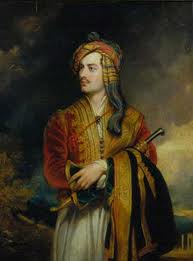
Lord Byron
At one ball, after she first returned from Ireland, she took a knife to her wrists before him, when he would give her no attention. (poor, sad, broken-hearted Caro).
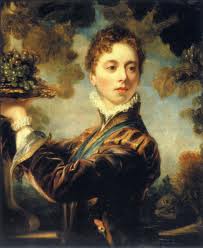
Caroline as a page
When Byron married Annabella Millbanke, Caro was insanely Jealous but encouraged to stay away, and yet as soon as his marriage fell apart she was there to console Annabella, so say, or rather to have another route to get near Byron.
(Byron’s marriage failed because Annabella threw him out after discovering something intolerable about him, and when Caro visited Annabella, Annabella accused Caro of having known and said nothing. None of their letters reveal what.)
When he left the country, on the run from an even greater scandal, having been accused of incest with his half-sister, Caro was desolate again, realising she may never see him anymore. But she still wrote to Byron when he was abroad, commenting on the daughter he had with Mary Shelley’s step-sister.
When Byron died she found a way to watch the procession bearing his coffin, even though she should not have done.
Caro at that time was still so wrapped up in Byron’s affairs, she frequently managed to see the writing he sent from abroad before it was published and on his death she read his memoirs, which were burnt by his publisher and never printed. (I’d have loved to have read them and known the whole truth about Byron’s life – darn you for burning them Murray).
Her own marriage finally failed following the publication of her novel. William thought it a good thing initially, with his usual head-in-the-sand approach, when it was clearly virtually an autobiography, but his mother and father finally persuaded him Caro was too much of an embarrassment as she was shunned by all polite society, and he wished for a political career.
They were officially separated by agreement in the summer of 1825, and a couple of months after that, she was declared insane.
Caro died three years later, having lived a very lonely existence for the last three years of her life. William returned to be with her at the end.
While Caro called Byron ‘mad, bad and dangerous to know.’
Lord Byron wrote of her, after she had left a note in his apartment having broken into it, again, saying “Remember me”
“Remember thee! Remember thee!; Till Lethe quench life’s burning stream; Remorse and shame shall cling to thee, And haunt thee like a feverish dream! Remember thee! Ay, doubt it not. Thy husband too shall think of thee! By neither shalt thou be forgot, Thou false to him, thou fiend to me!”
Another sad ending for one of my scandalous women.
Next week, I am changing the subject and I shall be blogging about an 18th Century Christmas Party leading up to Christmas, and then in the New Year I shall return to stories of scandalous women as I delve into those memoirs of an 18th Century Courtesan.
Oh, also leading up to Christmas, I am going to reveal some of my old blogs, one per day, as an advent calendar on my website. If you want to follow these go to www.janelark.co.uk and click on the advent calendar in the menu.
Wow I think this has been my longest ever blog!!! I hope you liked it.
Jane Lark is a writer of authentic, passionate and emotional love stories.
See the side bar for details of Jane’s books, and Jane’s website www.janelark.co.uk to learn more about Jane. Or click ‘like’ on Jane’s Facebook page to see photo’s and learn historical facts from the Georgian, Regency and Victorian eras, which Jane publishes there. You can also follow Jane on twitter at @janelark




 Author, Jane Lark's stories