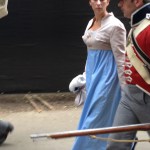
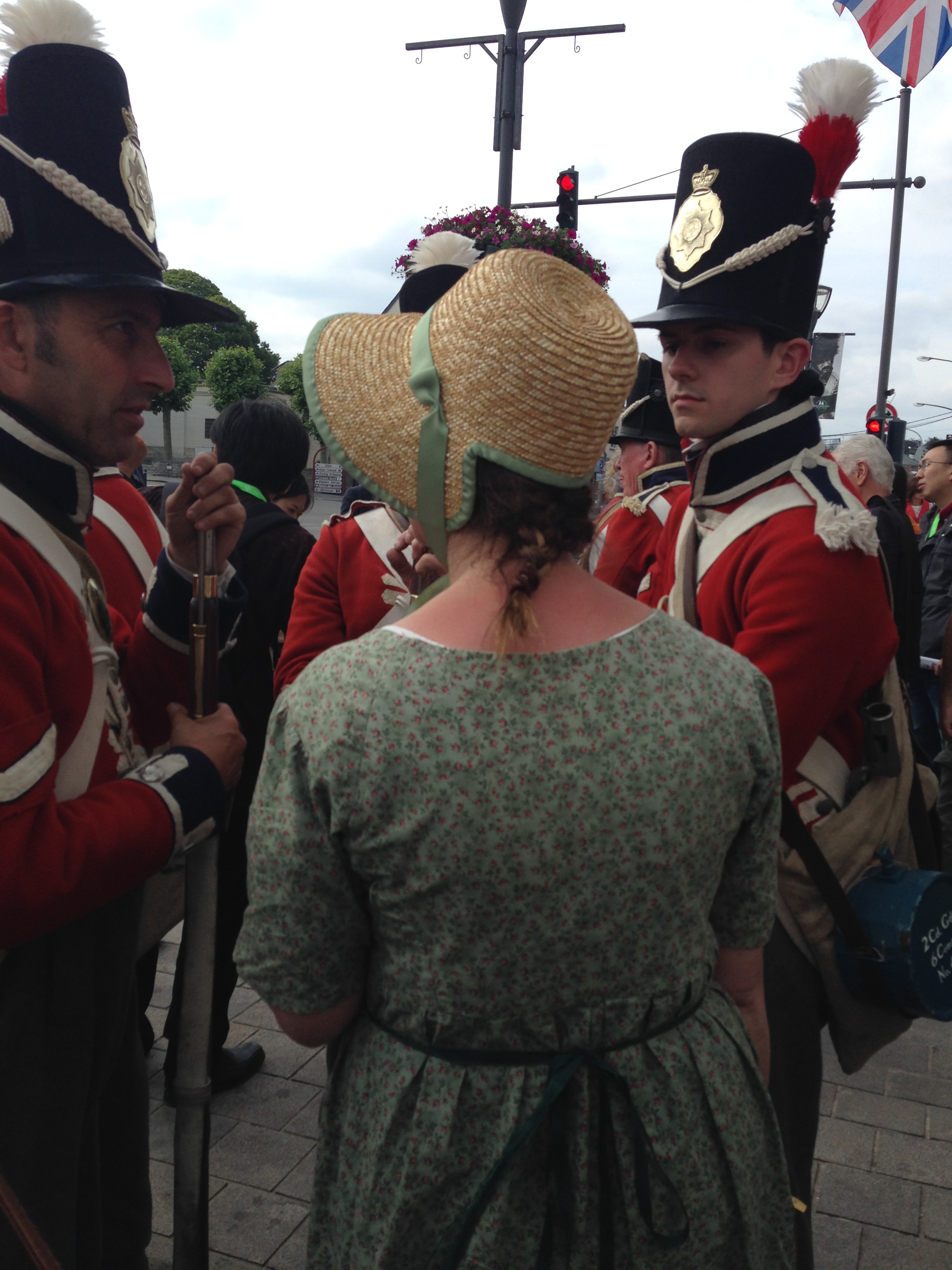
 If you have already read The Lost Love of a Soldier you will know that my fictional character Ellen travels with Paul to Brussels in 1815 as an officer’s wife so I’ve done some research on the army wives who followed their men, travelling with the drum. Yet when I followed their journey to Brussels for the bicentenary celebrations it was great to hear more depth and hear loads of details provided by our very knowledgeable tour guide, Nick Lipscombe.
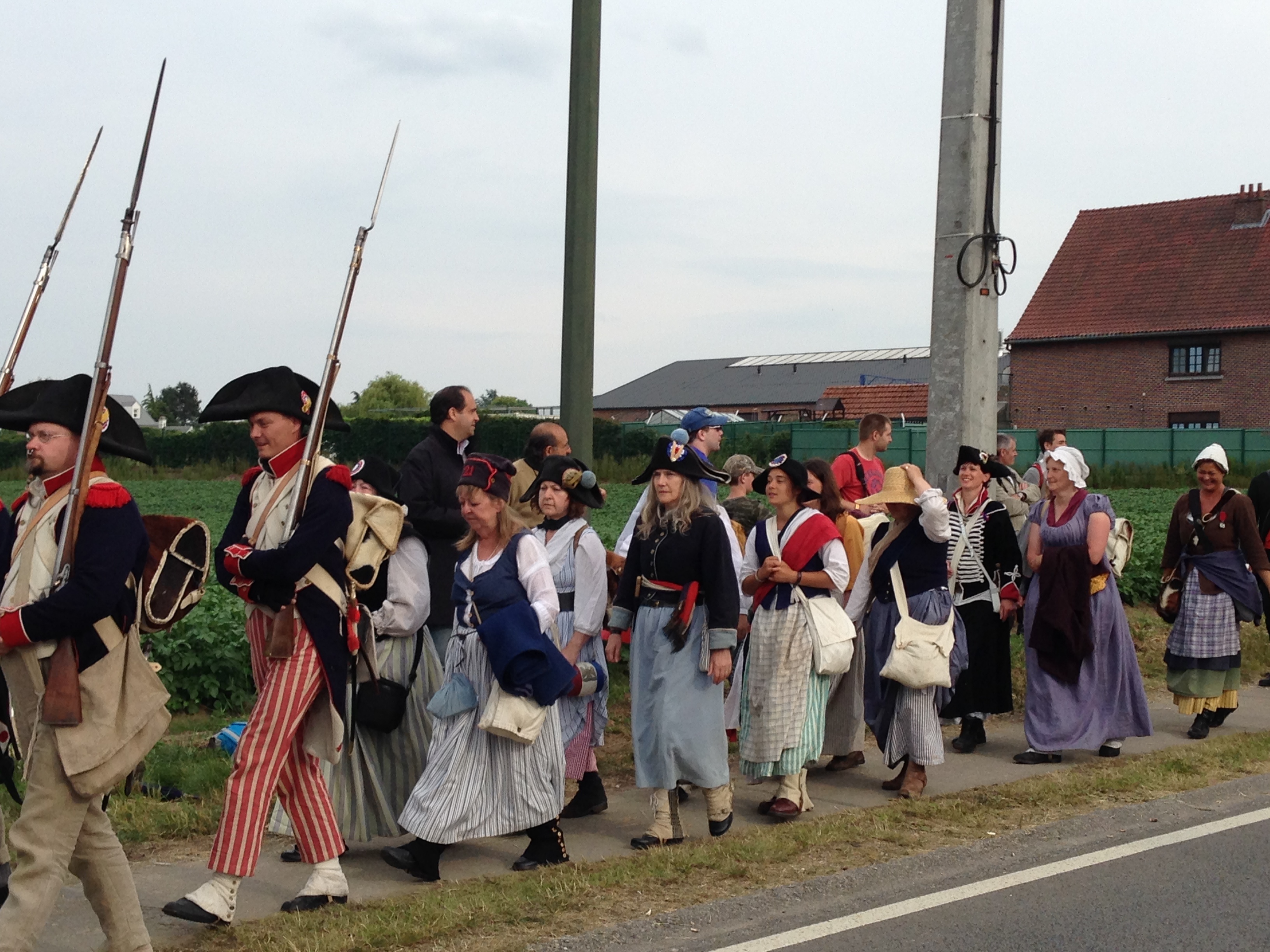
In general a quarter of the soldiers were allowed to take their wives with them (if their wives wished to go). They drew lots to decide who would be the lucky ones. When the army was marching the women of the general soldiers would walk behind the soldiers, not with the baggage train – the cobblers, baggage carts and prostitutes – but directly behind the men. Yet that would have still meant they might be a long way behind. There were 12-1400 men in an English Battalion and 800 in the French, and often Battalions were kept together and moved together. They also moved along the narrow roads and tracks in 99% of cases. It was easier to move the canons and carts containing ammunition along the roads as well as the large number of men and then the baggage train. So the army moved almost in a stream, rarely a river, and definitely never a sea, and the wives were the stragglers classed almost as soldiers, walking ahead of the baggage train.
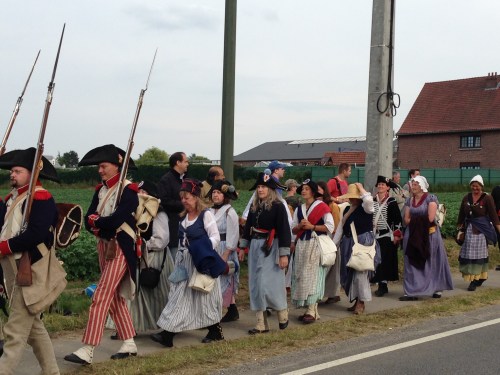
You can imagine then the 100,000 plus men who Wellington brought to Brussels spread out in a huge snake, but think of the disadvantage then if a general or marshal wished to move his men quickly. They might move quickly but there was then a trail of wives and followers to be moved too. The soldier’s wives were used to the life, though, persistent and determined. An eye-witness account mentions the wives at Waterloo, when Wellington was moving back to the battle site, ‘a multitude of army wives stuck to the army like glue, blocking pathways with their donkeys.’
Wellington often proclaimed his frustration with the wives, and said, ‘they extended his tail, got in the way of war, and were a distraction to the men.’
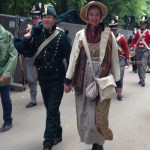 Perhaps you can imagine Wellington’s frustration when you hear this description of an officer of low rank travelling with his wife. ‘The captain rode first on a very fine horse warding off the sun with a parasol, but then came his wife, with a little black and tan dog on her knee, guiding a goat on a lead, then beside her walked a nurse carrying a silk scarf in which an infant was wrapped. Behind them came his man-servant, with his mistress. The man-servant occasionally tapped his mistress’s steed to chase it along. Then came a mule baring a kettle and a cage of canaries, guarded by a liveried servant holding a whip to occasionally make the donkey increase its pace.’
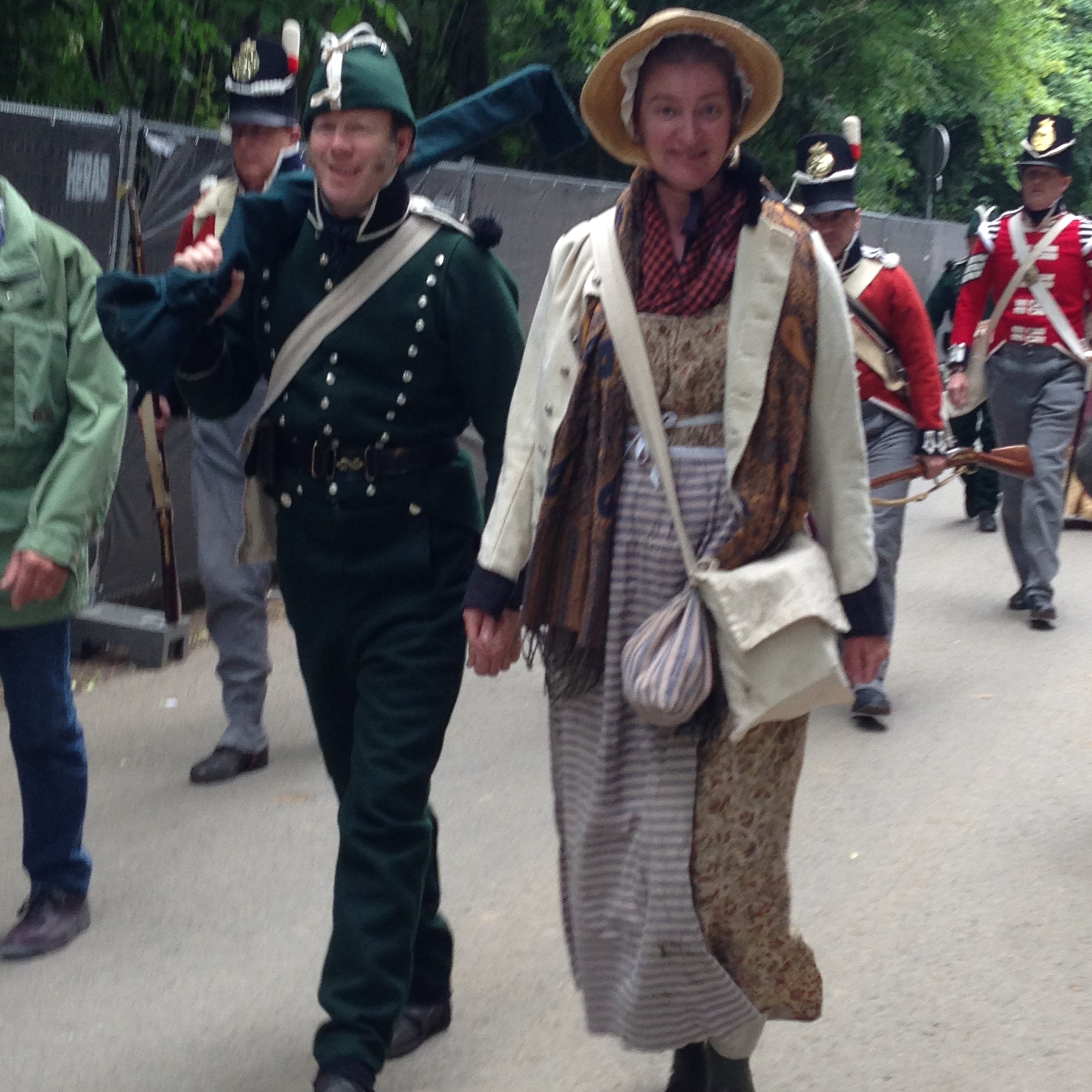
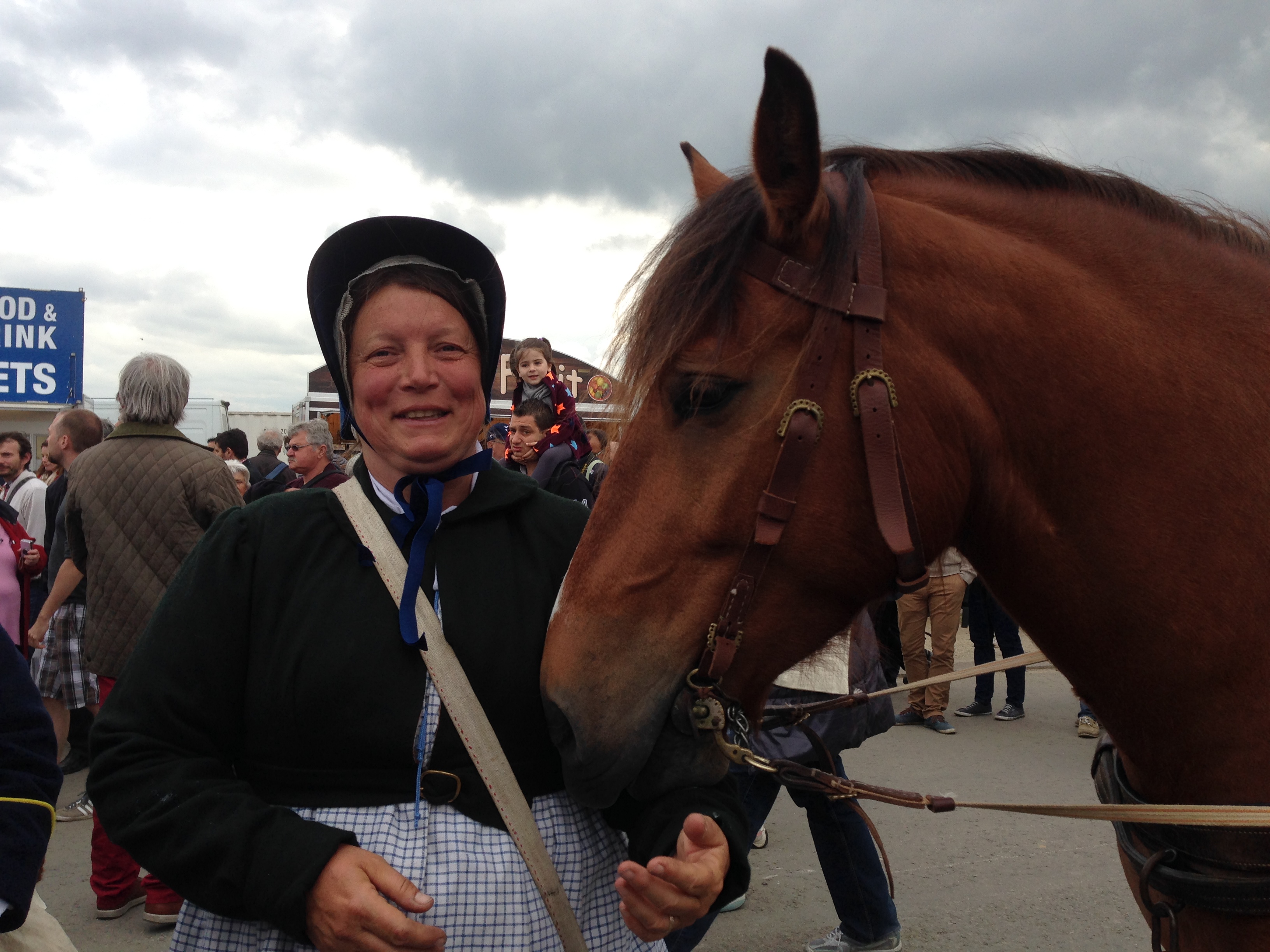
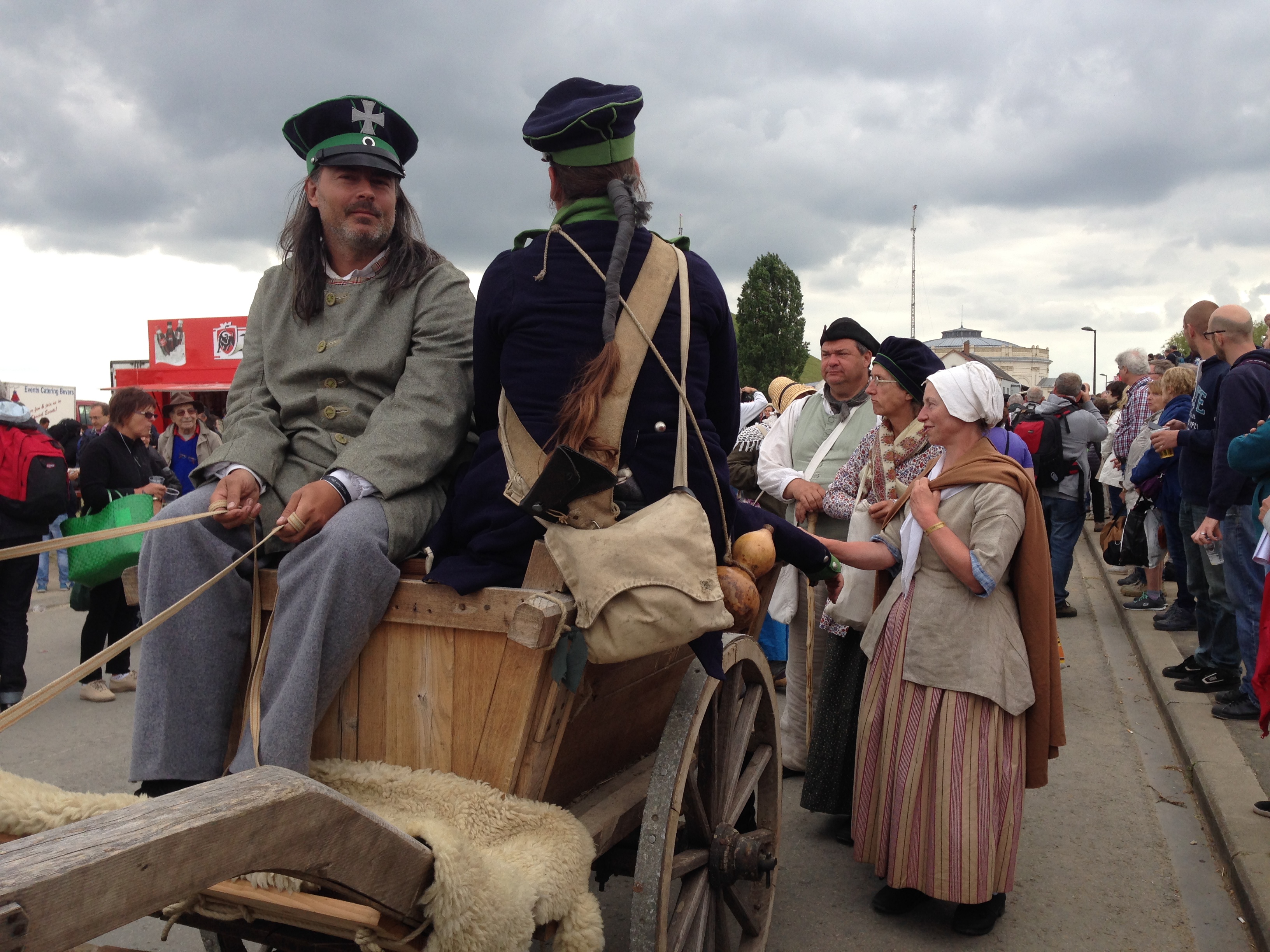
 Not only did it have to be agreed that you might bring your wife to manage the length of the army’s ‘tail’, but there were also restrictions to how much you may take with you. Obviously a soldier had only what he could carry on his back, and it would have been the same for their wives. But a captain was allowed to bring one mule, and a major was allowed a second horse and two or three mules. The mules were also not only for carrying baggage, they were also ridden by the wives.
You might think then, though, why did generals allow their men to bring any wives at all if they slowed and hindered the army. But you have to remember that they also played some very valuable roles. They could wash linen’s and repair uniforms, cook, fetch water and tend the fires as well as the wounded. They even had a role to play during battles, as they brought water onto the field and they did not only do this for their husbands but for their husbands’ company, also acting as mothers to the younger men. The officers’ wives acted in the same way with staff, one wife was recorded as ‘she always made tea for staff, and held small receptions’.
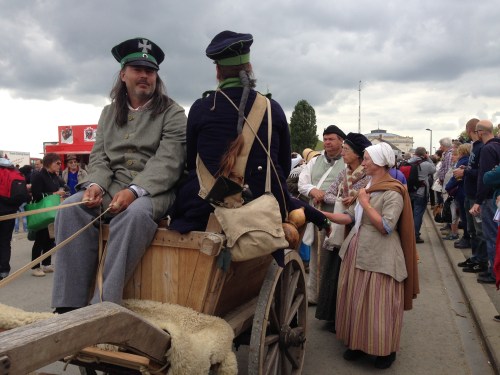
These women were well-respected among the men. One wife earned herself the nickname turtle. Her name was Biddy, and you might think it was an odd nickname, but when you hear that during the Peninsular wars when her husband could walk no further she picked him up and carried him for 200 miles, you will understand the nickname she earned from the men.
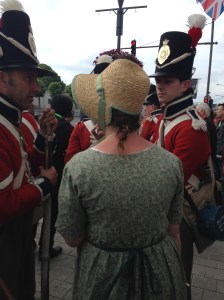 Officers’ wives equally earned respect for their actions. Lady Waldegrave, on one occasion, was nearly taken prisoner during the Peninsular wars. ‘She produced her pocket pistol aimed it at her attacker’s chest and was then allowed to go.’
They also came under fire at times when they collected water from wells or carried sandbags to block up broken walls while the men continued fighting.
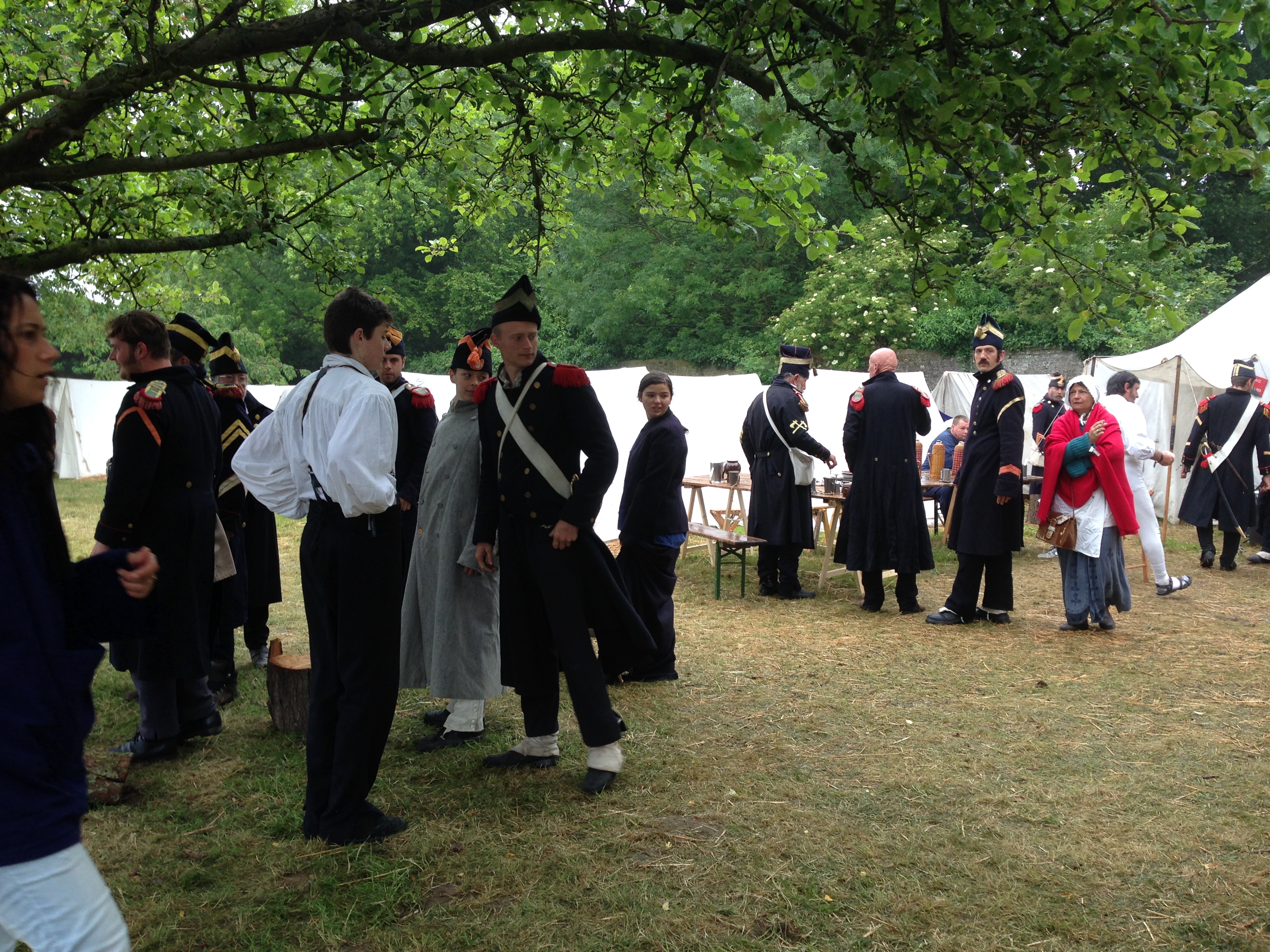
There is a less successful account from an eyewitness of a woman who travelled with the French army, their culture was different to the British army. They travelled more quickly. Napoleon had his armies cross the land at an outstanding pace, and frequently chose to travel at night to enable surprise. This meant it was more difficult for the women to accompany the French army, but it did not mean they did not bring women – officers would bring their mistresses even.
One French Marshal, a very senior officer, brought his mistress dressed in uniform thought to try to hide her. Their plan failed, though, because she wore a medal which was rarely awarded, and so the fact that she looked like a young man-made everyone disbelieve her. There is an eyewitness account though which describes his constant concern for her whereabouts in the line and safety, when he ought to be focusing on moving his men. She falls from her horse four or five times, as they cross difficult uneven terrain through the night. She was bruised but got back up several times, and continued without complaint earning respect from the men. But then her horse fell again and she could no longer walk, the Marshal implored them not to abandon her, and in the end the grenadiers had to carry her. The marshal said later, “What a mistake I made bringing a woman.”
What about the women at Waterloo? What happened to them after the battle? There is one terrible eyewitness account. ‘When the role was called after the battle the females came along the line looking for their men. I heard a concerned shout in a female voice, calling a name. There was no reply,’ The eyewitness who recorded this had in fact seen his comrade shot and fall, but he did not speak, because he did not wish to distress the man’s wife further. ‘Capt Leach called out to the company,’ urging any man who knew to speak, and so our eyewitness then admitted what he knew. ‘I took her to the ground… she was following and sobbing after me.’ He showed her where her husband had fallen and they found his body. When they walked back up to the camp together, he says, ‘she laid herself down on the hearth near us’ He said then that he immediately felt a bond with her, because he’d been the one to share that moment with her, and his words imply that the wives were truly almost recognised as wives of them all.
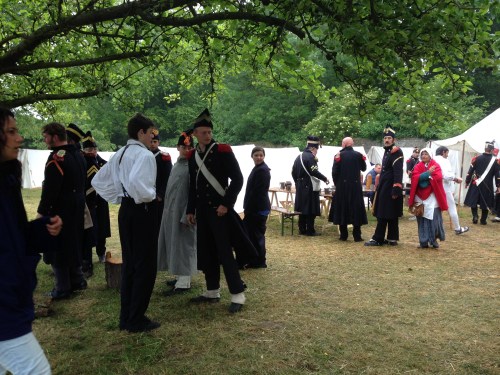
In fact when men died, frequently within a few days, the wives were married to another man. Sometimes they had four of five husbands, as they remained with a company. Think about it, though, they married again or they must somehow pay their own way and try to travel back home or settle near where they are, away from the army.
Everyone knows that the local peasants came onto the fields and stripped the bodies of everything after the Battle of Waterloo, and women played a role in that, although I have not heard of any wives taking part. But the armies’ wives, and some local women, also walked about the terrible scene of those left to die on the fields and did some good. Some men were left dying on the battle field for four days and these women walked about the battle site throughout those days, taking water and bread to the wounded who lay dying, but had not been reached yet and taken to a hospital.
I will explain more about why men remained on the field alive in a later story here.
If you would like to read my fictional story set around the lead up to the Battle of Waterloo, then now is the time to do it, Harper Collins have put on some amazing deals this month to commemorate the battle. In one country the deal only lasts two weeks, though, I have not put the amounts as they are different in different countries, just click on the cover of The Lost Love of a Soldier in the side bar to find out your great cut price deal.
If you would like to see all the pictures and videos of Waterloo 200 which I will share on my Facebook page, click Like on the Jane Lark Facebook link in the right-hand column.


 Author, Jane Lark's stories