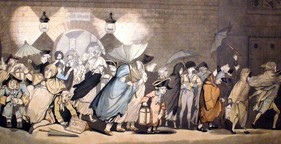
I discovered a real gem to add to my blogs on Bath yesterday – the old Royal Theatre, Orchard Street, Bath – Jane Austen was certainly a visitor there.

Old Royal Theatre, Orchard Street, Bath

When I met a friend for coffee in Bath yesterday I happened to spot a leaflet on the Orchard Street Theatre which is still open for guided tours. I was wonderfully surprised. I have lived near and visited Bath for thirty years and never heard of it before. I knew there had been a previous theatre to the one in use now, which I have been to several times, but I thought it had been destroyed long ago. I have even tried previously to find out where it was. So what a brilliant thing to find it still existed and be able look around it and find out all about its history.

c1694 Map of Bath by Gilimore, available from Bath in Time

I spoke in my blog on The history of life in 18th Century Bath about Queen Anne’s visit to Bath in 1703 to take the waters for her health. There is an old map of Bath by Gilmore from 1694 which shows Bath before the Georgian redevelopment. It must have looked still much like this when Queen Anne visited and the city experienced its embarrassing lack of entertainments.

There was a theatre at the time but it was in a stable by the upper borough walls, where the Mineral Water Hospital stands now, the current hospital for Rheumatic Diseases. Opposite this hospital is the only standing section of the medieval wall.

The Queen had brought with her, in her entourage, the entire Drury Lane Theatre Company and they must have been sorely disgusted by the adapted stable for a stage.

After Queen Anne had  left, Bath was embarrassed enough for its wealthy occupants to raise the funds to build a theatre on this spot.But even so it was poor in comparison to its London counterparts and therefore attracted only equally poor travelling players.

A contemporary writer in ‘The Spectator’ spoke of the entertainments thus, in derision of the costumes;

Alexander the Great was acted in a paper cravat; the Earl of Sussex seemed to have no distress but his poverty; and my Lord Foppington wanted any better means to show himself a fop than by wearing stocking of different colour!

As well as this Theatre of course, as I have mentioned in my blog on the Assembly Rooms in Bath ,after Queen Anne’s visit the assembly rooms began to be established to provide entertainment for visitors to Bath and in general Bath was a growing improving and developing city.

It was at this point Beau Nash who I have been blogging about for the last few weeks began his reign.

North Parade including the Lower Assembly Rooms, 1779, available from Bath in Time

Of course the assembly rooms recognised the inadequacy of the Theatre and took advantage establishing unofficial stage plays as part of their entertainments and one of these, the Harrison’s Rooms, had by the late 1730’s built a theatre to seat 200 in its basement.

The Harrison’s Rooms, later known as the “Lower Rooms”, in comparison to the “Upper Rooms” which are still open, used to stand in the position of what is now the island in the middle of the traffic area where the tourist buses depart from.

However this basement Theatre was still no comparison to the London Theatres but its rivals, including the old stable, were closed in 1736, when an Act of Parliament was made to close unlicensed playhouses.

John Hippisley in “The Cheats of Scapin” by J H Green – The art Archive Garrick Club, London

It was finally in 1747 that  Bath was challenged to do better.

A Bristol actor, John Hippisley, raised the point that Bath needed a better theatre by addressing the ‘Nobility and Gentry of Bath’, he stated;

Plays are like mirror made, for men to see, How bad they are, how good they ought to be. Theatrical Performances, when conducted with Decency and Regularity, have been always esteem’d the most rational Amusements, by the Polite and Thinking Part of Mankind: Strangers therefore, must be greatly surpris’d to find at Bath, Entertainments of this Sort in no better Perfection than they are, as it is a Place, during its Seasons, honour’d with so great a Number of Persons, eminent for Politeness, Judgement and Taste: and where might reasonably be expected (next to London) the best Theatre in England.

Bath responded to the challenge and raised the funds for a brand new, purpose built theatre to be positioned outside of the old medieval walls near the South Gate. Nine investors contributed fifty pounds. Beau Nash, and John Wood the elder, who I have also mentioned in previous blogs on Prior Park and its Grotto and Graffiti, were included in the investors along with Hippisley and other actors.

John Wood was responsible for much of the building and the development of Bath. He chose the site. But the syndicate still had to raise further funds to complete the build and when Hippisley died before its completion a Bath brewer and candle maker took charge of the project, John Palmer. To raise the additional investment he tempted other investors with a prospectus of what they had to gain including the offer of a ‘Silver Ticket, which shall admit the Bearer into any Part of the House, every Night of Performing, except on Benefit nights.

He increased the share holders to twenty and the Orchard Street Theatre opened on the 27th October, 1750, to a prologue spoken by a good friend of John Hippisley, Mr Watts.

‘As some you Shoot, which by the Plante’s Hand, is gently mov’d into a kinder Land; If the warm Sunshine spread itsgenial Rays, Soon a fair Tree is verdant Leaves displays, And rears with Blossoms its luxuriant Head, Whilst all the Warblers’wanton in the Shade . ‘Tis Steadiness alone can fix the Root, And rip’ning Autumn gives the Golden Fruit But if nipping Blast, or dead’ning Frost Too Fierce advance, the hopeful product’s lost. So will it be with Us, whose Art and Care Have raised this Structure, to what we call fair; with ev’ry varied Art have strove to charm, If painting pleaser, or Harmony can warm. Shine forth auspicious, Endeavours crown, And Fire Us, by Success, to gain Renown.

Coming out of Country Theatre by Frederick George Byron – Said to be based on the Orchard Street Theatre, Bath

Of course the New Theatre was now in direct competition with the old one in the Lower Assembly rooms and they competed quite hotly with many arguments as they fought for actors and staff over a period of five years, but then Beau Nash in his way of orchestrating Bath for his own profit stepped in and informed the Lower Assembly rooms that their theatre, which he had no investment in, must close.

In my next blog I’ll tell you more about the new theatre and share some more pictures, stories and facts, both about the building itself, life within the theatre and those who visited it. There is still loads to tell, including details of Jane Austen’s connection, too much for one blog probably.


Jane Lark is a writer of authentic, passionate and emotional love stories.

See the side bar for details of Jane’s books, and Jane’s website www.janelark.co.uk to learn more about Jane. Or click  ‘like’ on Jane’s Facebook  page to see photo’s and learn historical facts from the Georgian, Regency and Victorian eras, which Jane publishes there. You can also follow Jane on twitter at @janelark
The history of life in 18th Century Bath

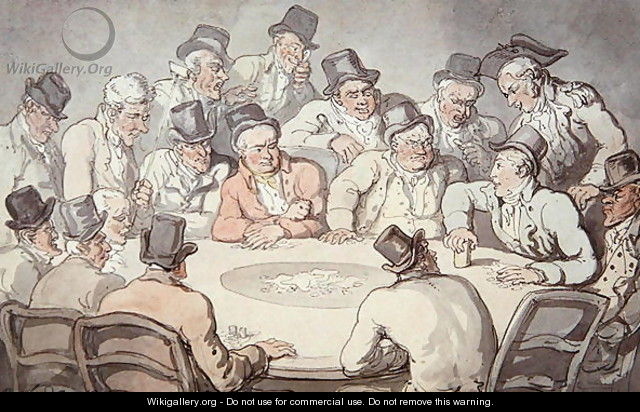
Thomas Rowlandson The Gaming Table

When Queen Anne visited Bath in 1703 to take the waters for her health, as described by Oliver Goldsmith in 1762, she was entertained ‘with a fiddle and a hautboy, and with country dances on the bowling-green. The lodgings were dingy and expensive, the pump-house had no director.’ Even the properties of the water were under challenge by a choleric physician who threatened to ‘throw a toad into King Bladud’s Well,‘  by writing a pamphlet against the medicinal merits of the waters.

At the time Queen Anne visited Bath, London was the only real social centre in England and peers thronged there in the winter to socialize, see and be seen.

‘Beau’ Nash was among those who enjoyed the entertainments of London ‘this great mart of every folly’.

The son of a gentleman, ‘Beau’ Nash had been thrown out of Oxford College for intrigue with woman, tried an army life and decided it was not for him and then became a gamester.

Men who lived on their income from gambling  ‘sharpers’ flocked to London ‘from every country daily’ to take advantage of the wealthy peerage in the winter season, but in the summer they left England for the spa towns of the continent to fleece the wealthy there while English society dispersed in the country.

Nash was a charmer, he certainly knew how to win friends and influence people in London, as a young man he had already risen to a point where he once acted master of ceremonies to entertain King William and did it so successfully the King offered him a knighthood, which Nash rejected but hinted he’d accept if the title came with a fortune.

The king did not take the hint.

But obviously a man with an eye for opportunity, following Queen Anne’s visit to Bath, ‘Beau’ Nash headed there.

As Goldsmith puts it, society in England lacked ‘someplace where they might each have each other’s company, and win each other’s money as they had done during the winter in town.’

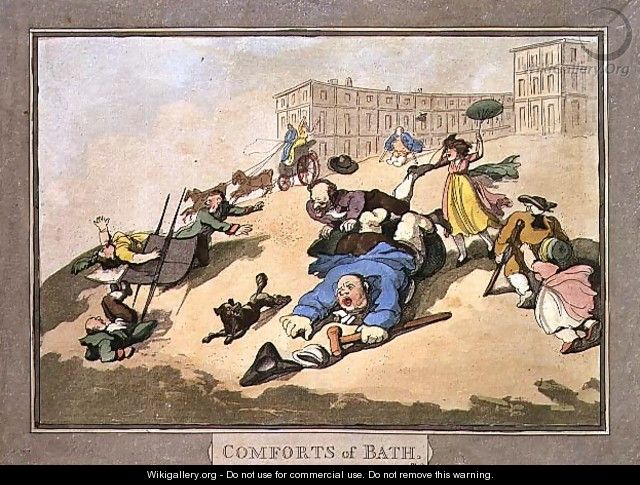
Thomas Rowlandson 1798 The Bath Races – from the Comforts of Bath

At the time of Queen Anne’s visit, Bath was only attended by people seeking cures for ill-health, however once Queen Anne had attended a small social scene began to develop.

A Captain Webster, another gamester, had begun establishing balls in the town hall asking half-a-guinea from those who attended, but the entertainments and its society were considered crude. Smoking was permitted in the rooms, gentlemen and ladies appeared at entertainments in informal dress, the lodgings were paltry and plain; Goldsmith comments on beer and feet stained floorboards. ‘The city in itself was mean and contemptible’.

It was now Nash saw the opportunity of establishing a spa town like those of Aix and the Hague, in Bath. ‘He humorously assured the people, that if they would give him leave, he would charm away the poison of the Doctor’s toad, as they usually charmed the venom of the Tarantula, by music. He therefore was immediately empowered to set up the force of a band of music, against the poison of the Doctor’s reptile.’

Initially he worked alongside Captain Webster, but when Webster was killed in a duel Nash became the Master of Ceremonies. Like a circus ring leader he orchestrated life there; a king ruling over his kingdom. And thus the life we know Bath most for began.

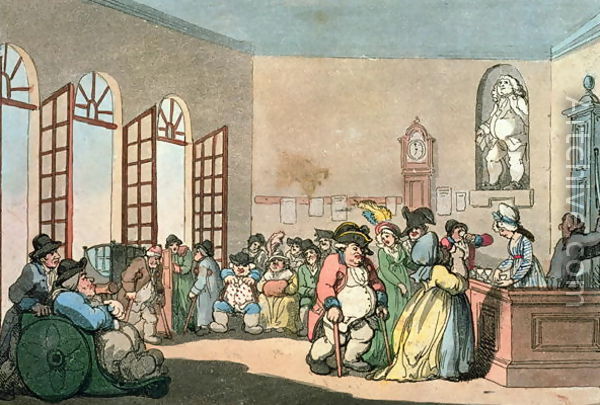
Thomas Rowlandson The Pump Room

His entertainments started with assemblies in the town hall, and a six piece orchestra in the pump room and led on to a whole new rule of life for people in Bath. Days and evenings were mapped out as Nash wished them. He put these rules up in the pump room;

RULES to be observed at BATH. 

1. THAT a visit of ceremony at first coming and another at going away, are all that

are expected or desired, by ladies of quality and fashion,– except impertinents.

2. That ladies coming to the ball appoint a time for their footmen coming to wait on

them home, to prevent disturbance and inconveniencies to themselves and others

3. That gentlemen of fashion never appearing in a morning before the ladies in gowns

and caps, show breeding and respect.

4. That no person take it ill that any one goes to another’s play, or breakfast, and not

theirs,– except captious by nature.

5. That no gentleman give his ticket for the balls, to any but gentlewomen.– N.B.

Unless he has none of his acquaintance.

6. That gentlemen crowding before the ladies at the ball, show ill manners, and that

none do so for the future,– except such as respect nobody but themselves.

7. That no gentleman or lady takes it ill that another dances before them;– except

such as have no pretence to dance at all.

8. That the elder ladies and children be content with a second bench at the ball, as

being past or not come to perfection.

9. That the younger ladies take notice how many eyes observe them. N.B. This does

not extend to the Have-at-alls.

10. That all whisperers of lies and scandal, be taken for their authors.

11. That all repeaters of such lies, and scandal, be shunned by all company,– except

such as have been guilty of the same crime.

N.B. Several men of no character, old women and young ones, of questioned

reputation, are great authors of lies in these places, being of the sect of levellers.

Goldsmith says ‘These laws were written by Mr Nash himself, and, by the manner in which  they are drawn up, he undoubtedly designed them for wit. The reader, however, it is feared, will think then dull. Poor Nash was not born a writer, for whatever humour he might have in conversation, he used to call a pen his torpedo, whenever he grasped it, it numbed all his faculties.’

By 1706 new terraces of houses had been built and pavements laid for promenading, and the streets had been paved and lit, then as people were still ‘obliged to assemble in a booth to drink tea and chocolate, or to game’ Nash directed the erection of an Assembly-house and added gardens ‘for people of rank and fashion to walk in’.

Nash ruled this life so thoroughly and so charmingly he even managed to order the highest ranking peers. Goldsmith describes a number of events where his rules were challenged and he still won out. ‘Even the royal family themselves had not influence enough to make him deviate from any of these rules. The princesss Amelia once applying to him for one dance more, after he had given the signal to withdraw, he assured her royal highness, that the established rules of Bath resembled the laws of Lycurgus, which would admit of no alteration, without an utter subversion of all his authority.’

 Likewise ‘He had the strongest aversion to a white apron, (a garment ladies wore over their dresses) and absolutely excluded all who ventured to come to the assembly dressed in that manner. I have known him on a ball night strip even the duchess of Q—, and throw her apron at one of the hinder benches among the ladies’ women; observing, that none but Abigails appeared in white aprons. This from another would be insult, in him it was considered as a just reprimand, and the good natured duchess acquiesced in his censure, and with great good sense, and good humour, begged his Majesty’s pardon.’

He equally told men what they may and may not do, banning smoking in rooms, and the wearing of swords which frequently tore ladies clothing. And banning duels; if he caught anyone making a challenge he would have them arrested.

His biggest battle of note though was to get gentlemen to cease wearing their boots to balls.

Country squires denied his authority, but in the end ridicule won out. He wrote a song;

FRONTINELLA’S invitation to the Assembly.

Come, one and all, to Hoyden Hall,

For there’s the assembly this night,

None but prude fools,

Mind manners and rules,

We Hoydens do decency slight.

Come Trollops and Slatterns,

Cocked hats and white aprons,

This best our modesty suits,

For why should not we,

In dress be as free,

As Hogs-Norton squires in boots?


Nobility in Bath relished this jest and it humiliated boot wearers, but Nash did not stop there, he continued his advantage by setting up a puppet-show, ‘in which Punch came in booted and spurred, in the character of a country squire. He was introduced as courting his mistress, and having obtained her consent to comply with his wishes, upon going to bed, he is desired to pull off his boots. My boots, replies Punch, why, madam, you may as well bid me pull off my legs, I never go without boots, I never ride, I never dance without them, and this piece of politeness is quite the thing at Bath. We always dance at our town in boots, and the ladies often move minuets in riding-hoods. Thus he goes on, till his mistress, grown impatient, kicks him off the stage. From that time few ventured to appear at the assemblies in Bath in a riding-dress; and whenever any gentleman, through ignorance, or haste, appeared in the rooms in boots, Nash would make up to him, and, bowing in an arch manner, would tell him, that he had forgot his horse. Thus he was at last completely victorious.’

Next week I’ll look at a day in the life of 18th Century Bath during ‘Beau’ Nash’s reign.


Jane Lark is a writer of authentic, passionate and emotional love stories.

See the side bar for details of Jane’s books, and Jane’s website www.janelark.co.uk to learn more about Jane. Or click  ‘like’ on Jane’s Facebook  page to see photo’s and learn historical facts from the Georgian, Regency and Victorian eras, which Jane publishes there. You can also follow Jane on twitter at @janelark