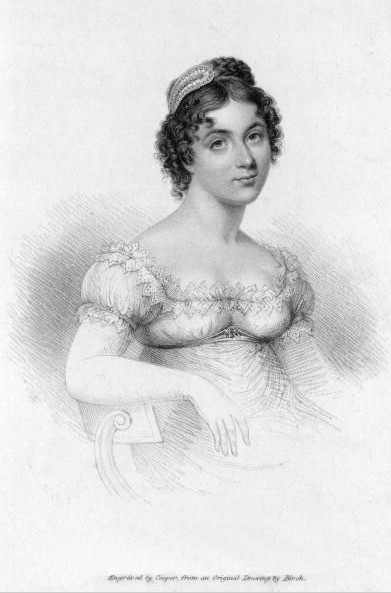
 This is my last post on the stories Harriette Wilson wrote in her memoirs, telling us about her life as a courtesan in 19th Century, England, but I will return next week with some of the stories about her life which she did not put in. But I’m sorry to say, Harriette ends her memoirs on a sad note. Perhaps because the last thing she wanted to say, was to preserve the memory of the sister she was closest too. In fact probably the person she was closest too – the person she esteemed the most – and the person she considered her closest friend all her life, Fanny––until…
Before I tell the story, though, here, for the last time, is the history to this series of posts if you are joining us today, and as always, I have marked where to start reading on from in bold type if you have read the introduction already. (For anyone who has only just discovered these, all the posts are listed in the index)
In 1825 Harriette Wilson, a courtesan, published a series of stories as her memoirs in a British broad sheet paper. The Regency gentleman’s clubs were a buzz, waiting to see the next names mentioned each week. While barriers had to be set up outside the shop of her publisher, Stockdale, to hold back the disapproving mob.
Harriette was born Harriette Debochet, she chose the name Harriette Wilson as her professional name, in the same way Emma Hart, who I’ve blogged about previously, had changed her name. Unlike Emma, it isn’t known why or when Harriette changed her name.
She was one of nine surviving children. Her father was a watchmaker and her mother a stocking repairer, and both were believed to be from illegitimate origin.
Three of Harriette’s sisters also became courtesans. Amy, Fanny and Sophia (who I have written about before). So the tales I am about to begin in my blogs will include some elements from their lives too.
For a start you’ll need to understand the world of the 19th Century Courtesan. It was all about show and not just about sex. The idle rich of the upper class aspired to spending time in the company of courtesans, it was fashionable, the thing to do.
You were envied if you were linked to one of the most popular courtesans or you discovered a new unknown beauty to be admired by others.
Courtesans were also part of the competitive nature of the regency period too, gambling was a large element of the life of the idle rich and courtesans were won and lost and bartered and fought for.
So courtesans obviously aspired to be one of the most popular, and to achieve it they learnt how to play music, read widely, so they could debate, and tried to shine in personality too. They wanted to be a favoured ’original’.
The eccentric and outspoken was admired by gentlemen who liked to consort with boxers and jockeys, and coachmen, so courtesans did not aim for placid but were quite happy to insult and mock men who courted them, and demand money for any small favour.
One day, while I was dressing to drive out in my carriage, my servant informed me that Fanny had just called on me, and was in the drawing-room. I was surprised that she did not come up to my bedroom, that being the constant habit whenever I happened to be at my toilette. I hurried on my pelisse, and went down to join her.
She was sitting near the window, with her head reclined on her hand, and appeared more than usually pensive.
‘My dear Fanny,’ said I, ‘what is the matter? Why did not you come upstairs?’
‘I feel a weight here,’ said she, laying her hand on her heart. ‘It is not a weight of spirits only; but there is something not right here. I am sick and faint.’
‘A drive in Hyde Park will do you good,’ said I, and we were soon seated in the carriage. Turning down Baker Street we saw Colonel Parker. Fanny was greatly agitated. He did not seem to have observed us.
‘I dare say he is only just come to town, and means to call and see his child,’ said I, hoping to enliven her. We then drove twice up the park, and Fanny made an effort to answer the beaux who flocked around the carriage, with cheerfulness. Suddenly she complained to me again of sickness, occasioned by some pressure or tightening about the heart.
‘I am sorry to take you from this gay scene,’ said poor Fanny, ‘but I am too unwell to remain.’ I immediately pulled the check-string, and desired my coachman to drive to Hertford Street, Mayfair, where Fanny was then residing. After remaining with her half an hour she begged me to leave her, while she endeavoured to obtain a little sleep. She made light of the sickness, and told me to call and take her into the park on the following day. I did so, and just as I was stepping out of my carriage in Hertford Street for that purpose, Lord Hertford came running downstairs to join me, from Fanny’s apartment.
‘Don’t get out Harriette,’ said he, ‘ as you will only lose time; but go directly for a surgeon. I was going myself. Fanny is very ill, and her physician has prescribed bleeding, without loss of time.’
In the most extreme agitation I hurried after the surgeon and brought him with me in my carriage. Fanny was now affected with such a violent palpitation of the heart that its pulsations might be distinctly seen at the opposite side of the room through her handkerchief.
‘I am very ill, Harriette,’ said the dear sufferer, with encouraging firmness holding out her hand to me; ‘but don’t frighten yourself. I shall soon get better: indeed I shall. Bleeding will do me good directly,’ continued she, observing, with affectionate anxiety, the fast gathering tears in my eyes.
I called Lord Hertford aside, and addressed him: ‘Tell me, I earnestly implore you, most candidly and truly, do you think Fanny will recover?’
‘I do not think she ever will,’ answered Hertford.
‘Nonsense!’ said I, forcing my mind by an effort to disagree with him. ‘Fanny was so perfectly well the day before yesterday, so fresh, and her lips so red and beautiful; and then many people are afflicted with these palpitations of the heart, and recover perfectly.’
‘If her pulse beat with her heart, I should have hopes; but her pulse is calm, and I have none. Disorders of the heart, are incurrable.’
Instead of wishing to display feeling, Lord Hertford seemed ashamed, and afraid of feeling too much.
For another fortnight, Fanny’s sufferings were dreadfully severe, and, being quite aware of her danger , she requested that her body might be examined after her death for the benefit of others. My readers will, I hope, do me the justice to acquit me of affectation, when I say that this subject still affects me so deeply, I cannot dwell upon it. All the world were anxiously, and almost hourly, inquiring if there were hope: Sir William Knighton and Sir John Millman, her medical attendants, gave us none, or very slight hopes, even from the first hour.
Fanny never slept, nor enjoyed a single interval of repose. Her courage and patient firmness exceeded all I had imagined possible, even in a man. Once and once only, she spoke of Colonel Parker; for it was the study of every moment of her life to avoid giving us pain. Fanny called me to her bedside: it was midnight.
‘Harriette, remember, for my sake, not to be very angry with poor Parker. It is true, you have written to say I am ill, and he refuses to come and shake hands with me; but then believe me, he does not think me so ill as I really am, or he would come. Oblige me by forgiving him! Now talk to me of something else: no more of this, pray!’
I pressed her hand and immediately changed the subject. She begged, when we told her of Lord Hertford having had straw put down by her door, and for all his constant, steady attentions, that, when he came next, she might see him, and thank him. In consequence of this request, he was admitted on the following morning. Fanny was not able to talk much; but she seemed gratified and happy to see him. When His Lordship was about to depart, she held out her hand to him. Hertford said, in a tone of much real feeling, ‘God bless you, poor thing,’ and then left the room.’
After fanny had been ill for three weeks, she asked to be moved to somewhere with more light, and so she was carried to new apartments.
‘Reclined at length on a couch in her new apartments, Fanny’s spirits appeared so much improved as to encourage hopes which had become extinct.
‘Do you not breathe with rather less pain?’ I asked, while I pressed her cold damp hand between my own.
‘At all events,’ answered poor Fanny, ‘I would rather die here, than in the close apartment I have just quitted. How sweet and refreshing the flowers smelt, as I was carried along the garden! I did not see them, for I could not endure the light. I wish I could,’ continued Fanny, fixing her clear, still lovely blue eyes on my face beseechingly…
‘Do dearest, Fanny,’ said I, making a violent effort to conceal my tears, lest they should agitate my suffering sister, ‘let me open one of the shutters a very little. The air is mild and delicious, and the heat no longer oppressive, as it was when you passed through the garden.’
The last ray of the setting sun fell on poor Fanny’s pale, beautiful features, as I drew back the curtains. It was one of those lovely evenings in the month of June, which often succeeded a thunderstorm, and the honeysuckles, which clustered round the windows, emitted a rich and fragrant perfume.
I asked her if the fresh air did not enliven her a little.
She requested to have her head raised, and I rested it on my bosom.
‘Alas!’ said poor Fanny, ‘glorious as the sun is setting, I may now behold it for the last time!’
…I suddenly imprinted a kiss on my sister’s dying lips.
The last tear poor Fanny ever shed trembled in her eyes. Forcing a smile, I now endeavoured to address her with cheerfulness, and administered her last draught of goat’s milk, which she held firmly in her hand without requiring my assistance.
‘I did not believe I should shed another tear,’ said Fanny, brushing away the drops which were stealing slowly down her fair, wan cheeks. ‘Pray for me, Harriette! Pray that my sufferings may soon cease.’
‘I do pray for you, my poor sister, and God knows how earnestly. Be assured dearest, that your sufferings will very soon cease. You will recover, or you will be at rest for ever. Remember my love, that we have all committed many faults, and you may be called upon to suffer yet a few more hours, as your only punishment, before you are permitted to rest eternally with your God. Yet a little fortitude, my dearest Fanny. It is all that will be required of you.’
Fanny seemed deeply impressed with what I had said. Her agony was at that moment dreadfully severe. She crossed her hands on her breast, and there was something sublime in the stern expression her features assumed, while she suppressed the cries which nature would almost have wrung from her…
…’I am better,’ said Fanny, half an hour after having made this strong effort.
‘Thank God!’ I ejaculated, taking hold of her hand.
‘What o’clock is it?’ she inquired.
‘Near seven.’
‘I am very sleepy. I could sleep if you would promise to continue holding my hand, and would not leave me.’
I placed myself close to my sister, with her cold damp hand clasped between both mine.
‘I am near you always dearest,’ said I. ‘Sleeping or waking, I shall never leave you more.’ Fanny threw her arms once more round my neck, and with a convulsive last effort pressed me to her heart.
‘May the Almighty forever bless you!’ said she, and, sinking back on her pillow a gentle sleep stole her senses. I watched her lovely countenance with breathless anxiety.
In less than an hour poor Fanny opened her eyes and fixed them on me with a bright smile, expressive of her purest happiness.
‘I am quite well,’ said Fanny, in a tone of great animation.
Again her eyes closed and her breathing became shorter.
Suddenly, a slight convulsion of the upper lip induced me to place my trembling hand on my sister’s heart.
I felt it beat!
Joy flushed my face with a momentary hectic––
And then, hope fled for ever!
Fanny’s cheek, still warm and lovely, rested on her arm. The expression of pain and agony was exchanged for calm, still, innocent smile of a sleeping infant.
I had felt the last faint vibrations of poor Fanny’s heart…’
😥
‘Fanny was my only friend on earth. I had no sister but her. She was my hope, and my consoler in affliction, ever eloquent in my defence, and would not have forsaken me to have become the wife of an emperor, but God willed Fanny’s death.’
‘I saw her laid low in her kindred vaults,
And her immortal part with angels lives.’
Goodbye Harriette and Fanny!
~
Next week some of the truth she did not tell
~
Jane Lark is a writer of authentic, passionate and emotional Historical and New Adult Romances, and the author of a No.1 bestselling Historical Romance novel in America, ‘The Illicit Love of a Courtesan’ and ‘I Found You’ a bestselling novel in the contemporary chart.
Jane’s novels, The Passionate Love of Rake and I Found You, will be available in Paperback on 17th April and The Scandalous Love of a Duke will be available in paperback in June, all are available to pre-order.
Why not also read A Lord’s Desperate Love the story of two of the characters from The Passionate Love of a rake which Jane is telling for free here, there is a link to each part in the index of posts.
Click here to find out more about Jane’s books, and see Jane’s website www.janelark.co.uk to learn more about Jane. Or click ‘like’ on Jane’s Facebook page to see photo’s and learn historical facts from the Georgian, Regency and Victorian eras, which Jane publishes there. You can also follow Jane on twitter at @janelark

 Author, Jane Lark's stories