So More about Jane Austen’s visit to Stoneleigh Abbey and how it influenced her characters

If you are picking this up through ‘twitter’ or ‘Linkedin ‘ to follow this blog by email go to janelark.wordpress.com

When Jane Austen arrived at Stoneliegh with her mother and Cousins Rev. Thomas Leigh and his sister Elizabeth Leigh she must have been full of awe and excitement. They had travelled 30 miles in a rush to reach Stoneleigh as soon as possible to deter any challenge to the estate Rev. Thomas Leigh had inherited and Jane knew her cousin Thomas well so she must have been caught up in his emotion.

When they arrived and faced such a lavish statement of wealth,

Stoneleigh Abbey

Jane’s eyes must have been wide and her heart thumping. Remember she had come from an apartment in the narrow cobbled Trim St, in Bath.

Trim Street in Bath

The area about the house looked very different then. There was a narrow path and lawn and then a farm directly before its entrance as the walled gardens were still in front of the Elizabethan manor behind the silver baroque wing and the river Avon ran further away from the house. Yet a wilderness walk stretched off towards the river.

Jane’s mother wrote of it

I expected to find everything about the place very fine and all that, but I had no idea of its being so beautiful. I had figured to myself long avenues dark rookeries and dismal yew trees, but here are no such melancholy things.

The Avon runs near the house amidst green meadows bounded by large and beautiful woods, full of delightful walks.’

In comparison to the rectories Jane had grown up in and Thomas had lived in during his career Stoneleigh must have seemed a place of pure dreams. When they stepped down from the carriage and Thomas dismounted from his horse you might imagine her hand shaking with the excitement of it. Jane knew her family history and we know she cared about history. She had written about it in her childhood after all. Now she finally faced the house where her ancestors had resided – and her dear cousin was to own it. We know what they experienced on their arrival because both Jane and her mother wrote letters about it including their thoughts and feelings.

The staircase Jane Austen entered via on her arrival

The Steward greeted them at the front stairs and led them into the hall where Thomas apologised because he had to disappear and get the papers signed to claim his inheritance. He told them then to ask the servants for anything they needed and said they may wonder where they wished. Can you imagine how that must have felt in comparison to the dingy distressing life they’d left behind in Bath. For months Jane and her mother had endured poverty and emotional pain counting pennies and eating poorly and now they were faced with the antithesis.

Jane must have been gazing at it all and taking it in and as a writer I am certain she must have been looking about and thinking what wonderful inspiration for books capturing every detail and

The Entrance Hall Stoneleigh Abbey

wondering how it might influence scenes and plots. And she was to have character inspiration almost immediately when Lady Saye & Sele arrived from Broughton Castle near Banbury (another place I’ve visited which is still owned by Lord and Lady Saye & Sele) with her daughter and son-in-law to claim the inheritance in Rev. Thomas Leigh’s stead.

Lady Saye & Sele’s son-in-law was another of Jane’s cousins and that Lady was a domineering pushy aristocrat who thought the money and the property should come to her far more prestigious and deserving family than to a mere Reverend. But Thomas had been selected to inherit from all the cousins of the deceased Mary Leigh as he was the eldest. He refused to concede to Lady Saye & Sele’s arguments.

Now which character do you think may have been if not inspired at least remodelled on Jane’s experiences and observations that day? Of course Lady Catherine de Bourgh from Pride and Prejudice. Perhaps even Rev. Collins’s excitement over the qualities of Rosings were drawn from her own cousin’s first views of Stoneleigh.

The beginning of the wilderness on the left of the West Wing

In Pride and Prejudice when Lady Catherine de Bourgh arrives to warn Jane off Darcy she says ‘Miss Bennet, there seemed to be a prettyish kind of a little wilderness on one side of the lawn. I should be glad to take a turn in it.’  The wilderness at Stoneleigh was on the right side of the West Wing which faced a lawn strectching towards the river and we know during Jane’s stay both Jane and her mother enjoyed frequent walks through it. Jane’s mother says in a letter, ‘We walk a great deal, for the woods are impenetrable to the sun even in the middle of an August day.Perhaps Lady Saye & Sele commented on it during her visit.

If you doubt Jane’s inspiration in Lady Saye & Sele Jane’s mother gives us an insight into Jane’s personality and their thoughts on their aristocratic companion.

Poor Lady Saye & Sele to be sure is rather tormenting, tho’ sometimes amusing, and affords Jane many a good laugh—but she fatigues me sadly on the whole.’

More stories of Stoneleigh next week.

Jane Lark is a writer of authentic, passionate and emotional love stories.

See the side bar for details of Jane’s books, and Jane’s website www.janelark.co.uk to learn more about Jane. Or click  ‘like’ on Jane’s Facebook  page to see photo’s and learn historical facts from the Georgian, Regency and Victorian eras, which Jane publishes there. You can also follow Jane on twitter at @janelark

This slideshow requires JavaScript.

Old Orchard Street Theatre Royal, Bath, its actors and actresses, including Sarah Siddons, and its links to Jane Austen

Plaque outside the Old Theatre Royal, Orchard St, Bath, today

So this week, let’s hear a little more about life in the old Royal Theatre, Bath. Once it had gained its Royal recognition John Palmer Junior the manager in 1768 was able to capture the attention of the top theatre companies and draw some of the leading stars in English theatre to Bath. He was not only good at attracting current successful actors though, but spotting new talent and he undertook regular talent-scouting trips to recruit new unheard of actors to Bath. In the later part of the 1700s this developed a reputation for the Royal Theatre at Bath as being a nursery for developing talent.

One of the first such actors was John Henderson, who first appeared in 1772 under a ‘nom de theatre’ Mr Courtney. He did not reveal his name because he was uncertain of his talent and his inclination to make acting a career. But his first performance was a huge success and the Bath Chronicle reported.

‘Last night a young gentleman, whose name is Courtney, made his first appearance on our stage in the character of Hamlet, which he supported throughout with so much ease, judgement and propriety in action as well as expression, as gained him the warmest plaudits of the whole audience. And we cannot help congratulating the admirers of the tragic muse on so valuable an acquisition to our Theatre.’

His second performance was an equal success when he appeared as Richard III and he continued in the next two months in such tragic roles until he became certain of his future and began using his real name. He spent five seasons in Bath and then transferred to the London stage in 1777/8.

It was the season following this that the Royal Theatre Bath’s most famous actress took to the stage. Another prodigy discovered in the provincial theatres by John Palmer Junior and his actor-manager William Keasberry. They had already contracted Sarah at the point Henderson left.

Sarah’s father had run a touring theatre company so acting was in her blood and in 1774 she had gained a chance to shine and appeared in Drury Lane but preformed badly and in her words was,

‘banished from Drury Lane as a worthless candidate for fame and fortune’

Like Henderson, Sarah was most celebrated for her tragic roles and I wonder if John Palmer employed her as the taste in Bath leant toward tragedies. Her most famous role was that of Lady Macbeth, the audience were said to be spellbound as she expressed Lady Macbeth’s murderous passions. Sarah was tall and recorded as strikingly beautiful with powerful expressive eyes and a solemn dignity.
She also played Rosalind, Desdemona, Ophelia and Queen Catherine in Henry VIII. As the Life of Samuel Johnson, written in 1787, records, she once told the author Samuel Johnson that Catherine was her favourite role, as it was the most natural

Another actor of the time, William Macready, described her performance as holding a power over her spectators. When she played Aphasia in Tamburlaine after seeing her lover strangled before her eyes, he said, her performance of agony as she fell lifeless on the stage, was so convincing the audience thought she was really dead and only the manager’s assurance could pacify them. One night Charles Young was playing Beverly to Sarah’s Mrs. Beverly in The Gamester and even he was so overwhelmed by her performance that he could not speak. She was so acclaimed and respected in her era that the Duke of Wellington attended her receptions and King George III and Queen Charlotte employed her as a reader of English to the Royal children. While a constant stream of carriages were drawn up outside her door daily.

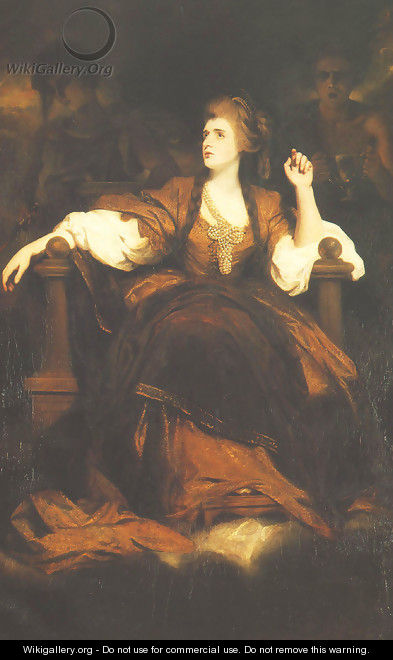
The portrait below of Sarah Mrs. Siddons as the Tragic Muse, was painted by Sir Joshua Reynolds in 1784. He signed it on the hem of her dress, “for,” he told her, “I have resolved to go down to posterity on the hem of your garment.”

Mrs Siddons as ‘the Tragic Muse’ by Sir Joshua Reynolds

Thus I would say as noted in my last blog, Sarah Siddons was one of the women the gentlemen of high society liked to play the romantic for. They would have courted her with a terrible determination I’m sure. She was married young, before she found fame, to a fellow actor who had first proposed to her when she was sixteen. At the time her father had sent her suitor William Siddons away from the company and Sarah was forced to take up the appointment of ladies maid. But they were allowed to marry two years later and Sarah had several children and miscarriages before they separated after she came into her own at Drury Lane. A little snit bit of 18thcentury gossip tells that Sarah had a romantic

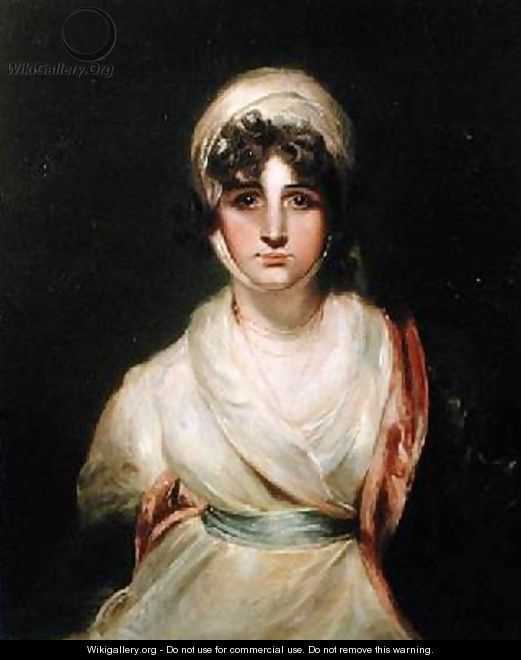
Sarah Siddons by Sir Thomas Lawrence

inclination towards a young painter who captured her image in portraits several times, Thomas Lawrence, who also had romantic relationships with two of her daughters, which was not an uncommon thing. I’ll say more on that some other time regarding another family I am researching.

She returned to Drury Lane to high acclaim and much ado on 10th October 1782. After the following report of her performance by the niece of the play write Richard Sheridan, Mrs Le Fanu; ‘My Grandfather was strongly solicited to go to the play, to witness the performance of a young actress, who was said to distance all competition in tragedy. He found, to his astonishment, that it was the lady who had made so little impression some years before, but who was possessed of tragic powers sufficient to delight and electrify an audience. After the play was over he went behind the scenes, in order to complement her. He said: ‘I am surprised, Madame, that with such talents you should confine yourself to the country; talents that would be sure of commanding, in London, fame and success.’ The

Another painting of Sarah Siddons by Sir Tomas Lawrence

actress modestly replied that she had already tried London, but without success which had been anticipated, and that she was advised by her friends to be content with the fame and profit she obtained in Bath. Immediately on his return to London, he spoke to my uncle, strenuously recommending her to him.’

Now a statue of Sarah Siddons stands In Westminster Abbey in London in the chapel of St Andrew.

I also spoke last time about the difference in audience behaviour in the 1700s and 1800s and there is another instant of their engagement with the play when Sarah performed for the last time in Covent Garden on the 29th of June 1812, she played Lady Macbeth and at the end of the sleep walking scene the audience refused to let the play continue. In the end the curtain fell and when it was lifted Sarah Siddons appeared sitting in one of those chairs at the edge of the stage as herself and went on to give an eight minute farewell speech.

Interior of the Theatre in Orchard Street by Nixon

Jane Austen first visited Bath in 1797 with her mother and sister Cassandra. They stayed in No. 1 The Paragon visiting her aunt Jane Leigh-Perrot. She wrote the first draft of Northhanger Abbey in 1798 undoubtedly drawing on her own experience of attendance at the pump room, the upper assembly rooms and the Orchard St Theatre Royal.

We can only guess which actors she may have seen there or where she sat, but it was likely to have been in one of the boxes and perhaps she saw Sarah Siddons. Sarah did return to Bath for benefit performances from time to time. One occasion is noted in February 1799 when her fame brought dozens of people onto the streets to wait all day for a chance to see her and the tickets were sold out immediately and oversold so not everyone could squeeze in. The audience were so raucous when the performance began they would not cease applauding. The actors stopped and called for a constable to silence them and then the play had to begin again.

Sarah Siddons by Thomas Gainsborough

Jane Austen was not reported to be in Bath in the February but she did come to Bath for six weeks in the summer of 1799. She stayed in No. 13 Queen Street, with her brother Edward and his wife and would certainly have visited the Theatre Royal in Orchard St during that time.

Persuasion which is Jane Austen’s other novel including scenes of life in Bath was written much later in 1815-1816 and Jane’s experience of Bath was very different by then. In 1797 and 1799 she had attended Bath for the benefit of enjoying Bath’s pleasures, but from 1801 until 1806 she lived there under the sorrowful circumstances of her father’s diminishing health and death, and their increasing poverty.

Well that is all for this week, I think there is one more story I’d like to pull out of the Orchard St Theatre next week, but then I’ll move to a new subject.

Jane Lark is a writer of authentic, passionate and emotional love stories.

See the side bar for details of Jane’s books, and Jane’s website www.janelark.co.uk to learn more about Jane. Or click  ‘like’ on Jane’s Facebook  page to see photo’s and learn historical facts from the Georgian, Regency and Victorian eras, which Jane publishes there. You can also follow Jane on twitter at @janelark

This slideshow requires JavaScript.