Follies rolling into February – the obelisk at Kingston Lacy

 There is of course another form of folly, the memorial of the Grand Tour, an article obtained in pursuit of antiquity.

William Bankes, a friend of Lord Byron, who travelled through the period of Peninsular War was a collector.

In the later years he travelled with the well known excavator of Egyptian artefacts, Geovanni Belzoni, who he engaged to bring back an obelisk, which was a feat which took years.

On its first move, it plunged into the river out of sight.

However the obelisk did eventually make it to William Bankes home in Kingston Lacy, Dorset.

It arrived in England in 1821 and the Duke of Wellington offered to ship it to Dorset on a gun carriage.

The Duke of Wellington was then asked to lay the foundation stone in April 1827, when the granite steps it is mounted on and other fragments of the obelisk arrived in England.

This is commemorated in the plaques about the obelisk. As is the fact that King George IV donated granite from the ruins of Leptis Magna to repair damage to the obelisk which occurred during travel.  
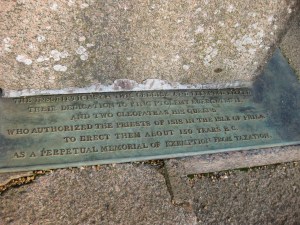
Kingston Lacy 4  

 The obelisk still stands proudly erect in full view of the house at Kingston Lacy. It comes from the temple of Isis on the island of Philae, and is inscribed with the names of Ptolemy VII Euergetes II who died in 116BC, and his second consort Cleopatra III recording the exemption granted to the priests of Isis from the expense of local administration and has both Egyptian and Greek inscription.
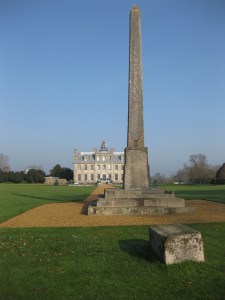
Kingston Lacy 1

There are many more tales to come from Kingston Lacy, but I’ll save those for another day.

To find out more go to:

http://en.wikipedia.org/wiki/William_John_Bankes

http://en.wikipedia.org/wiki/Giovanni_Battista_Belzoni

Kingston Lacy 3 (2)

Illicit_LoveJane Lark’s debut novel is due to be published 2nd May 2013, by Sapphire Star Publishing See  Jane’s website www.janelark.co.uk to learn more or click  like on Jane’s Facebook  page. You can also follow Jane on twitter at @janelark

A Boxing Day blog…

The traditions of Christmas as we know it, with decorated trees, presents and cards, began in the Victorian era, but in the reign of the Regency people feasted, swapped presents and decorated their homes with winter greenery.

Earlier on in December this year I visited #Stourhead near Warminster. It is a beautiful estate in every season, and this year the National Trust opened the house to visitors over three weekends in December. The house was decorated for Christmas, and volunteers served warm spiced cider, traditional cinnamon biscuits, peppermints and other festive treats.

The most fascinating room in the house was the music room, which was arranged and decorated as though a musical evening had just taken place. The small pianoforte stood at the front of the room beside a music stand, and on it lay a lady’s fan she may have just put down before beginning to sing. The room had various pieces of furniture laid out in rows, with the odd shawl laid over some, left behind. The eclectic pieces of furniture gathered together, a loveseat, a sofa, soft chairs and spindle chairs, brought together from about the house, surprised me. I imagined such events as well-ordered, regimented almost, with the armies of servants houses had in the Regency era I assume everything to have been perfection. But usually on a music evening they would have dined too, so they would not have used the matching dining room chairs and laid them out in the music room, they would have gathered together all sorts of furniture from the rest of the house. There was something cosy, inclusive, about the room. I had equally imagined these events in big marble lined halls, with a chill in the air, and a soprano voice ringing off the stone. But this room, which is probably like that in the large majority of country estate houses, was relatively low ceilinged and the curtains, the silk covered walls and other furnishing would have caught and held the sound making the whole affair far more intimate.

In a large hall, with light shining back from pale marble and mirrors, I had imagined that in the brightness, those attending, the audience, would have been very visible to others. But this room had the curtains drawn and lamps burning, leaving it shrouded in shadows, and with the chairs on a level, people would have only seen the gestures of those near them, sat in the row in front perhaps, but not if they were seated on a love seat, with a solid back. Even the performer would not see all through the people sitting in the front rows. Ah my romantic imagination flies. Expect this scene in a book.

Happy Christmas, happy reading.

To see pictures of Stourhead at Christmas, see their blog on the link below.

http://stourheadnt.wordpress.com/2011/12/01/a-sneak-peek-at-our-christmas-displays

Jane Lark is a writer of authentic, passionate and emotional love stories.

See the side bar for details of Jane’s books and Jane’s website www.janelark.co.uk to learn more about Jane. Or click  ‘like’ on Jane’s Facebook  page to see photo’s and learn historical facts from the Georgian, Regency and Victorian eras, which Jane publishes there. You can also follow Jane on twitter at @janelark