The gossip of a real 19th Century Courtesan offers a window into the past

Harriette_Wilson00Last week we left Harriette establishing a fashionable lifestyle in London and breaking into the most fashionable group of the Regency aristocracy there. At the time she was still engaged to Lord Lorne, but all good things must come to an end as they say. Each summer, as was fashionable, Lord Lorne returned to his estates. Lord Lorne’s estates were in Scotland, and Harriette had no intention of burying herself away there when there was far more fun and society to be courted in town.

So now we reach the point that Harriette must search for another new protector.

Before I go on though, I will quickly recap some of the background to this series of blogs for those following for the first time today. Please read from the end of the italics if you have already read this.

In 1825 Harriette Wilson, a courtesan, published a series of stories as her memoirs in a British broad sheet paper. The Regency gentleman’s clubs were a buzz, waiting to see the next names mentioned each week. While barriers had to be set up outside the shop of her publisher, Stockdale, to hold back the disapproving mob.

Harriette was born Harriette Debochet, she chose the name Harriette Wilson as her professional name, in the same way Emma Hart, who I’ve blogged about previously, had changed her name. Unlike Emma, it isn’t known why or when Harriette changed her name.

She was one of nine surviving children. Her father was a watchmaker and her mother a stocking repairer, and both were believed to be from illegitimate origin.

Three of Harriette’s sisters also became courtesans. Amy, Fanny and Sophia (who I have written about before). So the tales I am about to begin in my blogs will include some elements from their lives too.

For a start you’ll need to understand the world of the 19th Century Courtesan. It was all about show and not just about sex. The idle rich of the upper class aspired to spending time in the company of courtesans, it was fashionable, the thing to do.

You were envied if you were linked to one of the most popular courtesans or you discovered a new unknown beauty to be admired by others.

Courtesans were also part of the competitive nature of the regency period too, gambling was a large element of the life of the idle rich and courtesans were won and lost and bartered and fought for.

So courtesans obviously aspired to be one of the most popular, and to achieve it they learnt how to play music, read widely, so they could debate, and tried to shine in personality too. They wanted to be a favoured ’original’.

The eccentric and outspoken was admired by gentlemen who liked to consort with boxers and jockeys, and coachmen, so courtesans did not aim for placid but were quite happy to insult and mock men who courted them, and demand money for any small favour.


Sometimes Harriette’s memoirs take detours from recounting specific tales and then they give us some far more real insights into the life of a courtesan in the early 1800s. Last week I spoke about the new bonds and friendships she had struck up with her sister Fanny, her friend Julia and the less close relationship she had with her eldest sister, Amy. So now when Harriette speaks of searching for a new relationship from which to earn her income, we slip into learning some of the gossip the four women shared as she thought about how to progress her career. Both Amy and Harriette were living beyond their means, hiring opera boxes and hosting parties, and Lord Lorne was due to retire to his Scottish Estates for summer. So both women were busy keeping a close eye out on the field of men available, and they must have had much to discuss and compare.

Frederick Ponsonby, Earl of Bessborough, William Ponsonby's father to give an idea of William's looks

Frederick Ponsonby, Earl of Bessborough, William Ponsonby’s father to give an idea of William’s looks

Harriette records a conversation when Amy declared that one of the men Amy was interested in, who did not return her interest but did attend her parties, had been taken up to her bedchamber, a little worse for drink, and unknown to Amy he’d been left there to sleep off his excess, fully clothed, behind the curtains surrounding her bed.

When Amy had retired to bed, thinking herself alone, she says she used the chamber-pot ‘indelicately’ and then it was at this moment her favoured Lord Ponsonby appeared from behind her bed curtains laughing at her. She was mortified.

Harriette replied that she thought the bed was exactly where Amy had wished Lord Ponsonby (The brother of the infamous Lady Caroline Lamb), but Amy told Harriette then that Lord Ponsonby had made it plain he was only there for ‘repose, not a companion.’

Julia then recounted her own experience of a man hiding in her bedchamber when she began her affair with Colonel Cotton. She admitted that he first succeeded with her on a stone staircase in Hampton Court Palace because it was so hard to find privacy in such a place. But wishing to spend a longer time in the arms of the young woman he’d successfully seduced he then begged Julia that he might come to her room. Julia said she claimed it was impossible because she undressed with her sister, who slept in their mother’s bedchamber next door, and her mother always came to her to say goodnight and between times other women from the court came and went. But determined to achieve a night in Julia’s bed Cotton said he would willingly endure three to four hours of discomfort beneath Julia’s bed.

Julia then describes how knowing Colonel Cotton was there she undressed herself with care, took her hair down prettily and bathed her hands and face, while all the time imagining herself watched by a romantic lover. But at the same time her sister undressed and to Julia’s embarrassment on her behalf she splashed and rattled without care, speaking of her sensations and pimples and wishes, Julia said she could have fainted with dismay.

Then Harriette decided in this moment of honest conversation to press her eldest sister to tell how she had used to come by hundred pound notes, at the time when Harriette was still a child at home, and Amy was with her second lover a penniless soldier.

Amy declares she did nothing more than let a man ‘pat’ her, and to earn her hundred pounds she simply told him when he asked that she enjoyed it. Harriette implies much disbelief among the group of women and then their laughter when Amy declares it true and showed them how he patted her, and the face she made to express her enjoyment. Yes you can just imagine them all sitting about Harriette’s parlour gossiping about the men surrounding their lives.

But how then to decide who to pick for a new protector when you were short of money and the man who was your preference did not want you. Both Amy and Harriette had preferences, who were in fact brothers but they didn’t know it at the time. Lord Ponsonby who had hidden in Amy’s chamber was Amy’s favourite but he was a good-looking young man who needn’t pay a courtesan and he was not interested in Amy. But Amy had bills to pay and so must take a man.

Harriette records a conversation with her sister Amy, as Harriette used to write her letters, Harriette shares their debate over the best of the offers Amy had, and then the man she chose Harriette sat down and wrote a letter to, offering an agreement of two hundred pounds per month. Although Amy even at the time admitted she really didn’t like him.

Harriette’s preference though was for someone she could not approach because she had never spoken to him and had no idea who he was. She had only seen him from a distance. But such things did not pay bills, and as Lord Lorne disappeared off to Scotland, Harriette realised the time for preference had passed. Next week, we’ll look at how Harriette picks her next conquest…

Jane Lark is a writer of authentic, passionate and emotional love stories.

See the side bar for details of Jane’s books, and Jane’s website www.janelark.co.uk to learn more about Jane. Or click  ‘like’ on Jane’s Facebook  page to see photo’s and learn historical facts from the Georgian, Regency and Victorian eras, which Jane publishes there. You can also follow Jane on twitter at @janelark
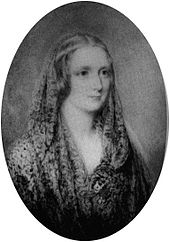
This week my scandalous woman is Mary Shelley the author of Frankenstein

Mary Shelley

If you have read my last two blogs about Mary’s sisters then you will already know that Mary began her affair with the Romantic Poet Shelley when she was just sixteen and Shelley twenty-one.

Initially to avoid the eyes of her father she used to meet Shelley by her mother’s grave. There is no knowing whether she was already pregnant at the point they eloped on 28th January 1814 but she fell pregnant to him soon afterwards if she was not already, while Shelley left behind an estranged pregnant wife.

Mary had her sister for company, Claire Claremont, who I wrote about last week and who may well have also been Shelley’s mistress, although Mary never believed this, but Shelley certainly believed in free love.

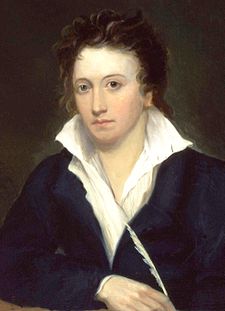
Percy Shelley

Mary, Claire and Shelley kept Journals as they travelled and excerpts of these can be found on the links below, which imply that for them it was a grand adventure. Certainly Mary thought it so, she even described it as a Romantic adventure in later years in 1826 ‘It was acting in a novel, being incarnate romance’. But Claire’s note about a dispute between Shelley and Mary implies Mary was subservient to her lover and probably in awe of him and all he declared to be true, so much so, she denied her own feelings of sadness at deserting her father, because Shelley challenged then and asked if her distress was targeted to blame him;

Mary’s Journal

Claire’s Journal

There is evidence of Mary’s inclination to be subordinate and the peace-maker in her later life too when she wrote of the impact of ‘feminine affections and compassion’ and stated she was ‘profoundly committed to an ethic of cooperation, mutual dependence, and self-sacrifice’.

There is another record of their journey through the war damaged continent in 1814, which again shows Shelley’s potential blindness to the feelings of anyone but himself as he writes to his estranged wife, Harriet, whom he’s deserted and left pregnant and asks her to join him and the girls.

She did not go, but she showed this letter to Mary’s father when he called upon Harriet in distress.

Mary, Claire and Shelley returned to England in September, with Mary pregnant, and were foolishly surprised when Mary’s father did not welcome them into his home.

Another letter exists from this era, the earliest letter known in existence from Mary to Shelley, expressing how much she misses him when he has to be away from the house hiding from debtors.

During this time, while Mary played mistress which did not seem to bother her, Harriet bore Shelley a son, and Claire, who lived with Shelley and Mary, spent hours in his company, while poor Mary suffered with ill-health. Though not such ill-health that she was incapable of Shelley seeking to encourage her to practice her own free love and sleep with his friends. There is no evidence that she complied with the assertions recorded in some of his correspondence to her.

Sadly Mary’s daughter was born premature and did not survive. But Mary quickly fell pregnant again and bore a second child, a son, who they named William for her father.

Then in 1816, they set out on a new adventure, with Claire now pregnant by Lord Byron, and Mary with her young son. They followed Byron to Lake Geneva. Mary now called herself Mrs Shelley as she travelled, although Harriet, Shelley’s wife was still alive.

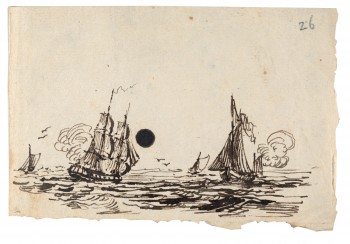
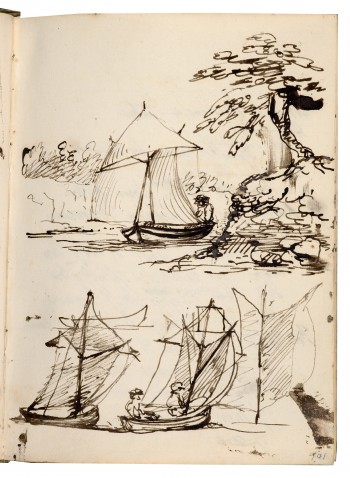
Shelley’s sketch of his own and Byron’s sailing boats

The story of Frankenstein came from this trip. Mary wrote at the time that the weather was often inclement for days, and they were frequently confined to the house and so when Shelley and Byron were not sailing on the lake, they were writing and telling stories.

It was Lord Byron who inspired the idea to write Mary’s first novel. They had been seated about the fire at Byron’s villa reading German ghost stories, and during their conversations recounted the rumours of a scientist who was said to have brought life back to human matter, and then Lord Byron suggested they all might write their own supernatural tales. Mary set out crafting Frankenstein, a story which Shelley loved and urged her to continue.

When Mary, Claire and Shelley arrived back in England after their fruitful summer it was to a time of burdens though. They were forced to hide away in Bath, both from debtors and to contain the secret of Claire’s pregnancy, which by then must have been notable. They arrived back in England in September, and then in the October, Mary’s oldest sister Fanny committed suicide, which was hushed up by Shelley (see Fanny’s story in one of my earlier blogs), and then two months later on the 10th December, Shelley’s wife also committed suicide. She was found drowned in the Serpentine Lake at the centre of Hyde Park.Here are links to letters of the time, including Harriet’s suicide letter. She was with child by another man when she died. Shelley sought to gain access to his children by Harriet, but due to his infidelity with Mary he did not succeed in gaining them, despite immediately marrying Mary to support his case. Mary wrote scant journal entries on the subject of Harriet’s suicide and her own marriage.

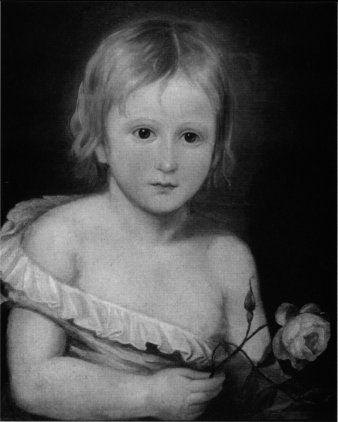
William Shelley their son who died in Rome

Shelley’s marriage to Mary did however reconcile Mary with her father and at last make her respectable. However Shelley’s debts still prevented them having any form of settled life and once Mary gave birth to another child, a girl, with little money, Mary, Shelley, their children and Claire and her illegitimate child, left England for good in March 1818 (the year Frankenstein was first published anonymously). They sought Byron in Italy to hand him Claire’s child. He did take her after some persuasion, and then the Shelley’s moved on to lead a nomadic life, moving from city to city in Italy with groups of friends and acquaintances.

However for Mary, despite now being respectable, her experience in Italy was ruined by first her young daughter’s death in September  1818, in Venice, and then her son become ill in Rome the following June 1819. She wrote to friends of her fears for her son. And then her father wrote after the boy had died, urging her not to remain in sadness as she was pushing Shelley away with her depression over the loss of her children.

Shelley wrote.

My dearest Mary, wherefore hast thou gone,

And left me in this dreary world alone?

Thy form is here indeed—a lovely one—

But thou art fled, gone down a dreary road

That leads to Sorrow’s most obscure abode.

For thine own sake I cannot follow thee

Do thou return for mine

It was another birth that finally restored Mary from her deep sorrow. Her second son was born in November 1819.

But it was after her depression that rumours of Shelley’s infidelity grew. As he was preacher of faithlessness in marriage it is fair to assume he was no more faithful to Mary than he had been to Harriet. There were rumours that his sister-in-law Claire produced his child in February 1819. And when Mary was heavily pregnant with their fourth child, who they named Percy, Shelley befriended a Welshwoman who was undertaking the grand tour and showed her Florence, while Mary was retired at home. He wrote her an ode, of which this is part.

 ‘Thou art fair, and few are fairer,
Of the nymphs of earth or ocean,

They are robes that fit the wearer –
Those soft limbs of thine whose motion
,
Ever falls and shifts and glances
As the life within them dances’

Jane Williams

She did not stay long in Shelley’s company but there were others and the most particular the wife of Edward Williams. Shelley knew Edward Williams from school and when the Williams started travelling with them he became affectionate with Edward’s wife, corresponding with her as frequently if not more frequently than with Mary when he was away from them and writing Jane poetry when he was with them.

Edward Williams

In 1822, with Mary pregnant once more, Mary, Shelley, Claire and the Edwards moved to a secluded Villa by the sea. Where Shelley hoped to practice his favorite hobby beyond writing, to sail. It was to be another period of sadness. It was here that Percy broke the news to Claire that her daughter by Byron had died in the monastery where he’d established her and then Mary miscarried in June and lost so much blood Shelley sat her in a bath of ice to stop bleeding. He saved her life by doing so.

With Mary depressed once more and ill, Shelley paid more attention to Jane Williams.

He bought her a guitar, and wrote this poem to accompany it.

In July Shelley left Jane and Mary and went to meet Byron in Pisa. He never returned. The ship he sailed back on with Edward Williams was caught in a storm and Shelley drowned. His body was washed ashore three days after he set out.

Here are the links to the last letter he wrote to Mary, and the last letter from Jane Williams to him, as he’d also written to her at the same day he had written to Mary.

Mary received the news of his disappearance by receipt of letter asking him to confirm he had reached home. He had not and so she set out to find him.

Shelley’s body was cremated on a beach by three of his friends, including Lord Byron, but excluding Mary present – it was not considered appropriate for women to attend funerals.

Mary continued her writing and lived to raise her young son who survived childhood. She never remarried. She died at the age of fifty-three having lived her life extolling Shelley’s literary gifts and creating a legacy for him. One year after her death her son and his wife opened her box-desk. Inside were locks of her deceased children’s hair, a note-book she’d shared with Shelley, and a copy of his poem Adonais with one page folded around a silk parcel some of his ashes and what was believed to be the remains of his heart.

She never remarried, and she appeared to never cease loving Shelley.

Jane Lark is a writer of authentic, passionate and emotional love stories.

See the side bar for details of Jane’s books, and Jane’s website www.janelark.co.uk to learn more about Jane. Or click  ‘like’ on Jane’s Facebook  page to see photo’s and learn historical facts from the Georgian, Regency and Victorian eras, which Jane publishes there. You can also follow Jane on twitter at @janelark