
Old Royal Theatre, Orchard Street, Bath
When I met a friend for coffee in Bath yesterday I happened to spot a leaflet on the Orchard Street Theatre which is still open for guided tours. I was wonderfully surprised. I have lived near and visited Bath for thirty years and never heard of it before. I knew there had been a previous theatre to the one in use now, which I have been to several times, but I thought it had been destroyed long ago. I have even tried previously to find out where it was. So what a brilliant thing to find it still existed and be able look around it and find out all about its history.

c1694 Map of Bath by Gilimore, available from Bath in Time
I spoke in my blog on The history of life in 18th Century Bath about Queen Anne’s visit to Bath in 1703 to take the waters for her health. There is an old map of Bath by Gilmore from 1694 which shows Bath before the Georgian redevelopment. It must have looked still much like this when Queen Anne visited and the city experienced its embarrassing lack of entertainments.
There was a theatre at the time but it was in a stable by the upper borough walls, where the Mineral Water Hospital stands now, the current hospital for Rheumatic Diseases. Opposite this hospital is the only standing section of the medieval wall.
The Queen had brought with her, in her entourage, the entire Drury Lane Theatre Company and they must have been sorely disgusted by the adapted stable for a stage.
After Queen Anne had left, Bath was embarrassed enough for its wealthy occupants to raise the funds to build a theatre on this spot.But even so it was poor in comparison to its London counterparts and therefore attracted only equally poor travelling players.
A contemporary writer in ‘The Spectator’ spoke of the entertainments thus, in derision of the costumes;
‘Alexander the Great was acted in a paper cravat; the Earl of Sussex seemed to have no distress but his poverty; and my Lord Foppington wanted any better means to show himself a fop than by wearing stocking of different colour!’
As well as this Theatre of course, as I have mentioned in my blog on the Assembly Rooms in Bath ,after Queen Anne’s visit the assembly rooms began to be established to provide entertainment for visitors to Bath and in general Bath was a growing improving and developing city.
It was at this point Beau Nash who I have been blogging about for the last few weeks began his reign.

North Parade including the Lower Assembly Rooms, 1779, available from Bath in Time
Of course the assembly rooms recognised the inadequacy of the Theatre and took advantage establishing unofficial stage plays as part of their entertainments and one of these, the Harrison’s Rooms, had by the late 1730’s built a theatre to seat 200 in its basement.
The Harrison’s Rooms, later known as the “Lower Rooms”, in comparison to the “Upper Rooms” which are still open, used to stand in the position of what is now the island in the middle of the traffic area where the tourist buses depart from.
However this basement Theatre was still no comparison to the London Theatres but its rivals, including the old stable, were closed in 1736, when an Act of Parliament was made to close unlicensed playhouses.

John Hippisley in “The Cheats of Scapin” by J H Green – The art Archive Garrick Club, London
It was finally in 1747 that Bath was challenged to do better.
A Bristol actor, John Hippisley, raised the point that Bath needed a better theatre by addressing the ‘Nobility and Gentry of Bath’, he stated;
‘Plays are like mirror made, for men to see, How bad they are, how good they ought to be. Theatrical Performances, when conducted with Decency and Regularity, have been always esteem’d the most rational Amusements, by the Polite and Thinking Part of Mankind: Strangers therefore, must be greatly surpris’d to find at Bath, Entertainments of this Sort in no better Perfection than they are, as it is a Place, during its Seasons, honour’d with so great a Number of Persons, eminent for Politeness, Judgement and Taste: and where might reasonably be expected (next to London) the best Theatre in England.’
Bath responded to the challenge and raised the funds for a brand new, purpose built theatre to be positioned outside of the old medieval walls near the South Gate. Nine investors contributed fifty pounds. Beau Nash, and John Wood the elder, who I have also mentioned in previous blogs on Prior Park and its Grotto and Graffiti, were included in the investors along with Hippisley and other actors.
John Wood was responsible for much of the building and the development of Bath. He chose the site. But the syndicate still had to raise further funds to complete the build and when Hippisley died before its completion a Bath brewer and candle maker took charge of the project, John Palmer. To raise the additional investment he tempted other investors with a prospectus of what they had to gain including the offer of a ‘Silver Ticket, which shall admit the Bearer into any Part of the House, every Night of Performing, except on Benefit nights.’
He increased the share holders to twenty and the Orchard Street Theatre opened on the 27th October, 1750, to a prologue spoken by a good friend of John Hippisley, Mr Watts.
‘As some you Shoot, which by the Plante’s Hand, is gently mov’d into a kinder Land; If the warm Sunshine spread itsgenial Rays, Soon a fair Tree is verdant Leaves displays, And rears with Blossoms its luxuriant Head, Whilst all the Warblers’wanton in the Shade . ‘Tis Steadiness alone can fix the Root, And rip’ning Autumn gives the Golden Fruit But if nipping Blast, or dead’ning Frost Too Fierce advance, the hopeful product’s lost. So will it be with Us, whose Art and Care Have raised this Structure, to what we call fair; with ev’ry varied Art have strove to charm, If painting pleaser, or Harmony can warm. Shine forth auspicious, Endeavours crown, And Fire Us, by Success, to gain Renown.’
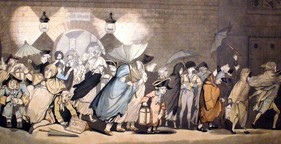
Coming out of Country Theatre by Frederick George Byron – Said to be based on the Orchard Street Theatre, Bath
Of course the New Theatre was now in direct competition with the old one in the Lower Assembly rooms and they competed quite hotly with many arguments as they fought for actors and staff over a period of five years, but then Beau Nash in his way of orchestrating Bath for his own profit stepped in and informed the Lower Assembly rooms that their theatre, which he had no investment in, must close.
In my next blog I’ll tell you more about the new theatre and share some more pictures, stories and facts, both about the building itself, life within the theatre and those who visited it. There is still loads to tell, including details of Jane Austen’s connection, too much for one blog probably.
Jane Lark is a writer of authentic, passionate and emotional love stories.
See the side bar for details of Jane’s books, and Jane’s website www.janelark.co.uk to learn more about Jane. Or click ‘like’ on Jane’s Facebook page to see photo’s and learn historical facts from the Georgian, Regency and Victorian eras, which Jane publishes there. You can also follow Jane on twitter at @janelark

 Author, Jane Lark's stories