If you are a history lover, research can be very addictive, and I love it. Of course, you can follow me on Instagram or Like my Facebook Author Page to catch snippets of research but my recent journey to Rome gathered so much that I thought I’d share this here too.
As I said in my last post my next historical series will follow a group of young poets who move on to begin a grand tour of the European continent and so I wanted to understand what they saw when they visited Rome. I have read things that tell you what life was like for them on the tour. Hedonistic. Then, of course, there is the influence of the grand tour in all the painting collections and Palladian architecture across the UK. But that doesn’t really help me to imagine what their exploration felt like. To understand feelings and emotions I like to go to places, but what I felt I knew would be different today because since the 1700s and 1800s excavations have taken place. So I wanted to know what it would have looked like then to understand what would have interested and inspired my characters. I was thrilled, then, to discover pictures of old paintings on boards all the way around the excavated Roman Forum.
The painting below shows what people would have seen in the area of the forum in 1786-1791. I imagine this was painted from within the tall ruins on the hill opposite the Palantine hill where the Farnese Gardens were created in 1550. It shows the entrance to the Farnese Gardens that had structures decorated with white marble (the marble was no doubt robed from the Roman ruins). If the painter had stepped through the arch of these ruins and turned left, he would have been looking at the Colleseum which was definitely visible in the 1700s and 1800s and used as a market.
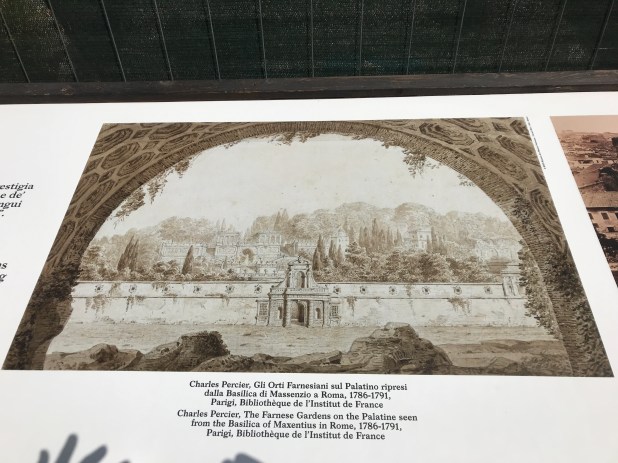
Below are three more paintings of the area from different angles, showing the steps and layout of the entrance to the Farnese Gardens, that were built on top of the ruins of the emperors’ palaces.
- Bottom right: 1826 – A painting of the view of the Colleseum from the gardens.
- Left: 1827 – A view of the area from another or Rome’s seven hills, that looks down over the walls and into the gardens. This shows that the Arch that still stands today was a real feature of the area then but actually what would have been prominent for the tourists of the 1700s and 1800s would be the gardens with their marble steps climbing up the hill (the Colosseum is left of this picture).
- Top right: 1650 – 1700 – A closer view of the entrance to gardens.
Another clue showing how much of the ruins were above ground in the 1700s and 1800s is a church that was once a Roman temple that stands in the Forum area. The door that is halfway up the wall shows you where the ground was before the excavations began. The whole area had been silted up by the river flooding over the years. So our old tourists would have seen the pillars literally rising out of the ground in front of this church door.
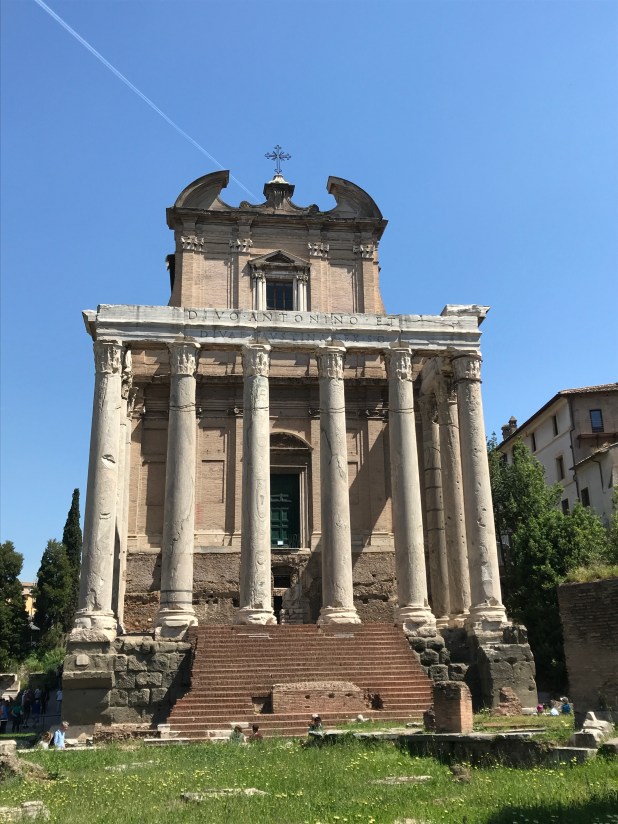
Many areas of Rome would have similarly displayed pillars dramatically rising from the ground like this.
You can see in the painting below from 1842 and beside it the same area today, what it would have been like walking through the streets of Rome when there were the occasional outbreaks of columns.
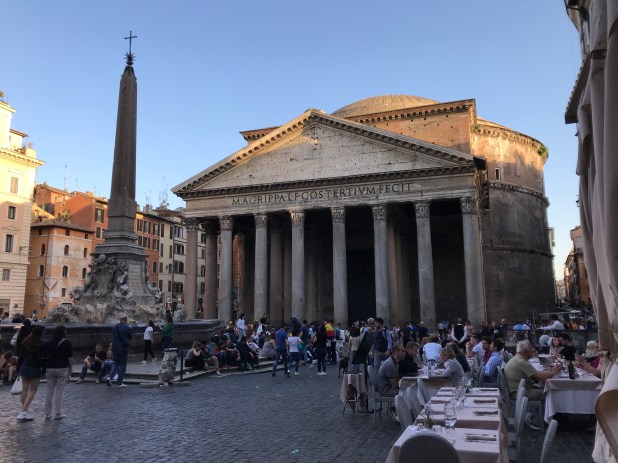
The guide who took us around the Roman Forum highlighted that the buildings still standing and looking as they did in the 1700s and 1800s were those that had become churches. All Roman buildings that had developed a Christian connection were left mostly intact. The Pantheon is a great example of this.
It is no wonder then that the Palladian style of building came back to the UK after men had completed their grand tour in the 1700s. The Georgian men no longer wanted to live in a castle, Tudor or Jacobean homes, with narrow hallways and low-ceilinged living quarters. They were inspired by bold spaces and towering structures, came home and built them. Thier sons in the 1800s then went on the tour with some expectation of the impressive architecture and sense of history that they would walk through.

The Lion Mount was built by King William I of Holland in 1820 to commemorate the part his son The Prince of Orange played in the period leading up to and during The Battle of Waterloo, it was built on the spot where The Prince was shot in the shoulder. He survived the battle.

Attingham Park – Sophia’s – Lady Berwick’s home

Hampton Court Palace

John Churchill’s, Blenheim Palace

John Churchill’s, Blenheim Palace

The Pump Room entrance facing the Cross Bath

Colonnades leading to the Cross Bath

The Upper Assembly Rooms Bath
The Marlow Intrigues

The Lost Love of Soldier ~ The Prequel
The Illicit Love of a Courtesan
The Passionate Love of a Rake
The Scandalous Love of a Duke
The Dangerous Love of a Rogue
The Secret Love of a Gentleman
The Reckless Love of an Heir
The Tainted Love of a Captain
Jane’s books can be ordered from booksellers in ebook or paperback





 Author, Jane Lark's stories