The Theatre Royal, Orchard St, Bath, was the Theatre Jane Austen attended – I’ll tell you more about it today

The Exterior of the Theatre Royal, Orchard St, Bath by T Woodfall

In my last blog I spoke about how the Theatre was established in Bath in the 1700s and now I’ll tell you a bit about the Theatre Royal itself. It was opened on 27th October 1750 but at the time it had no boxes. When it opened the space was simply a stage and the audience watched from a sloped floor which rose by roughly seven feet from the front of the Theatre to the back.

The elite who visited Bath must have still thought the then new Theatre a bit less than genteel in comparison to the venues they frequented in London. They could not reserve a space nor escape the local less well born who might attend. But still they managed to engineer an improvement to their Theatre visit. They would send their servants to the Theatre early and have them reserve a space and then arrive once the play had commenced. Of course that meant disturbance for everyone else as people forced a path through the crowd to get in and their servants forced back through the crowd to get out. And let’s remember there were probably at least two dozen or more aristocrats or gently born patrons reserving spaces.
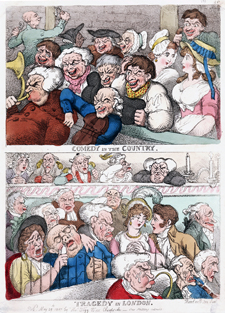
Comedy in the Country and Tragedy in London, by Thomas Rowlandson

But then a Theatre excursion was very different in the 1700s and 1800s, it was quite normal for people to talk through a whole play and the servants reserving spaces in Bath were often known to shout across the hall to one another if they were bored with waiting for their employers to arrive. In London those who occupied boxes would move between them, visiting each other and socializing, and sometimes pay no mind to the play at all. In the pit and on the floor level as in Bath, the audience were known to regularly converse with the actors too, shouting things up at the stage. The courtesan’s in London hired out boxes for a season solely to hold court there. As the play progressed they entertained gentlemen visitors as it was the fashion for men to be seen with the priciest of courtesans and vie for her favours. It was the age of romance, or what the gentlemen of the era called romance, which was to pine and write poetry and say pretty words to a woman.

A scene in Harriette Wilson’s Memoirs which were published in 1825 describes a Theatre excursion. Harriette was a courtesan as were two of her sisters – I wrote a blog about one of her sisters who ended up marrying a Duke previously– see Attingham family tales, Sophia Dubochet and the 2nd Lord Berwick . Anyway Harriette used to share a box with other courtesan’s in London and to earn a little extra money they would resell the seats for the box, yet people who purchased them did not have space in the box but room in the pit below. On this occasion a couple who were from the country misunderstood the purchase, took the seats in her box and would not move unaware they shared it with a courtesan. Harriette describes their growing agitation as she continued to speak with the one gentleman in her company that night.

Harriette describes how the young man she was with, ‘A little Captain Chruchill’ called for the box-keeper to through the squatters out and they asked the box-keeper to force Harriette to be silent. He said ‘that he really could not take upon himself to request me or my friend to be silent, when we were inclined to converse or laugh in my own box, as it was what everybody did, and many went there for no other purpose but to chat with their friends.’

She describes the other parties reaction too ‘turning up their eyes and throwing out contemptuous remarks on the man for having attempted to impose on them with such an improbable story as that of people putting themselves to the expense of going to the King’s Theatre, when they only wanted to converse.’

I should imagine many similar arguments occurred in Bath. But on that occasion Harriette tried to force them from the box by talking louder and laughing more and when that did not work she cleared them from it by telling them who she was and that they appeared her friends.

The interior of the Theatre Royal, Orchard St, Bath, by Nixon

So anyway, back to Bath. Not only would the elite in the audience arrive late they may also dip in and out of the play and only attend for a particular scene which their favorite actor or actress played in. And of course the actors and actresses were as human then as they are now and treated their late arrivals and early leavers in the same manner a comedian would treat a heckler now, welcoming them or bidding them goodbye in a range of responses dependent on their mood.

There is one instance of an actor in Bath becoming thoroughly outraged with a member of his audience. The favored elite could sit on chairs at the side of stage during a performance as there were no boxes, and on this occasion the gentleman was so bored he walked across the stage to speak to his friend on the other side. Swords were drawn over the issue. Even other actors could be disrespectful of the play. When their part finished they would sit on stage, not in the wings, and an actor with an ego was known to make faces and deliberately look bored through another’s performance.

Perhaps you can imagine the atmosphere in the Theatre too. There were no windows and no air vents. It would have been hot with so many people crowded in and the air would have smelt of sweat and been quite thin by the end of a performance, probably not a comfortable or pleasant experience – really it’s no wonder they only stayed for elements of a play. The Theatre was lit with tallow candles, both burning on the stage and about the auditorium which meant members of the audience had hot wax dripping on their clothes and heads.

The stage, Theatre Royal, Orchard St, Bath

It is not surprising then that improvement commenced quite quickly, boxes were added along both edges of the Theatre, you can see on the photographs of the walls as the Theatre is today the markings in the plaster where the boxes once were. And boxes were added at the side of stage too so the chairs could be removed from the stage itself. Also a dome was placed in the middle of the ceiling and decorated with a picture of Apollo and the Muses  in 1767 to add beauty and grandeur, which it did, it was described as ‘esteemed, in fancy, elegance and construction, inferior to none in Europe,’ except that it was a dreadful addition as it ruined the acoustics. It was later taken out.

In 1768, once the beautifying dome had been added, the Theatre’s manager of the time, John Palmer Junior, the son of the John Palmer who helped build it, presented a petition in London for a Royal Warrant for the Theatre. It was granted by special Act of Parliament and the Orchard Street Theatre became the Theatre Royal, Bath. It was the first provincial theatre to receive the accolade, prior to this only Drury Lane and Covent Garden held the honor.

This picture shows one of the boxes built at the side of the stage, which is still in situ, look up to the left

Then in 1774 an entrance lobby was added on the front of the building and a crush room serving refreshment, and above this seven more grand boxes facing the stage, there are no signs of these now. The boxes stretched back in a fan shape and had five rows of benches, seating five occupants on each bench. It cost three shillings for a box seat and two shillings for the pit.

The other addition was a carriage forecourt in which the elite might be deposited at the door easily without needing to walk through the street. The steps down to the carriage forecourt can be seen at the far right of the picture of the exterior by Woodfall.

We know Jane Austen definitely visited the Theatre Royal and occupied one of the boxes on a visit to Bath, but more about this in my next blog.

http://www.oldTheatreroyal.com/

Jane Lark is a writer of authentic, passionate and emotional love stories.

See the side bar for details of Jane’s books, and Jane’s website www.janelark.co.uk to learn more about Jane. Or click  ‘like’ on Jane’s Facebook  page to see photo’s and learn historical facts from the Georgian, Regency and Victorian eras, which Jane publishes there. You can also follow Jane on twitter at @janelark

This slideshow requires JavaScript.

Stories of Amore in Eighteenth Century Bath – Miss Sylvia S—

The Successful Fortune Hunter – Thomas Rowlandson

On my exploration of life in Eighteenth Century Bath I am going to begin some specific tales to get a more individual view of the people living in Bath in this period. And there are some great stories which emerge from Oliver Goldsmith’s History of Beau Nash written in 1762.

Of course in the daily idle play of the high society which flocked to Bath, what is not listed in the records of their public pursuits (mentioned in my last blogs) is the private activity which went on behind closed doors, or in secret conversations, love affairs. Or as they said in the 18th Century amore and intrigues.

Oliver Goldsmith describes Beau Nash as a lover, and says of him ‘He had assiduity, flattery, fine clothes, and as much wit as the ladies he addressed. Wit, flattery, and fine clothes, he used to say, were enough to debauch a nunnery.’ And Beau Nash had his fair share of intrigues ‘As Nestor was a man of three ages, so Nash sometimes humorously called himself a beau of three generations. He had seen flaxen bobs succeeded by majors, which in their turn gave way to negligents, which were at last totally routed by bags and ramilees. [Editor’s note: These are different kinds of wig.]’

Oliver Goldsmith describes these different ages of amore which Beau Nash viewed and participated with as follows; ‘The manner in which gentlemen managed their amours, in these different ages of fashion, were not more different than their periwigs. The lover in the reign of king Charles was solemn, majestic, and formal. He visited his mistress in state. Languished for the favour, kneeled when he toasted his goddess, walked with solemnity, performed the most trifling things with decorum, and even took snuff with a flourish. The beau of the latter part of queen Anne’s reign was disgusted with so much formality, he was pert, smart and lively, his billet-doux were written in a quite different style from that of his antiquated predecessor, he was ever laughing at his own ridiculous situation, till at last, he persuaded the lady to become as ridiculous as himself. The beau of the third age, in which Mr Nash died, was still more extraordinary than either, his whole secret intrigue consisted in perfect indifference. The only way to make love now, I have heard Mr Nash say, was to take no manner of notice of the lady, which method was found the surest way to secure her affections.’

But the story I am going to recite today is not of Beau Nash, it is of a woman, ‘Miss Sylvia S—‘, who Beau Nash knew and sought to help, though his help did not succeed, and the tale is true as told to Oliver Goldsmith by ‘Mr Wood, the architect of Bath’.

Miss Sylvia S—, a descendent of one of the best families in the kingdom, owned a large fortune, inherited from her sister and she’d consorted with ‘the best company’ from an early age, and therefore had a passion for elegance and expense. Oliver Goldsmith says ‘It is usual to make the heroine of a story very witty, and very beautiful, and such circumstances are so surely expected, that they are scarce attended to. But whatever the finest poet could conceive of wit, or the most celebrated painter imagine of beauty, were excelled in the perfections of this young lady. Her superiority in both was allowed by all, who either heard, or had seen her. She was naturally gay, generous to a fault, good-natured to the highest degree, affable in conversation, and some of her letters, and other writings, as well in verse as prose, would have shone amongst those of the most celebrated wits of this, or any other age, had they been published. But these great qualifications were marked by another, which lessened the value of them all. She was imprudent! But let it not be imagined, that her reputation of honour suffered by her imprudence, I only mean, she had no only knowledge of the use of money,’  In Essence she was rich, well-bred, connected and a perfect disposition.

She arrived in Bath at the age of nineteen with a crowd of lovers (suitors), used to frequent ‘new flattery’ and therefore thought she would be forever adored, never forsaken and never poor. Like most young ladies she believed that with so many lovers she would safely secure a husband, ‘and yet’ Oliver Goldsmith states, ‘I have seldom seen a girl courted by an hundred lovers, that found an husband in any. Before the choice is fixed, she has either lost her reputation, or her good sense, and the loss of either is sufficient to consign her to perpetual virginity.’

Among the number of this young lady’s lovers was the celebrated S—. who, at that time, went by the name of the good-natured man. This gentleman, with talents that might have done honour to humanity, suffered himself to fall at length into the lowest fate of debasement. He followed the dictates of every newest passion, his love, his pity, his generosity, and even his friendships were all in excess, he was unable to make head against any of his sensations or desires, but they were in general worthy wishes and desires, for he was constitutionally virtuous. This gentleman… was at that time this lady’s envied favourite.’

It is said of ‘the good natured man’ in Oliver Goldsmith recount of this story that the ‘thoughtless creature,’  may have ‘had no other prospect from this amour, but that of passing the present moments agreeably.’ Flirtations at this time were frequently a game as much as a serious adventure to either engage a lady’s interest for marriage or intrigue. And often men simply competed for time in a ladies company only for the sake of competition. Oliver Goldsmith said of ‘the good natured man’ that ‘He only courted dissipation,’ but unfortunately ‘the lady’s thoughts were fixed on happiness,’ and Miss Sylvia S thought far more of his flirtation.

At length ‘the good natured man’s thirst for enjoyment led him into debt, which meant he was arrested and thrown into prison. ‘He endeavoured at first to conceal his situation from his beautiful mistress; but she soon came to a knowledge of his distress, and took a fatal resolution of freeing him from confinement by discharging all the demands of his creditors.’ Mr Nash was in London at the time and told Miss S ‘that so warm a concern for the interests of Mr S—, would in the first place quite impair her fortune, in the eyes of our sex, and what was worse, lessen her reputation in those of her own.’  More bluntly that he would ruin them both. He also added, that releasing ‘Mr S— from prison, would be only a temporary relief,’  and that instead of improving their friendship or affection his guilt over such generosity would only encourage him to ‘avoid a creditor he could never repay, that though small favours produce good-will, great ones destroy friendship’

However she ignored Beau Nash’s advice, only to find it true. Paying Mr S’s debts depleted her fortune to virtual non-existence and ‘she found her acquaintance began to disesteem her, in proportion as she became poor.’ At this Beau Nash encouraged her to return to Bath which she did. ‘Yet still, as if from habit, she followed the crowd in its levities, and frequented those places, where all persons endeavour to forget themselves in the bustle of ceremony and show.’

Sadly, ‘Her beauty, her simplicity, and her unguarded situation, soon drew the attention of a designing wretch, who at that time kept one of the rooms at Bath, and who thought, that this lady’s merit, properly managed, might turn to good account. This woman’s name was dame Lindsey, a creature, who, though vicious, was in appearance sanctified, and, though designing, had some wit and humour.’  Dame Lindsey, slyly ingratiated herself with Miss S and manipulated her by offering money and fake which Miss S became reliant upon, and as a consequence she gained control ‘over this poor, thoughtless, deserted girl, and, in less than one year, namely about 1727, Miss S—, without ever transgressing the laws of virtue, had entirely lost her reputation. Whenever a person was wanting to make up a party for play at dame Lindsey’s, Sylvia, as the was then familiarly called, was sent for, and was obliged to suffer all those slights, which the rich but too often let fall upon their inferiors in point of fortune.

Oliver Goldsmith describes Miss S’s acceptance of this ‘In most, even the greatest, minds, the heart at last becomes level with the meanness of its condition, but, in this charming girl, it struggled hard with adversity, and yielded to every encroachment of contempt with sullen reluctance.’ And after three years of this life, despite her ruined reputation Mr Wood said ‘he could never, by the strictest observations, perceive her to be tainted with any other vice, than that of suffering herself to be decoyed to the gaming-table, and, at her own hazard, playing for the amusement and advantage of others.’

It was at this point Beau Nash came to her aid and arranged for her to rent a room from Mr Nash. Accepting she retired there with a single maid, but she could not be happy. ‘She was unable to keep company for want of the elegancies of dress, that are the usual passport among the polite, and she was too haughty to seem to want them. The fashionable, the amusing, and the polite in society now seldom visited her, and from being once the object of every eye, she was now deserted by all, and preyed upon by the bitter reflections of her own imprudence

Eventually, ‘m sorry to say, she took her own life. When Mr Wood and his family were in London she chose the day ‘Mr Wood was expected to return from London,’ ensuring her debts were settled, before dinner ‘Thus resolved, she sat down at her dining-room window, and with cool intrepidity, wrote the following elegant lines on one of the panes of the window.


O death, thou pleasing end of human woe

Thou cure for life! Thou greatest good below!

Still may’st thou fly the coward, and the slave,

And thy soft slumbers only bless the brave.


She then went into company with the most cheerful serenity; talked of indifferent subjects till supper, which she ordered to be got ready in a little library belonging to the family. There she spent the remaining hours, preceding bed-time, in dandling two of Mr Wood’s children on her knees. In retiring from thence to her chamber she went into the nursery, to take her leave of another child, as it lay sleeping in the cradle. Struck with the innocence of the little babe’s looks, and the consciousness of her meditated guilt, she could not avoid bursting into tears, and hugging it in her arms; she then bid her old servant a good night, for the first time the had ever done so, and went to bed as usual.’

She then dressed carefully and read ‘the story of Olympia, in the Orlando Furioso of Ariosto, where, by the perfidy and ingratitude of her bosom friend, she was ruined, and left to the mercy of an unpitying world’ leaving the book open at this page and hung herself with her girdle, it even took her two attempts to succeed, as a weaker broken girdle lay on the floor.

Thus ended a female wit, a toast, and a gamester, loved, admired, and forsaken.’

Society again took interest after her death, and ‘Hundreds in high life lamented her fate, and wished, when too late, to redress her injuries. They who once had helped to impair her fortune, now regretted that they had assisted in so mean a pursuit. The little effects she had left behind were bought up with the greatest avidity, by those who desired to preserve some token of a companion, that once had given them such delight.’  In death she was the fashion again.

As for Mr S, ‘the good natured man’, he died in gaol.


Jane Lark is a writer of authentic, passionate and emotional love stories.

See the side bar for details of Jane’s books, and Jane’s website www.janelark.co.uk to learn more about Jane. Or click  ‘like’ on Jane’s Facebook  page to see photo’s and learn historical facts from the Georgian, Regency and Victorian eras, which Jane publishes there. You can also follow Jane on twitter at @janelark