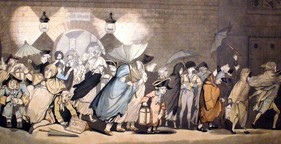
I discovered a real gem to add to my blogs on Bath yesterday – the old Royal Theatre, Orchard Street, Bath – Jane Austen was certainly a visitor there.

Old Royal Theatre, Orchard Street, Bath

When I met a friend for coffee in Bath yesterday I happened to spot a leaflet on the Orchard Street Theatre which is still open for guided tours. I was wonderfully surprised. I have lived near and visited Bath for thirty years and never heard of it before. I knew there had been a previous theatre to the one in use now, which I have been to several times, but I thought it had been destroyed long ago. I have even tried previously to find out where it was. So what a brilliant thing to find it still existed and be able look around it and find out all about its history.

c1694 Map of Bath by Gilimore, available from Bath in Time

I spoke in my blog on The history of life in 18th Century Bath about Queen Anne’s visit to Bath in 1703 to take the waters for her health. There is an old map of Bath by Gilmore from 1694 which shows Bath before the Georgian redevelopment. It must have looked still much like this when Queen Anne visited and the city experienced its embarrassing lack of entertainments.

There was a theatre at the time but it was in a stable by the upper borough walls, where the Mineral Water Hospital stands now, the current hospital for Rheumatic Diseases. Opposite this hospital is the only standing section of the medieval wall.

The Queen had brought with her, in her entourage, the entire Drury Lane Theatre Company and they must have been sorely disgusted by the adapted stable for a stage.

After Queen Anne had  left, Bath was embarrassed enough for its wealthy occupants to raise the funds to build a theatre on this spot.But even so it was poor in comparison to its London counterparts and therefore attracted only equally poor travelling players.

A contemporary writer in ‘The Spectator’ spoke of the entertainments thus, in derision of the costumes;

Alexander the Great was acted in a paper cravat; the Earl of Sussex seemed to have no distress but his poverty; and my Lord Foppington wanted any better means to show himself a fop than by wearing stocking of different colour!

As well as this Theatre of course, as I have mentioned in my blog on the Assembly Rooms in Bath ,after Queen Anne’s visit the assembly rooms began to be established to provide entertainment for visitors to Bath and in general Bath was a growing improving and developing city.

It was at this point Beau Nash who I have been blogging about for the last few weeks began his reign.

North Parade including the Lower Assembly Rooms, 1779, available from Bath in Time

Of course the assembly rooms recognised the inadequacy of the Theatre and took advantage establishing unofficial stage plays as part of their entertainments and one of these, the Harrison’s Rooms, had by the late 1730’s built a theatre to seat 200 in its basement.

The Harrison’s Rooms, later known as the “Lower Rooms”, in comparison to the “Upper Rooms” which are still open, used to stand in the position of what is now the island in the middle of the traffic area where the tourist buses depart from.

However this basement Theatre was still no comparison to the London Theatres but its rivals, including the old stable, were closed in 1736, when an Act of Parliament was made to close unlicensed playhouses.

John Hippisley in “The Cheats of Scapin” by J H Green – The art Archive Garrick Club, London

It was finally in 1747 that  Bath was challenged to do better.

A Bristol actor, John Hippisley, raised the point that Bath needed a better theatre by addressing the ‘Nobility and Gentry of Bath’, he stated;

Plays are like mirror made, for men to see, How bad they are, how good they ought to be. Theatrical Performances, when conducted with Decency and Regularity, have been always esteem’d the most rational Amusements, by the Polite and Thinking Part of Mankind: Strangers therefore, must be greatly surpris’d to find at Bath, Entertainments of this Sort in no better Perfection than they are, as it is a Place, during its Seasons, honour’d with so great a Number of Persons, eminent for Politeness, Judgement and Taste: and where might reasonably be expected (next to London) the best Theatre in England.

Bath responded to the challenge and raised the funds for a brand new, purpose built theatre to be positioned outside of the old medieval walls near the South Gate. Nine investors contributed fifty pounds. Beau Nash, and John Wood the elder, who I have also mentioned in previous blogs on Prior Park and its Grotto and Graffiti, were included in the investors along with Hippisley and other actors.

John Wood was responsible for much of the building and the development of Bath. He chose the site. But the syndicate still had to raise further funds to complete the build and when Hippisley died before its completion a Bath brewer and candle maker took charge of the project, John Palmer. To raise the additional investment he tempted other investors with a prospectus of what they had to gain including the offer of a ‘Silver Ticket, which shall admit the Bearer into any Part of the House, every Night of Performing, except on Benefit nights.

He increased the share holders to twenty and the Orchard Street Theatre opened on the 27th October, 1750, to a prologue spoken by a good friend of John Hippisley, Mr Watts.

‘As some you Shoot, which by the Plante’s Hand, is gently mov’d into a kinder Land; If the warm Sunshine spread itsgenial Rays, Soon a fair Tree is verdant Leaves displays, And rears with Blossoms its luxuriant Head, Whilst all the Warblers’wanton in the Shade . ‘Tis Steadiness alone can fix the Root, And rip’ning Autumn gives the Golden Fruit But if nipping Blast, or dead’ning Frost Too Fierce advance, the hopeful product’s lost. So will it be with Us, whose Art and Care Have raised this Structure, to what we call fair; with ev’ry varied Art have strove to charm, If painting pleaser, or Harmony can warm. Shine forth auspicious, Endeavours crown, And Fire Us, by Success, to gain Renown.

Coming out of Country Theatre by Frederick George Byron – Said to be based on the Orchard Street Theatre, Bath

Of course the New Theatre was now in direct competition with the old one in the Lower Assembly rooms and they competed quite hotly with many arguments as they fought for actors and staff over a period of five years, but then Beau Nash in his way of orchestrating Bath for his own profit stepped in and informed the Lower Assembly rooms that their theatre, which he had no investment in, must close.

In my next blog I’ll tell you more about the new theatre and share some more pictures, stories and facts, both about the building itself, life within the theatre and those who visited it. There is still loads to tell, including details of Jane Austen’s connection, too much for one blog probably.


Jane Lark is a writer of authentic, passionate and emotional love stories.

See the side bar for details of Jane’s books, and Jane’s website www.janelark.co.uk to learn more about Jane. Or click  ‘like’ on Jane’s Facebook  page to see photo’s and learn historical facts from the Georgian, Regency and Victorian eras, which Jane publishes there. You can also follow Jane on twitter at @janelark

Stories of Amore in Eighteenth Century Bath – Miss Sylvia S—

The Successful Fortune Hunter – Thomas Rowlandson

On my exploration of life in Eighteenth Century Bath I am going to begin some specific tales to get a more individual view of the people living in Bath in this period. And there are some great stories which emerge from Oliver Goldsmith’s History of Beau Nash written in 1762.

Of course in the daily idle play of the high society which flocked to Bath, what is not listed in the records of their public pursuits (mentioned in my last blogs) is the private activity which went on behind closed doors, or in secret conversations, love affairs. Or as they said in the 18th Century amore and intrigues.

Oliver Goldsmith describes Beau Nash as a lover, and says of him ‘He had assiduity, flattery, fine clothes, and as much wit as the ladies he addressed. Wit, flattery, and fine clothes, he used to say, were enough to debauch a nunnery.’ And Beau Nash had his fair share of intrigues ‘As Nestor was a man of three ages, so Nash sometimes humorously called himself a beau of three generations. He had seen flaxen bobs succeeded by majors, which in their turn gave way to negligents, which were at last totally routed by bags and ramilees. [Editor’s note: These are different kinds of wig.]’

Oliver Goldsmith describes these different ages of amore which Beau Nash viewed and participated with as follows; ‘The manner in which gentlemen managed their amours, in these different ages of fashion, were not more different than their periwigs. The lover in the reign of king Charles was solemn, majestic, and formal. He visited his mistress in state. Languished for the favour, kneeled when he toasted his goddess, walked with solemnity, performed the most trifling things with decorum, and even took snuff with a flourish. The beau of the latter part of queen Anne’s reign was disgusted with so much formality, he was pert, smart and lively, his billet-doux were written in a quite different style from that of his antiquated predecessor, he was ever laughing at his own ridiculous situation, till at last, he persuaded the lady to become as ridiculous as himself. The beau of the third age, in which Mr Nash died, was still more extraordinary than either, his whole secret intrigue consisted in perfect indifference. The only way to make love now, I have heard Mr Nash say, was to take no manner of notice of the lady, which method was found the surest way to secure her affections.’

But the story I am going to recite today is not of Beau Nash, it is of a woman, ‘Miss Sylvia S—‘, who Beau Nash knew and sought to help, though his help did not succeed, and the tale is true as told to Oliver Goldsmith by ‘Mr Wood, the architect of Bath’.

Miss Sylvia S—, a descendent of one of the best families in the kingdom, owned a large fortune, inherited from her sister and she’d consorted with ‘the best company’ from an early age, and therefore had a passion for elegance and expense. Oliver Goldsmith says ‘It is usual to make the heroine of a story very witty, and very beautiful, and such circumstances are so surely expected, that they are scarce attended to. But whatever the finest poet could conceive of wit, or the most celebrated painter imagine of beauty, were excelled in the perfections of this young lady. Her superiority in both was allowed by all, who either heard, or had seen her. She was naturally gay, generous to a fault, good-natured to the highest degree, affable in conversation, and some of her letters, and other writings, as well in verse as prose, would have shone amongst those of the most celebrated wits of this, or any other age, had they been published. But these great qualifications were marked by another, which lessened the value of them all. She was imprudent! But let it not be imagined, that her reputation of honour suffered by her imprudence, I only mean, she had no only knowledge of the use of money,’  In Essence she was rich, well-bred, connected and a perfect disposition.

She arrived in Bath at the age of nineteen with a crowd of lovers (suitors), used to frequent ‘new flattery’ and therefore thought she would be forever adored, never forsaken and never poor. Like most young ladies she believed that with so many lovers she would safely secure a husband, ‘and yet’ Oliver Goldsmith states, ‘I have seldom seen a girl courted by an hundred lovers, that found an husband in any. Before the choice is fixed, she has either lost her reputation, or her good sense, and the loss of either is sufficient to consign her to perpetual virginity.’

Among the number of this young lady’s lovers was the celebrated S—. who, at that time, went by the name of the good-natured man. This gentleman, with talents that might have done honour to humanity, suffered himself to fall at length into the lowest fate of debasement. He followed the dictates of every newest passion, his love, his pity, his generosity, and even his friendships were all in excess, he was unable to make head against any of his sensations or desires, but they were in general worthy wishes and desires, for he was constitutionally virtuous. This gentleman… was at that time this lady’s envied favourite.’

It is said of ‘the good natured man’ in Oliver Goldsmith recount of this story that the ‘thoughtless creature,’  may have ‘had no other prospect from this amour, but that of passing the present moments agreeably.’ Flirtations at this time were frequently a game as much as a serious adventure to either engage a lady’s interest for marriage or intrigue. And often men simply competed for time in a ladies company only for the sake of competition. Oliver Goldsmith said of ‘the good natured man’ that ‘He only courted dissipation,’ but unfortunately ‘the lady’s thoughts were fixed on happiness,’ and Miss Sylvia S thought far more of his flirtation.

At length ‘the good natured man’s thirst for enjoyment led him into debt, which meant he was arrested and thrown into prison. ‘He endeavoured at first to conceal his situation from his beautiful mistress; but she soon came to a knowledge of his distress, and took a fatal resolution of freeing him from confinement by discharging all the demands of his creditors.’ Mr Nash was in London at the time and told Miss S ‘that so warm a concern for the interests of Mr S—, would in the first place quite impair her fortune, in the eyes of our sex, and what was worse, lessen her reputation in those of her own.’  More bluntly that he would ruin them both. He also added, that releasing ‘Mr S— from prison, would be only a temporary relief,’  and that instead of improving their friendship or affection his guilt over such generosity would only encourage him to ‘avoid a creditor he could never repay, that though small favours produce good-will, great ones destroy friendship’

However she ignored Beau Nash’s advice, only to find it true. Paying Mr S’s debts depleted her fortune to virtual non-existence and ‘she found her acquaintance began to disesteem her, in proportion as she became poor.’ At this Beau Nash encouraged her to return to Bath which she did. ‘Yet still, as if from habit, she followed the crowd in its levities, and frequented those places, where all persons endeavour to forget themselves in the bustle of ceremony and show.’

Sadly, ‘Her beauty, her simplicity, and her unguarded situation, soon drew the attention of a designing wretch, who at that time kept one of the rooms at Bath, and who thought, that this lady’s merit, properly managed, might turn to good account. This woman’s name was dame Lindsey, a creature, who, though vicious, was in appearance sanctified, and, though designing, had some wit and humour.’  Dame Lindsey, slyly ingratiated herself with Miss S and manipulated her by offering money and fake which Miss S became reliant upon, and as a consequence she gained control ‘over this poor, thoughtless, deserted girl, and, in less than one year, namely about 1727, Miss S—, without ever transgressing the laws of virtue, had entirely lost her reputation. Whenever a person was wanting to make up a party for play at dame Lindsey’s, Sylvia, as the was then familiarly called, was sent for, and was obliged to suffer all those slights, which the rich but too often let fall upon their inferiors in point of fortune.

Oliver Goldsmith describes Miss S’s acceptance of this ‘In most, even the greatest, minds, the heart at last becomes level with the meanness of its condition, but, in this charming girl, it struggled hard with adversity, and yielded to every encroachment of contempt with sullen reluctance.’ And after three years of this life, despite her ruined reputation Mr Wood said ‘he could never, by the strictest observations, perceive her to be tainted with any other vice, than that of suffering herself to be decoyed to the gaming-table, and, at her own hazard, playing for the amusement and advantage of others.’

It was at this point Beau Nash came to her aid and arranged for her to rent a room from Mr Nash. Accepting she retired there with a single maid, but she could not be happy. ‘She was unable to keep company for want of the elegancies of dress, that are the usual passport among the polite, and she was too haughty to seem to want them. The fashionable, the amusing, and the polite in society now seldom visited her, and from being once the object of every eye, she was now deserted by all, and preyed upon by the bitter reflections of her own imprudence

Eventually, ‘m sorry to say, she took her own life. When Mr Wood and his family were in London she chose the day ‘Mr Wood was expected to return from London,’ ensuring her debts were settled, before dinner ‘Thus resolved, she sat down at her dining-room window, and with cool intrepidity, wrote the following elegant lines on one of the panes of the window.


O death, thou pleasing end of human woe

Thou cure for life! Thou greatest good below!

Still may’st thou fly the coward, and the slave,

And thy soft slumbers only bless the brave.


She then went into company with the most cheerful serenity; talked of indifferent subjects till supper, which she ordered to be got ready in a little library belonging to the family. There she spent the remaining hours, preceding bed-time, in dandling two of Mr Wood’s children on her knees. In retiring from thence to her chamber she went into the nursery, to take her leave of another child, as it lay sleeping in the cradle. Struck with the innocence of the little babe’s looks, and the consciousness of her meditated guilt, she could not avoid bursting into tears, and hugging it in her arms; she then bid her old servant a good night, for the first time the had ever done so, and went to bed as usual.’

She then dressed carefully and read ‘the story of Olympia, in the Orlando Furioso of Ariosto, where, by the perfidy and ingratitude of her bosom friend, she was ruined, and left to the mercy of an unpitying world’ leaving the book open at this page and hung herself with her girdle, it even took her two attempts to succeed, as a weaker broken girdle lay on the floor.

Thus ended a female wit, a toast, and a gamester, loved, admired, and forsaken.’

Society again took interest after her death, and ‘Hundreds in high life lamented her fate, and wished, when too late, to redress her injuries. They who once had helped to impair her fortune, now regretted that they had assisted in so mean a pursuit. The little effects she had left behind were bought up with the greatest avidity, by those who desired to preserve some token of a companion, that once had given them such delight.’  In death she was the fashion again.

As for Mr S, ‘the good natured man’, he died in gaol.


Jane Lark is a writer of authentic, passionate and emotional love stories.

See the side bar for details of Jane’s books, and Jane’s website www.janelark.co.uk to learn more about Jane. Or click  ‘like’ on Jane’s Facebook  page to see photo’s and learn historical facts from the Georgian, Regency and Victorian eras, which Jane publishes there. You can also follow Jane on twitter at @janelark